
Category Biology/Biotechnology

How a Waste Product of Exercise Protects Neurons from Trauma Damage

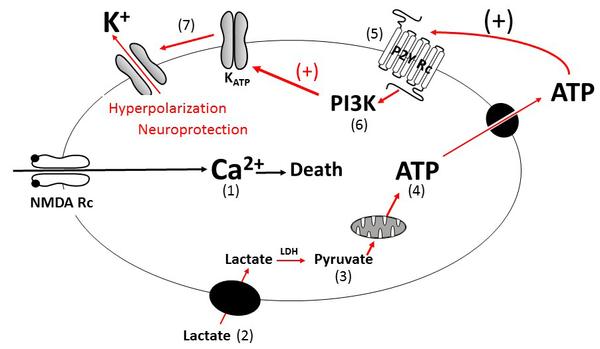
(1) Excessive glutamate activity triggers a strong influx of calcium (Ca2+) into the neuron through NMDA receptors, which leads to cell death. (2) Lactate is transported into the neuron and (3) converted to pyruvate by the enzyme lactate dehydrogenase (LDH). (4) Pyruvate is then transported into mitochondria by the mitochondrial pyruvate carrier (MPC) where it generates ATP. (5) ATP is then released through pannexins and activates the receptor P2Y, which (6) activates the PI3K pathway. (7) This triggers the opening of potassium channels (K+), which causes the neuron to hyperpolarize, decreasing the neuron's excitability, and thus protecting it from excitotoxic damage.

(1) Excessive glutamate activity triggers a strong influx of calcium (Ca2+) into the neuron through NMDA receptors, which leads to cell death. (2) Lactate is transported into the neuron and (3) converted to pyruvate by the enzyme lactate dehydrogenase (LDH). (4) Pyruvate is then transported into mitochondria by the mitochondrial pyruvate carrier (MPC) where it generates ATP. (5) ATP is then released through pannexins and activates the receptor P2Y, which (6) activates the PI3K pathway. (7) This triggers the opening of potassium channels (K+), which causes the neuron to hyperpolarize, decreasing the neuron’s excitability, and thus protecting it from excitotoxic damage.

Researchers led by EPFL have found how lactate, a waste product of glucose metabolism can protect neurons from damage follo...

Read More

Gene Therapy: T cells target Mutations to fight Solid Tumors:

The T cell receptor on T cells might recognize antigens derived from mutated proteins in cancer cells. Once a foreign "non-self" antigen is detected, the T cell will kill the cancer cell. Credit: Matthias Leisegang.

The T cell receptor on T cells might recognize antigens derived from mutated proteins in cancer cells. Once a foreign “non-self” antigen is detected, the T cell will kill the cancer cell. Credit: Matthias Leisegang.

T cell therapies with less side effects. An international team has successfully modified immune cells to recognize and specifically target tumor cells in mice. Cancer treatments based on the findings would likely have fewer side effects than standard therapies. Although T cells migrate into tumors and recognize antigens, the defense mechanism seems to fail during the formation of tumors. T cells in the tumors are usually inactive and therapeutically almost useless...

Read More

Link made between Genetics, Aging

Rob Pazdro, left, and Yang Zhou led a study looking at a new pathway by which genetics regulates aging and disease. Credit: Cal Powell/University of Georgia

Rob Pazdro, left, and Yang Zhou led a study looking at a new pathway by which genetics regulates aging and disease. Credit: Cal Powell/University of Georgia

Uni of Georgia scientists have shown a hormone instrumental in the aging process is under genetic control, introducing a new pathway by which genetics regulates aging and disease. Previous studies have found that blood levels of this hormone, growth differentiation factor 11, decrease over time. Restoration of GDF11 reverses cardiovascular aging in old mice and leads to muscle and brain rejuvenation, a discovery that was listed as one of the top 10 breakthroughs in science in 2014.

Scientists in the UGA College of Family and Consumer Sciences have now discovered that levels of this hormone are determined by genetics, representing ano...

Read More

Shape-Shifting Engineered Nanoparticles for Delivering Cancer Drugs to Tumors

U of T Engineering professor Warren Chan has spent the last decade figuring out how to deliver chemotherapy drugs into tumours -- and nowhere else. Now his lab has designed a set of nanoparticles attached to strands of DNA that can change shape to gain access to diseased tissue. Credit: NSERC

U of T Engineering professor Warren Chan has spent the last decade figuring out how to deliver chemotherapy drugs into tumours — and nowhere else. Now his lab has designed a set of nanoparticles attached to strands of DNA that can change shape to gain access to diseased tissue. Credit: NSERC

Modular nanoparticles attached to strands of DNA can change shape to gain access to diseased tissue. Many cancer drugs target fast-growing cells ie tumours, but unfortunately also hair follicles, GI lining, and skin. U of T Engineering Prof. Warren Chan has spent the last decade figuring out how to deliver chemotherapy drugs into tumours – and nowhere else.

One thing we know about cancer: no 2 tumours are identical...

Read More