Category Chemistry/Nanotechnology

2D Electronics’ Metal or Semiconductor? Both

Molybdenum telluride (MoTe2) polymorphism. Metallic (right) and semiconducting (left) MoTe2 crystals are obtained side by side on the same plane. Rectangular crystals represent metal MoTe2, while hexagonal crystals are the characteristic feature of semiconducting MoTe2.

Molybdenum telluride (MoTe2) polymorphism. Metallic (right) and semiconducting (left) MoTe2 crystals are obtained side by side on the same plane. Rectangular crystals represent metal MoTe2, while hexagonal crystals are the characteristic feature of semiconducting MoTe2.

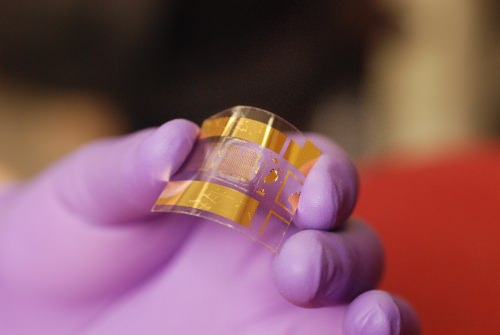
Researchers produced the first 2D field-effect transistor (FET) made of a single material. Modern life will be almost unthinkable without transistors. They are the ubiquitous building blocks of all electronic devices: each computer chip contains billions of them. However, as the chips become smaller and smaller, the current 3D field-electronic transistors (FETs) are reaching their efficiency limit...

Read More

Physicists discover a Tri-Anion Particle with Colossal Stability

A rendering of protons, neutrons and electrons in an atom.

A rendering of protons, neutrons and electrons in an atom.

The particle could be used in battery creation and for other industrial purposes. A team in the lab of Puru Jena, Ph.D., a distinguished professor in the Department of Physics in the College of Humanities and Sciences, has created the most stable tri-anion particle currently known to science. A tri-anion particle is a combination of atoms that contains three or more electrons than protons. This discovery is novel because previously known tri-anion particles were unstable due to their numerical imbalance. These unstable particles dispel additional electrons, interrupting chemical reactions.

Jena et al used quantum mechanical calculations to create computer models to prove the stability of the BeB11(CN)12 tri-anion...

Read More

Chemists Make Playdough/ Lego-like Hybrid to create Tiny Building Blocks

Computer renderings illustrating the design of micro-structured patchy particles. These tiny objects (1/4th of the size a red blood cell) are first created inside a computer using simulations and then fabricated in the laboratory. Image courtesy of Theodore Hueckel.

Computer renderings illustrating the design of micro-structured patchy particles. These tiny objects (1/4th of the size a red blood cell) are first created inside a computer using simulations and then fabricated in the laboratory. Image courtesy of Theodore Hueckel.

Playdough and Legos are among the most popular childhood building blocks. But what could you use if you wanted to create something really small – a structure less than the width of a human hair? It turns out, a team of chemists has found, this can be achieved by creating particles that have both playdough and Lego traits. These “patchy particles,” described in the latest issue of the journal Nature, are 1/200th the width of a human hair and can form endless architectures from a handful of basic pieces...

Read More

Graphene-wrapped Nanocrystals makes inroads toward Next-Gen Fuel Cells

Image - A new study explains how an ultrathin oxide layer (oxygen atoms shown in red) coating graphene-wrapped magnesium nanoparticles (gold) still allows in hydrogen atoms (blue) for hydrogen storage applications. (Credit: Berkeley Lab)

A new study explains how an ultrathin oxide layer (oxygen atoms shown in red) coating graphene-wrapped magnesium nanoparticles (orange) still allows in hydrogen atoms (blue) for hydrogen storage applications. (Credit: Berkeley Lab)

Simulations and analysis provide new atomic-scale clues to material’s enhanced hydrogen storage properties. A powdery mix of metal nanocrystals wrapped in single-layer sheets of carbon atoms, developed at the Department of Energy’s Lawrence Berkeley National Laboratory (Berkeley Lab), shows promise for safely storing hydrogen for use with fuel cells for passenger vehicles and other uses...

Read More