Category Chemistry/Nanotechnology

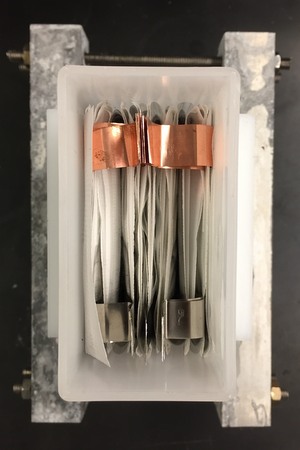
Engineers Invent the 1st Bio-Compatible, Ion Current Battery

Inverted battery design as ion generator for interfacing with biosystems. Nature Communications, 2017; 8: 15609 DOI: 10.1038/ncomms15609

Inverted battery design as ion generator for interfacing with biosystems. Nature Communications, 2017; 8: 15609 DOI: 10.1038/ncomms15609

Engineers at the University of Maryland have invented an entirely new kind of battery. It is bio-compatible because it produces the same kind of ion-based electrical energy used by humans and other living things. In our bodies, flowing ions (sodium, potassium and other electrolytes) are the electrical signals that power the brain and control the rhythm of the heart, the movement of muscles, and much more.

In traditional batteries the current of electrons out of the battery is generated within the battery by moving positive ions from one end (electrode) of a battery to the other. The new UMD battery does the opposite...

Read More

Molecular ‘Pulleys’ Improve Battery Performance

Visualization of silicon microparticles with polyrotaxane-polyacrylic acid binder in charging and discharging state.

Highly elastic polyrotaxane-polyacrylic acid polymers hold together silicon microparticles as they expand and contract while charging and discharging. Credit: Adapted from Jang Wook Choi and colleagues

Scientists have reported a molecular pulley binder for high-capacity silicon anodes of lithium ion batteries. Silicon anodes are receiving a great deal of attention from the battery community. They have 3~5-times higher capacities compared with those using current graphite anodes in lithium ion batteries. A higher capacity means longer battery use per charge, which is particularly critical in extending the driving mileage of all-electric vehicles...

Read More

3D Printing Sweeps Toy Manufacturing off the Shelves

1.The board game Save the Planet is an open source, cooperative game that is adaptable and customizable, making it an educational tool that grows with kids and enables creative freedom with everything from its "Good Deeds" cards to personalized game play figurines. The total cost with both 2-D and 3-D printing came to $2.89. 2, Legos

1.The board game Save the Planet is an open source, cooperative game that is adaptable and customizable, making it an educational tool that grows with kids and enables creative freedom with everything from its “Good Deeds” cards to personalized game play figurines. The total cost with both 2-D and 3-D printing came to $2.89. 2. Legos

Cheap, plastic toys – no manufacturer necessary. The 2020 toy and game market is projected to be $135 billion, and 3D printing brings those profits home. People have scoffed that 3D printers are simply toys themselves. But they probably didn’t realize how much money is made off playthings...

Read More

Novel 3D Printing process Strengthens Parts by 275%

Brandon Sweeney and Blake Tiepel working in the lab. Credit: Texas A&M University

Brandon Sweeney and Blake Tiepel working in the lab. Credit: Texas A&M University

A doctoral student in the Department of Materials Science and Engineering at Texas A&M University has developed a method to transform the landscape of 3D printing today by making 3D printed parts 275% stronger and immediately useful in real-world applications. 3D printed objects are comprised of many thin layers of materials, usually plastics, deposited on top of each other to form a desired shape. These layers are prone to fracturing, causing issues with the durability and reliability of the part when used in a real-world application, for example a custom printed medical device.

When Sweeney started his doctorate, he was working with Green in the Department of Chemical Engineering at Texas Tech University...

Read More