Category Chemistry/Nanotechnology

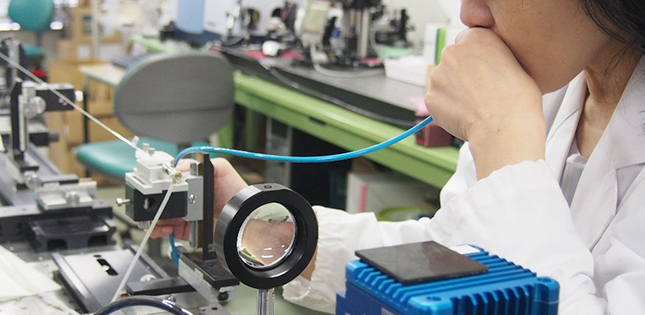
Compact Fiber Optic apparatus shines light on Breath Analysis in real-time

Takuro Iwata, Takashi Katagiri, Yuji Matsuura. Real-Time Analysis of Isoprene in Breath by Using Ultraviolet-Absorption Spectroscopy with a Hollow Optical Fiber Gas Cell. Sensors, 2016; 16 (12): 2058 DOI: 10.3390/s16122058

Takuro Iwata, Takashi Katagiri, Yuji Matsuura. Real-Time Analysis of Isoprene in Breath by Using Ultraviolet-Absorption Spectroscopy with a Hollow Optical Fiber Gas Cell. Sensors, 2016; 16 (12): 2058 DOI: 10.3390/s16122058

Affordable gas sensor setup developed by Tohoku University team monitors trace levels of health-indicating chemicals, paving the way for future non-invasive studies. Using hollow-core optical fibre as a sensitive gas cell, researchers in Japan have devised a relatively simple and affordable sensor for monitoring biomarkers in human breath at low concentrations. Trace amounts of gases exhaled through the nose and mouth offer clues to respiratory conditions such as asthma, as well as other easy-to-administer health screening opportunities.

Tohoku University scientists expl...

Read More

PowerPoint, LED Projector enable new technique for Self-folding Origami

A new technique for producing self-folding three-dimensional origami structures from photo-curable liquid polymer materials created these tiny samples, held in a hand for size comparison. Credit: Rob Felt, Georgia Tech

A new technique for producing self-folding three-dimensional origami structures from photo-curable liquid polymer materials created these tiny samples, held in a hand for size comparison. Credit: Rob Felt, Georgia Tech

Researchers at the Georgia Institute of Technology and Peking University have found a new use for the ubiquitous PowerPoint slide: Producing self-folding 3D origami structures from photocurable liquid polymers. The technique involves projecting a grayscale pattern of light and dark shapes onto a thin layer of liquid acrylate polymer placed in a plate or between 2 glass slides. A photoinitiator material mixed into the polymer initiates a crosslinking reaction when struck by light from an ordinary LED projector, causing a solid film to form...

Read More

The World’s Fastest Film Camera: When light practically stands still

The new camera was developed for filming chemistry and physics occurring at extreme speeds. Credit: Image courtesy of Lund University

The new camera was developed for filming chemistry and physics occurring at extreme speeds. Credit: Image courtesy of Lund University

Lund University, Sweden researchers has developed a camera that can film at a rate equivalent to 5 trillion images per second, or events as short as 0.2 trillionths of a second. This is faster than has previously been possible. The new camera will therefore be able to capture incredibly rapid processes in chemistry, physics, biology and biomedicine, that so far have not been caught on film. The researchers have successfully filmed how photons travels a distance corresponding to the thickness of a paper. In reality, it only takes a picosecond, but on film the process has been slowed down by a trillion times.

Currently, high-speed cameras capture images one by...

Read More

New Material inspired by a Sea Worm changes according to the environment

Ion Effect and Metal-Coordinated Cross-Linking for Multiscale Design of Nereis Jaw Inspired Mechanomutable Materials

Ion Effect and Metal-Coordinated Cross-Linking for Multiscale Design of Nereis Jaw Inspired Mechanomutable Materials

MIT scientists have looked at a sea worm called Nereis virens in order to create a changing material, with the ability to be flexible or rigid at convenience. The jaw of this worm has a texture similar to gelatin, but if the environment varies, the material may adopt the hardness of dentin or human bones. Chemical engineer Francisco Martín-Martínez explains, “the jaw of Nereis virens is composed of a protein that contains large amounts of histidine, an amino acid that interacts with the ions of the environment and makes it more or less flexible depending on the environment in which it finds itself.”

The material is “a hydrogel made from a synthesized protein, similar to th...

Read More