Category Chemistry/Nanotechnology

Electrochromic Films – like sunglasses for your windows?

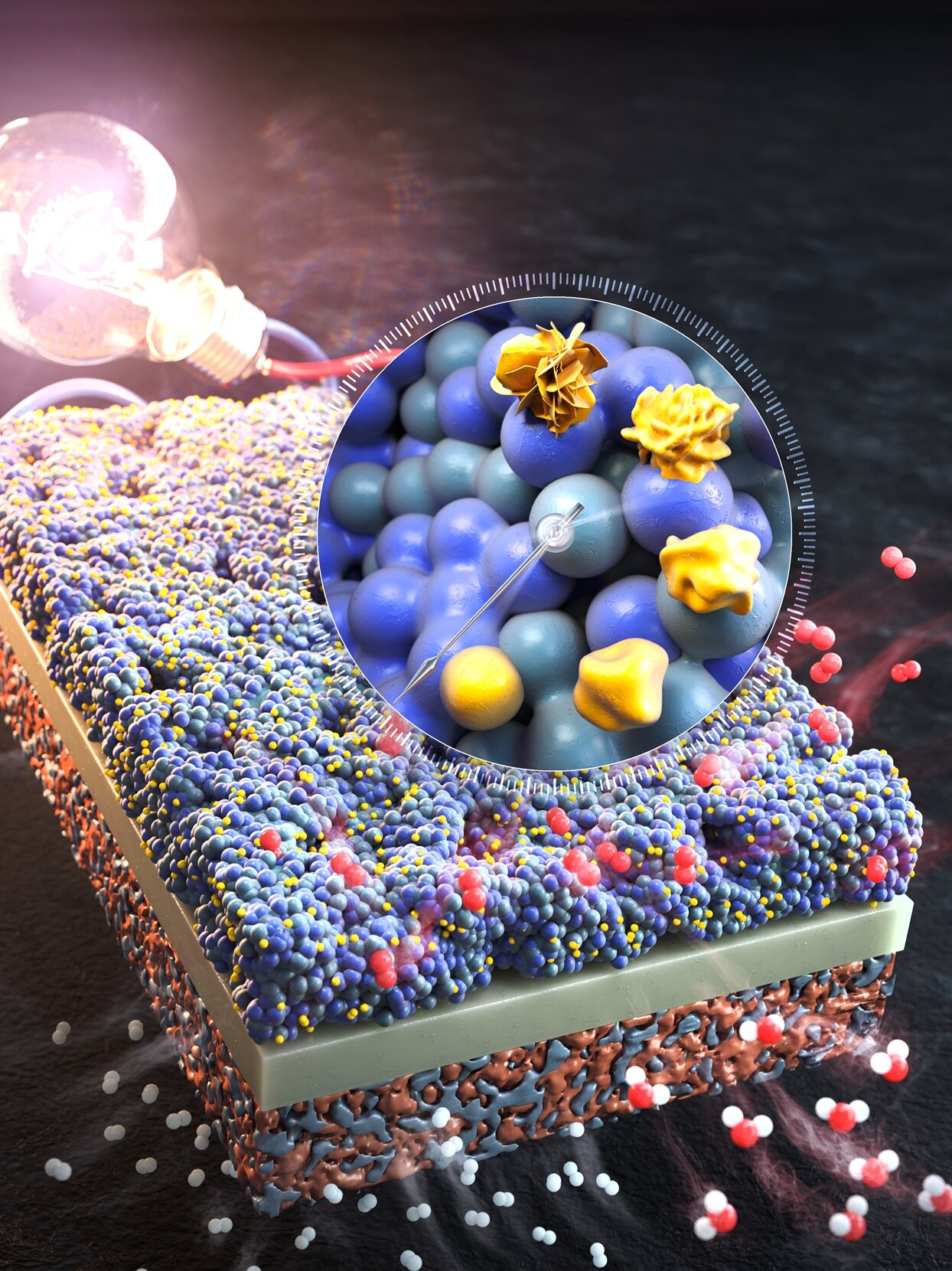
Biphenyl Dicarboxylic-Based Ni-IRMOF-74 Film for Fast-Switching and High-Stability Electrochromism

Advances in electrochromic coatings may bring us closer to environmentally friendly ways to keep inside spaces cool. Like eyeglasses that darken to provide sun protection, the optical properties of these transparent films can be tuned with electricity to block out solar heat and light. Now, researchers in ACS Energy Letters report demonstrating a new electrochromic film design based on metal-organic frameworks (MOFs) that quickly and reliably switch from transparent to glare-diminishing green to thermal-insulating red.

Hongbo Xu and colleagues used MOFs in their electrochromic film because of the crystalline substances’ abilities to form thin films with pore sizes that can be customize...

Read More

Battery Breakthrough could usher in Greener, Cheaper Electric Vehicles

Battery breakthrough could usher in greener, cheaper electric vehicles
Richie Fong, a PhD student in Materials Engineering, conducts research on cathodes in a McGill lab. Credit: McGill University

The global shift to electric vehicles is gaining momentum, yet the extraction of battery materials has a significant environmental footprint that comes with high costs.

Now, two studies led by McGill University researchers offer hope in the search to manufacture cheaper and greener lithium-ion batteries used in electric vehicles (EVs).

Their findings unlock the potential to produce batteries using more sustainable and less costly metals, known as disordered rock-salt-type (DRX) cathode materials.

In the first study, engineering researchers including lead author Richie Fong, a Ph.D. student in Materials Engineering, focused on cathodes...

Read More

First 3D-Printed, Defect-free Tungsten Components Withstand Extreme Temperatures

First 3D-printed, defect-free tungsten components withstand extreme temperatures
ORNL researchers used electron-beam additive manufacturing to 3D-print the first complex, defect-free tungsten parts with complex geometries. Research was performed at DOE’s Manufacturing Demonstration Facility at ORNL. The MDF, supported by DOE’s Advanced Materials and Manufacturing Technologies Office, is a nationwide consortium of collaborators working to innovate, inspire and catalyze the transformation of U.S. manufacturing. Credit: Michaela Bluedorn/ORNL, U.S. Dept. of Energy

Researchers at Oak Ridge National Laboratory used additive manufacturing to produce the first defect-free complex tungsten parts for use in extreme environments. The accomplishment could have positive implications for clean-energy technologies such as fusion energy.

Tungsten has the highest melting po...

Read More

Charge your Laptop in a Minute? Supercapacitors can help; new research offers clues

Imagine if your dead laptop or phone could charge in a minute or if an electric car could be fully powered in 10 minutes. While not possible yet, new research by a team of CU Boulder scientists could potentially lead to such advances.

Published today in the Proceedings of the National Academy of Sciences, researchers in Ankur Gupta’s lab discovered how ions, move within a complex network of minuscule pores. The breakthrough could lead to the development of more efficient energy storage devices, such as supercapacitors, said Gupta, an assistant professor of chemical and biological engineering.

“Given the critical role of energy in the future of the planet, I felt inspired to apply my chemical engineering knowledge to advancing energy storage devices,” Gupta said...

Read More