



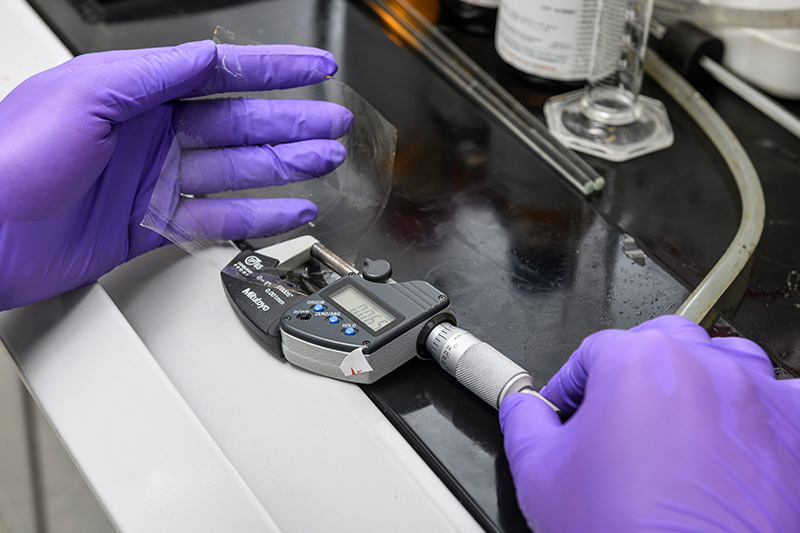
University of Delaware researchers have developed a self-healing membrane for fuel cells. Credit: Kathy F. Atkinson, University of Delaware
Self-healing membrane for hydrogen fuel cells have been developed by scientists. The membrane is typically made from a polymer called Nafion®. During fuel cell operation, it undergoes chemical and mechanical degradation, leading to cracks and pinholes that shorten its life. To address this issue, three members of the University of Delaware’s Department of Mechanical Engineering, Ajay Prasad, Liang Wang and Suresh Advani, have developed a membrane incorporating microcapsules prefilled with a Nafion® solution.
“The microcapsules are designed to rupture when they encounter defects in the membrane and then release the prefilled Nafion® solution to heal t...
Read More


Recent Comments