Category Chemistry/Nanotechnology

Record-Breaking Material Contracts when Heated

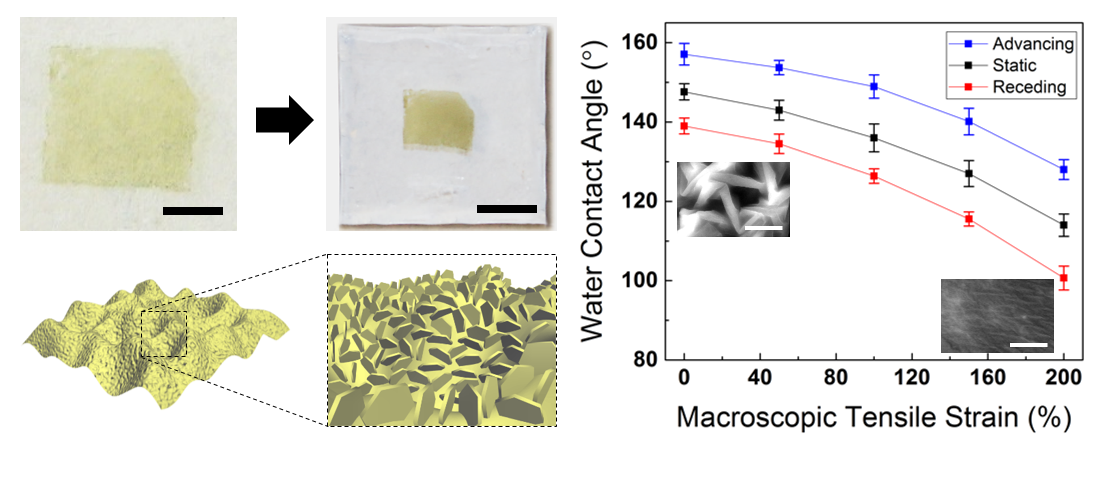
A layered ruthenate Ca2RuO4-y ceramic body contracts on heating, or exhibits negative thermal expansion (NTE). The sintered-body structure shows colossal NTE when extremely anisotropic thermal expansion of the crystal grains produces deformation, consuming open spaces (voids) on heating. The total volume change related to NTE reaches 6.7 percent at most, the largest reported so far. Credit: Koshi Takenaka

A layered ruthenate Ca2RuO4-y ceramic body contracts on heating, or exhibits negative thermal expansion (NTE). The sintered-body structure shows colossal NTE when extremely anisotropic thermal expansion of the crystal grains produces deformation, consuming open spaces (voids) on heating. The total volume change related to NTE reaches 6.7 percent at most, the largest reported so far. Credit: Koshi Takenaka

Machines and devices in modern industry are required to withstand harsh conditions. When environmental temperature changes, the volume of the materials used to make these devices usually changes slightly, typically by <0.01%. Although this may seem trivial, over time this thermal expansion can seriously degrade the performance of industrial systems and equipment.

Materials that contract o...

Read More

Scientists develop ‘Lab on a Chip’ that costs 1 cent to make

Rahim Esfandyarpour helped to develop a way to create a diagnostic "lab on a chip" for just a penny. Inset: The lab on a chip comprises a clear silicone microfluidic chamber for housing cells and a reusable electronic strip — a flexible sheet of polyester with commercially available conductive nanoparticle ink. Zahra Koochak

Rahim Esfandyarpour helped to develop a way to create a diagnostic “lab on a chip” for just a penny. Inset: The lab on a chip comprises a clear silicone microfluidic chamber for housing cells and a reusable electronic strip — a flexible sheet of polyester with commercially available conductive nanoparticle ink.
Zahra Koochak

Stanford University School of Medicine has developed a way to produce a cheap and reusable diagnostic “lab on a chip” with the help of an inkjet printer. At a cost of as little as 1 cent per chip, the new technology could usher in a medical diagnostics revolution like the kind brought on by low-cost genome sequencing. The inexpensive lab-on-a-chip technology has the potential to enhance diagnostic capabilities around the world, especially in developing countries...

Read More

Mimicking Nature’s Cellular Architectures via 3D Printing

1. How to make ceramic foam ink 2. Close up image of one node of the triangular honeycomb. The structure, which consists of air surrounded by ceramic, can be designed with specific porosity. (Image courtesy of James Weaver/Wyss Institute)

1. How to make ceramic foam ink 2. Close up image of one node of the triangular honeycomb. The structure, which consists of air surrounded by ceramic, can be designed with specific porosity. (Image courtesy of James Weaver/Wyss Institute)

Nature does amazing things with limited design materials. Grass, for example, can support its own weight, resist strong wind loads, and recover after being compressed. The plant’s hardiness comes from a combination of its hollow, tubular macrostructure and porous, or cellular, microstructure. These architectural features work together to give grass its robust mechanical properties. Harvard SEAS, Wyss Institute and MIT have developed a new method to 3D print materials with independently tunable macro-and microscale porosity using a ceramic foam ink...

Read More

Building a Better Microbial Fuel Cell—using Paper

A schematic illustration of a microbial fuel cell using a paper electrode coated with carbon paste. Credit: Michael Osadciw/University of Rochester Read more at: https://phys.org/news/2017-02-microbial-fuel-cellusing-paper.html#jCp

A schematic illustration of a microbial fuel cell using a paper electrode coated with carbon paste. Credit: Michael Osadciw/University of Rochester

The concept behind microbial fuel cells, which rely on bacteria to generate an electrical current, is more than a century old. But turning that concept into a usable tool has been a long process. Microbial fuel cells, or MFCs, are more promising today than ever, but before their adoption can become widespread, they need to be both cheaper and more efficient. Researchers at the University of Rochester have made significant progress toward those ends. In a fuel cell that relies on bacteria found in wastewater, Kara Bren, a professor of chemistry, and Peter Lamberg, a postdoctoral fellow, have developed an electrode using paper.

Until now, most el...

Read More