Category Chemistry/Nanotechnology

New Catalyst Paves way for Bio-Based Plastics, Chemicals

catalyst-process

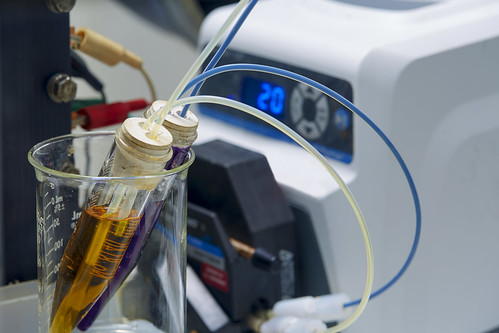
The catalyst works on bio-based ethanol to create isobutene used in plastics and other products.

Washington State University researchers have developed a catalyst that easily converts bio-based ethanol to a widely used industrial chemical, paving the way for more environmentally friendly, bio-based plastics and products. The chemical industry is interested in moving away from fossil fuels to bio-based products to reduce environmental impacts and to meet new regulations for sustainability. The catalyst works on bio-based ethanol to create isobutene used in plastics and other products.

The industry has traditionally made a widely used chemical called isobutene – used in everything from plastic soda bottles to rubber tires – by superheating crude oil...

Read More

Shaking the Nanomaterials out: New method to Purify Contaminated Water

After shaking, the oil and water in the vial separate, trapping unwanted nanomaterials in the bottom of the oil layer. Credit: Michigan Tech, Sarah Bird

After shaking, the oil and water in the vial separate, trapping unwanted nanomaterials in the bottom of the oil layer. Credit: Michigan Tech, Sarah Bird

Nano implies small – and that’s great for use in medical devices, beauty products and smartphones – but it’s also a problem. All these tiny particles get into our water and are difficult to remove. Now, researchers have a novel and very simple way to take the nanomaterials out. The tiny nanoparticles, nanowires, nanotubes and other nanomaterials that make up our technology eventually find their way into water. The Environmental Protection Agency says more 1,300 commercial products use some kind of nanomaterial. And we just don’t know the full impact on health and the environment.

Instead, shaking up oil and water traps the nanomaterials, ...

Read More

Near Zero Friction from Nanoscale Lubricants

Visualized model of a superlubricity (low-friction) system: gold = nanodiamond particles; red = graphene nanoscroll; green = underlying graphene on silica; black = diamond-like carbon surface. Credit: Image courtesy of Argonne National Laboratory

Visualized model of a superlubricity (low-friction) system: gold = nanodiamond particles; red = graphene nanoscroll; green = underlying graphene on silica; black = diamond-like carbon surface. Credit: Image courtesy of Argonne National Laboratory

Friction hampers the movement of all mechanical parts, including engines for transportation. At the Center for Nanoscale Materials, scientists built a system with virtually no friction. The system wraps graphene flakes around nanodiamonds that then roll between a diamond-like carbon-surface and graphene on silica. Such hard ball bearings wrapped in slippery Teflon(R) tissue paper rolling between 2 surfaces reduces the friction to almost zero.

Creating a low-friction situation has the potential for substantial cost savings because friction accounts...

Read More

Higher levels of Fukushima Cesium detected Offshore

This map shows the location of seawater samples taken by scientists and citizen scientists that were analyzed at the Woods Hole Oceanographic Institution for radioactive cesium as part of Our Radioactive Ocean. Cesium-137 is found throughout the Pacific Ocean and was detectable in all samples collected, while cesium-134 (yellow/orange dots), an indicator of contamination from Fukushima, has been observed offshore and in select coastal areas. Credit: Figure by Jessica Drysdale, Woods Hole Oceanographic Institution

This map shows the location of seawater samples taken by scientists and citizen scientists that were analyzed at the Woods Hole Oceanographic Institution for radioactive cesium as part of Our Radioactive Ocean. Cesium-137 is found throughout the Pacific Ocean and was detectable in all samples collected, while cesium-134 (yellow/orange dots), an indicator of contamination from Fukushima, has been observed offshore and in select coastal areas. Credit: Figure by Jessica Drysdale, Woods Hole Oceanographic Institution

Scientists monitoring the spread of radiation in the ocean from the Fukushima nuclear accident report finding an increased number of contaminated sites off the US West Coast, along with the highest detection level to date, from a sample collected about 1,600 miles west of SF...

Read More