

Hydrogen, the lightest element on the periodic table, is a master of escaping almost any container it’s stored in...
Read More

January 6, 2026,
 Physics, Chemistry/Nanotechnology
Hydrogen, the lightest element on the periodic table, is a master of escaping almost any container it’s stored in...
Read More
December 26, 2025,
Chemistry/Nanotechnology
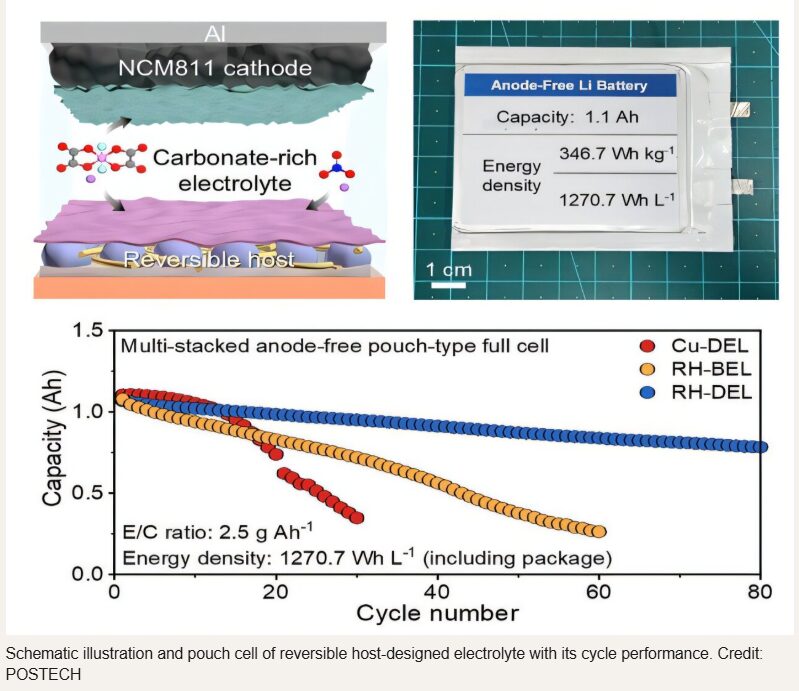
Could an electric vehicle travel from Seoul to Busan and back on a single charge? Could drivers stop worrying about battery performance even in winter? A Korean research team has taken a major step toward answering these questions by developing an anode-free lithium metal battery that can deliver nearly double driving range using the sa±me battery volume.
Breakthrough in battery energy density
A joint research team led by Professor Soojin Park and Dr. Dong-Yeob Han of the Department of Chemistry at POSTECH, together with Professor Nam-Soon Choi and Dr. Saehun Kim of KAIST, and Professor Tae Kyung Lee and researcher Junsu Son of Gyeongsang National University, has successfully achieved a volumetric energy density of 1,270 Wh/L in an anode-free lithium metal battery...
December 23, 2025,
Chemistry/Nanotechnology
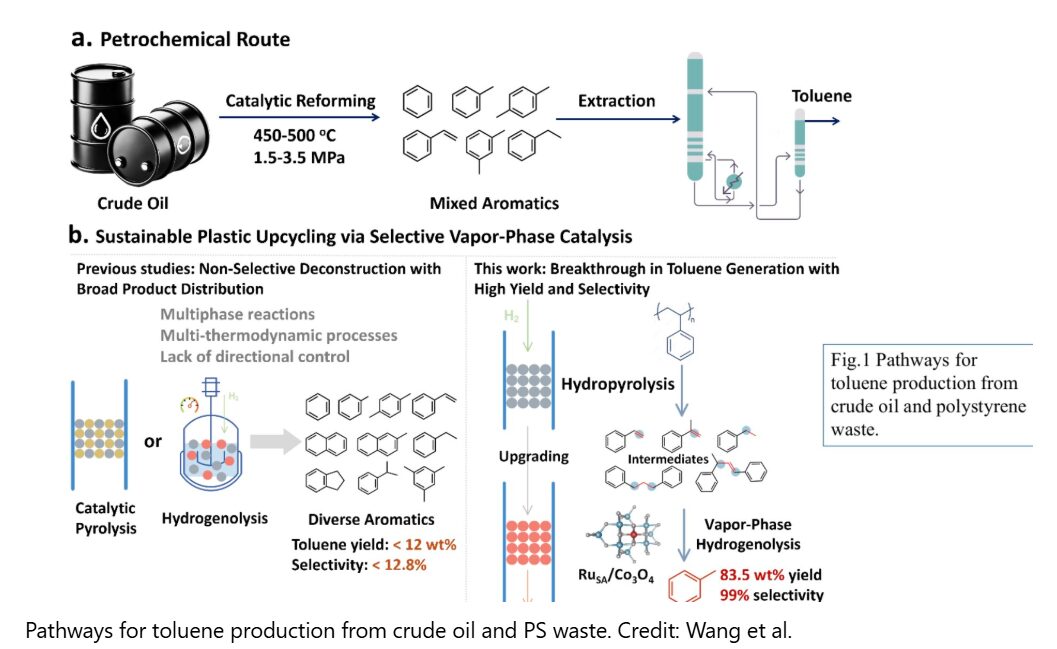
The rapid accumulation of plastic waste is currently posing significant risks for both human health and the environment on Earth. A possible solution to this problem would be to recycle plastic waste, breaking it into smaller molecules that can be used to produce valuable chemicals.
Researchers at Nanjing Forestry University and Tsinghua University recently introduced a new approach to convert polystyrene (PS), a plastic widely used to pack some foods and other products, into toluene, a hydrocarbon that is of value in industrial and manufacturing settings. Their proposed strategy, outlined in a paper published in Nature Nanotechnology, entails heating polystyrene waste in hydrogen and breaking it down into smaller vapor molecules, a process known as hydro-pyrolysis.
Life-cycle a...
Read More
December 11, 2025,
Chemistry/Nanotechnology

Skoltech scientists conducted a study that advances research on future batteries. Their paper, published in Small, sheds light on recent advances in designing multilayered structures of alkali metals, such as lithium, sodium, and potassium, within carbon anode materials.
This technology has the potential to transform the energy storage market, enabling electric vehicles to charge in minutes and providing green energy with stable, safe, and affordable storage systems.
How multilayered structures improve batteries
For years, ions were believed to form only single-atom layers in a battery’s carbon materials, such as graphite...

Recent Comments