Category Chemistry/Nanotechnology

Graphene Smart Textiles developed for Heat Adaptive Clothing

Graphene Smart Textiles The University of Manchester
Using electro-optical tunability of graphene, adaptive optical textiles were made with electrically controlled reflectivity and emissivity covering the infrared and near-infrared wavelengths.

New research on the two-dimensional (2D) material graphene has allowed researchers to create smart adaptive clothing which can lower the body temperature of the wearer in hot climates.

A team of scientists from The University of Manchester’s National Graphene Institute have created a prototype garment to demonstrate dynamic thermal radiation control within a piece of clothing by utilising the remarkable thermal properties and flexibility of graphene. The development also opens the door to new applications such as, interactive infrared displays and covert infrared communication on textile.

T...

Read More

Transparent Graphene Electrodes might lead to New Generation of Solar Cells

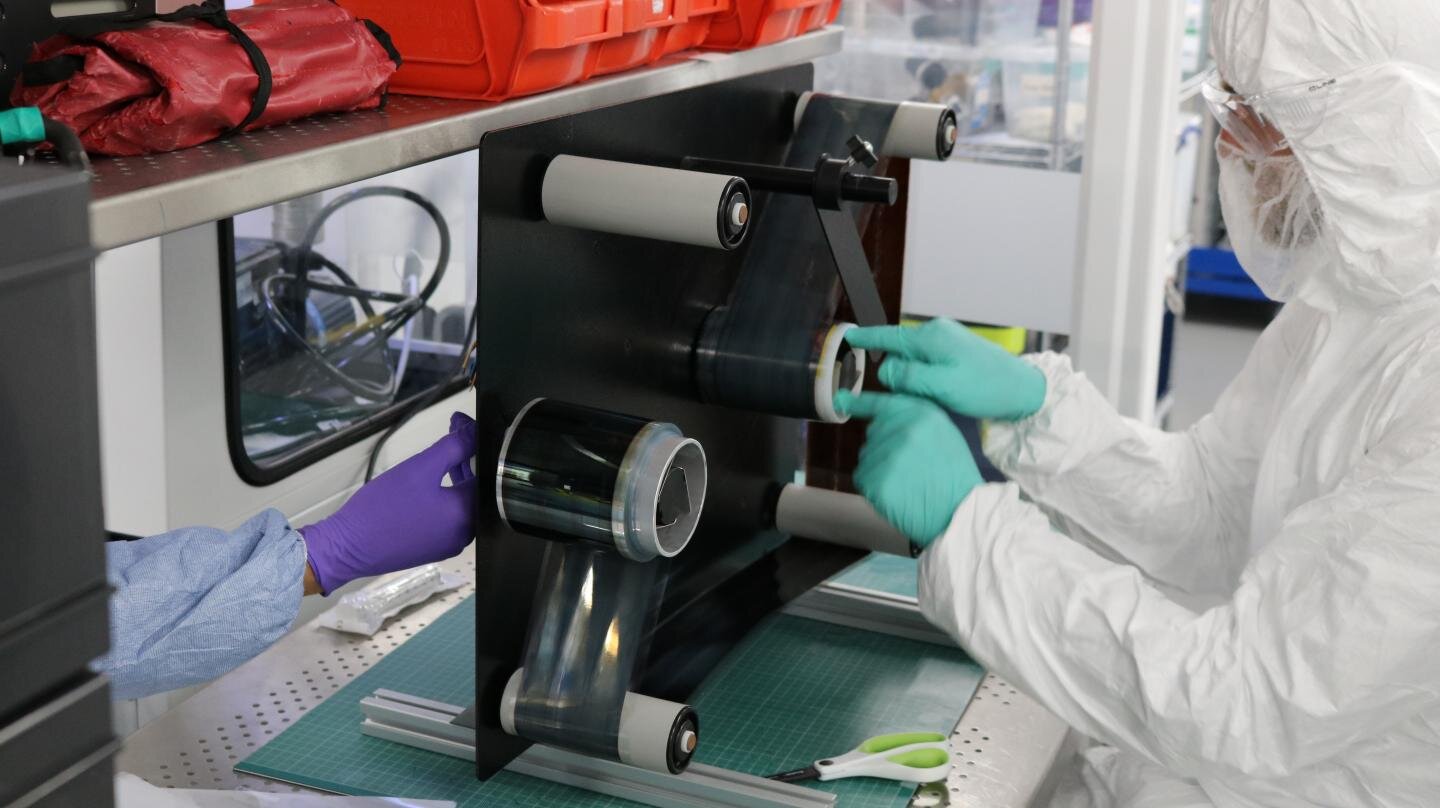
A new manufacturing process for graphene is based on using an intermediate carrier layer of material after the graphene is laid down through a vapor deposition process. The carrier allows the ultrathin graphene sheet, less than a nanometer (billionth of a meter) thick, to be easily lifted off from a substrate, allowing for rapid roll-to-roll manufacturing. These figures show this process for making graphene sheets, along with a photo of the proof-of-concept device used (b).
Courtesy of the researchers

Engineers have synthesized a tiny structure with high surface area and discovered how its unique architecture drives ions across interfaces to transport energy or information...

Read More

Breaking the mold: An unusual choice of Material yields incredibly Long-Lasting Batteries

This work has conducted an evaluation on the role of polarity over conductivity by using a polar but nonconductive platelet ordered mesoporous silica (pOMS) and its replica platelet ordered mesoporous carbon (pOMC), which is conductive but nonpolar. It is found that the polar pOMS/S cathode with a sulfur mass fraction of 80 wt% demonstrates outstanding long‐term cycle stability for 2000 cycles even at a high current density of 2C.

Non-conductive silica could be key to realizing next-generation lithium-sulfur batteries. Scientists have developed a novel silica-based cathode for lithium-sulfur batteries, thereby enabling the realization of batteries that can last for over 2000 charge/discharge cycles...

Read More

Solar Hydrogen production: Splitting Water with UV is now at almost 100% Quantum Efficiency

Photocatalytic water splitting with a quantum efficiency of almost unity
Authors:Tsuyoshi Takata, Junzhe Jiang, Yoshihisa Sakata, Mamiko Nakabayashi, Naoya Shibata, Vikas Nandal, Kazuhiko Seki, Takashi Hisatomi, Kazunari Domen
Journal:Nature, 581, 411-414 (2020)
DOI10.1038/s41586-020-2278-9

Scientists have successfully split water into hydrogen and oxygen using light and meticulously designed catalysts, and they did so at the maximum efficiency meaning there was almost no loss and undesired side reactions. This latest breakthrough in solar hydrogen production makes the likelihood of scalable, economically viable hydrogen production more than likely, paving the way for humanity to make the switch to clean energy.

Pour yourself a glass of water and take a look at it...

Read More