Dr. P.C. Dave P. Dingal uses zebrafish to understand how developmental signaling is coordinated in animal embryos. Zebrafish are ideal models for observing signaling proteins because of their similarity with the human genome and their size.
A University of Texas at Dallas bioengineer has developed synthetic enzymes that can control the behavior of the signaling protein Vg1, which plays a key role in the development of muscle, bone and blood in vertebrate embryos.
The team of researchers is using a new approach, called the Synthetic Processing (SynPro) system, in zebrafish to study how Vg1 is formed...
Researchers at the University of São Paulo (USP) in Brazil, partnering with colleagues in Australia, have identified a novel bacterial protein that can keep human cells healthy even when the cells have a heavy bacterial burden. The discovery could lead to new treatments for a wide array of diseases relating to mitochondrial dysfunction, such as cancer and autoimmune disorders. Mitochondria are organelles that supply most of the chemical energy needed to power cells’ biochemical reactions.
The study is published in the journal PNAS. The researchers analyzed more than 130 proteins released by Coxiella burnetii when this bacterium invades host cells, and found at least one to be capable of prolonging cell longevity by acting directly on mitochondria.
Compact genetic testing device created for Covid-19 could be used to detect a range of pathogens, or conditions including cancer.
A virus diagnosis device that gives lab-quality results within just three minutes has been invented by engineers at the University of Bath, who describe it as the ‘world’s fastest Covid test’.
The prototype LoCKAmp device uses innovative ‘lab on a chip’ technology and has been proven to provide rapid and low-cost detection of Covid-19 from nasal swabs. The research team, based at the University of Bath, say the technology could easily be adapted to detect other pathogens such as bacteria — or even conditions like cancer.
The device works by rapidly releasing and amplifying genetic material from a nasal swab sample by carrying out a chemical reactio...
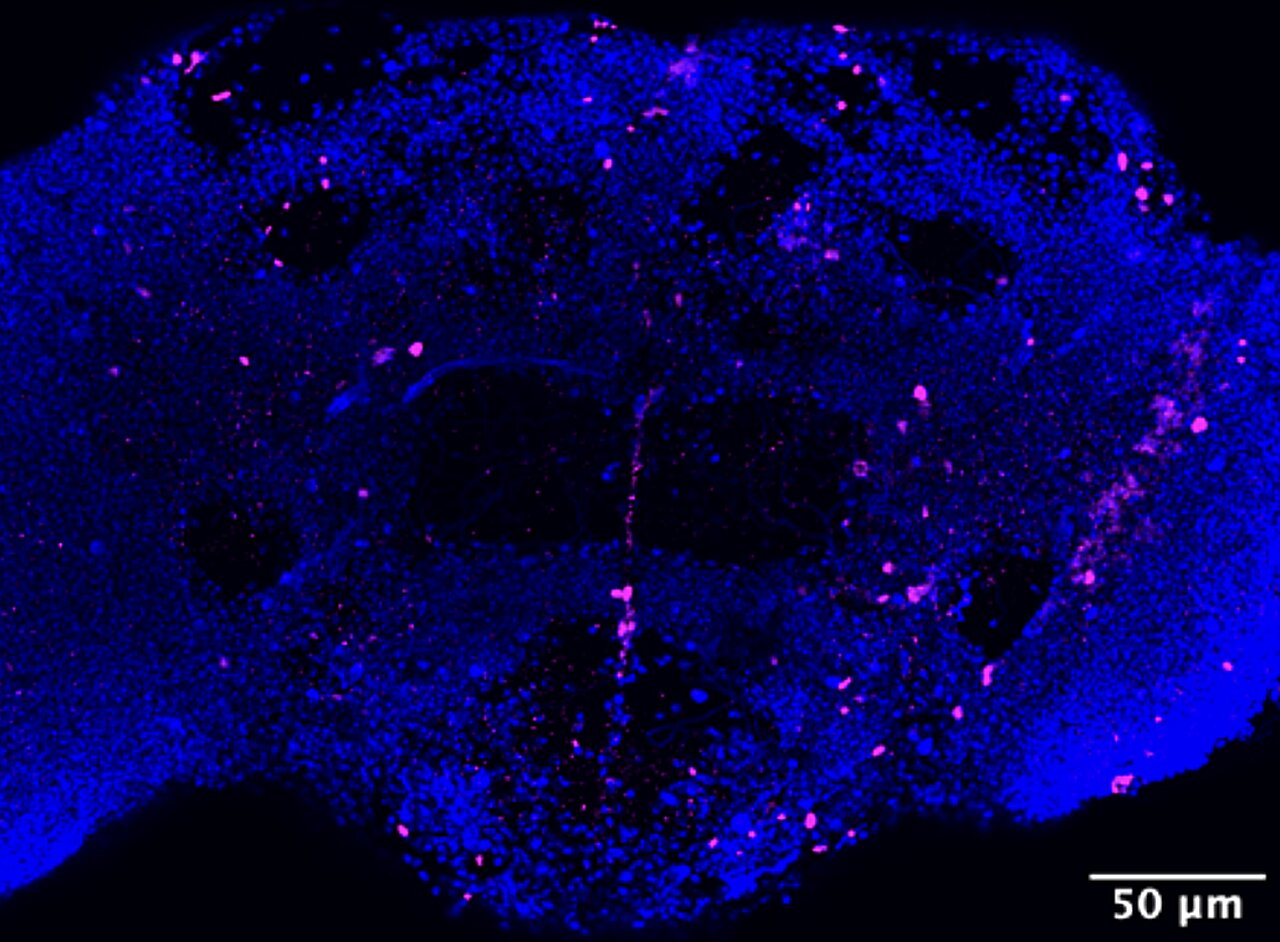
The expression of IM33 in fly brain. Blue: Dapi, which labels the nucleus of all the cells. Magenta: IM33 positive cells. Credit: Xu et al.
Aging is a natural process that affects all living organisms, prompting gradual changes in their behavior and abilities. Past studies have highlighted several physiological factors that can contribute to aging, including the body’s immune responses, an imbalance between the production of reactive oxygen (i.e., free radicals) and antioxidants, and sleep disturbances.
While the link between aging and these different factors is well-document, the connection between them is still poorly understood. Researchers at Washington University in St...





Recent Comments