Immune cells infiltrate a human tumor in the four colorized images above. In a mouse study, researchers at Washington University School of Medicine in St. Louis have found that an antibody that targets the protein TREM2 empowers tumor-destroying immune cells and improves the effectiveness of cancer immunotherapy. WILLIAM VERMI/MARTINA MOLGORA
In a mouse study, researchers have found that an antibody that targets the protein TREM2 empowers tumor-destroying immune cells and improves the effectiveness of cancer immunotherapy.
Immunotherapy has revolutionized cancer treatment by stimulating the patient’s own immune system to attack cancer cells, yielding remarkably quick and complete remission in some cases...
Due to the inherent stability of nanobodies, there was no loss of antiviral potency in the aerosolized form, suggesting that AeroNabs are a potent SARS-CoV-2 antiviral that could be practical to administer via a shelf-stable inhaler or nasal spray. Photo by Noah Berger
As the world awaits vaccines to bring the COVID-19 pandemic under control, UC San Francisco scientists have devised a novel approach to halting the spread of SARS-CoV-2, the virus that causes the disease.
Led by UCSF graduate student Michael Schoof, a team of researchers engineered a completely synthetic, production-ready molecule that straitjackets the crucial SARS-CoV-2 machinery that allows the virus to infect our cells...
Duke University researchers tested several models of mask. (Duke)
Researchers have devised a test for face masks to show which are the best at blocking droplets of fluid – and rated several current options.
In a proof-of-concept study, scientists at Duke University in Durham, North Carolina, devised a low-cost laser sensor that could spot the masks that were best at stopping droplets spreading.
The team led by Eric Westman found that medical-grade ‘N95’ masks and surgical masks performed extremely well.
Handmade cotton masks also performed well, eliminating a substantial amount of the spray from normal speech.
But improvised face coverings such as bandanas and balaclava-style face coverings were less effective, the researchers found.
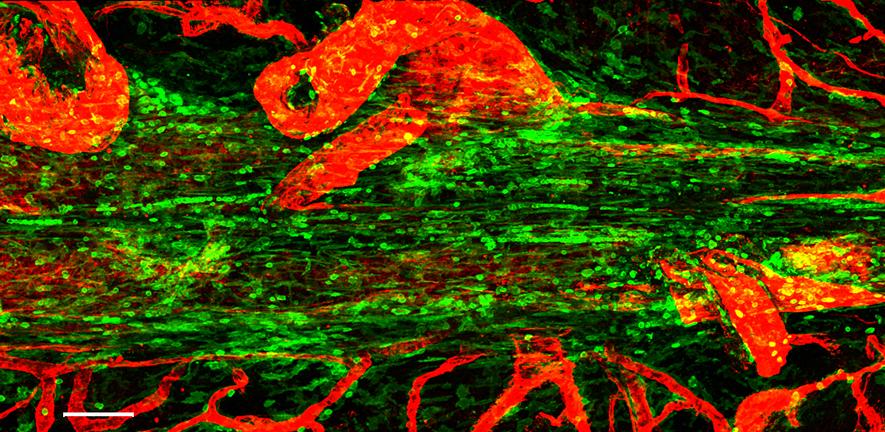
The image shows a series of suprachiasmatic nucleus slices expressing click beetle green in AVP neurons and click beetle red in non-AVP neurons. As time progresses (spiraling into the image), the AVP (green) and non-AVP (red) neurons luminesce together rhythmically, thanks to the intact genetic clocks of the AVP neurons and exchange of neuronal signals. Digital manipulation of bioluminescence images. Artwork by John Abel and Alta Lewis Millard. Credit: Neuron
A new mouse model helps researchers study the roles of cell types in keeping time inside the body. UT Southwestern scientists have developed a genetically engineered mouse and imaging system that lets them visualize fluctuations in the circadian clocks of cell types in mice...
Recent Comments