
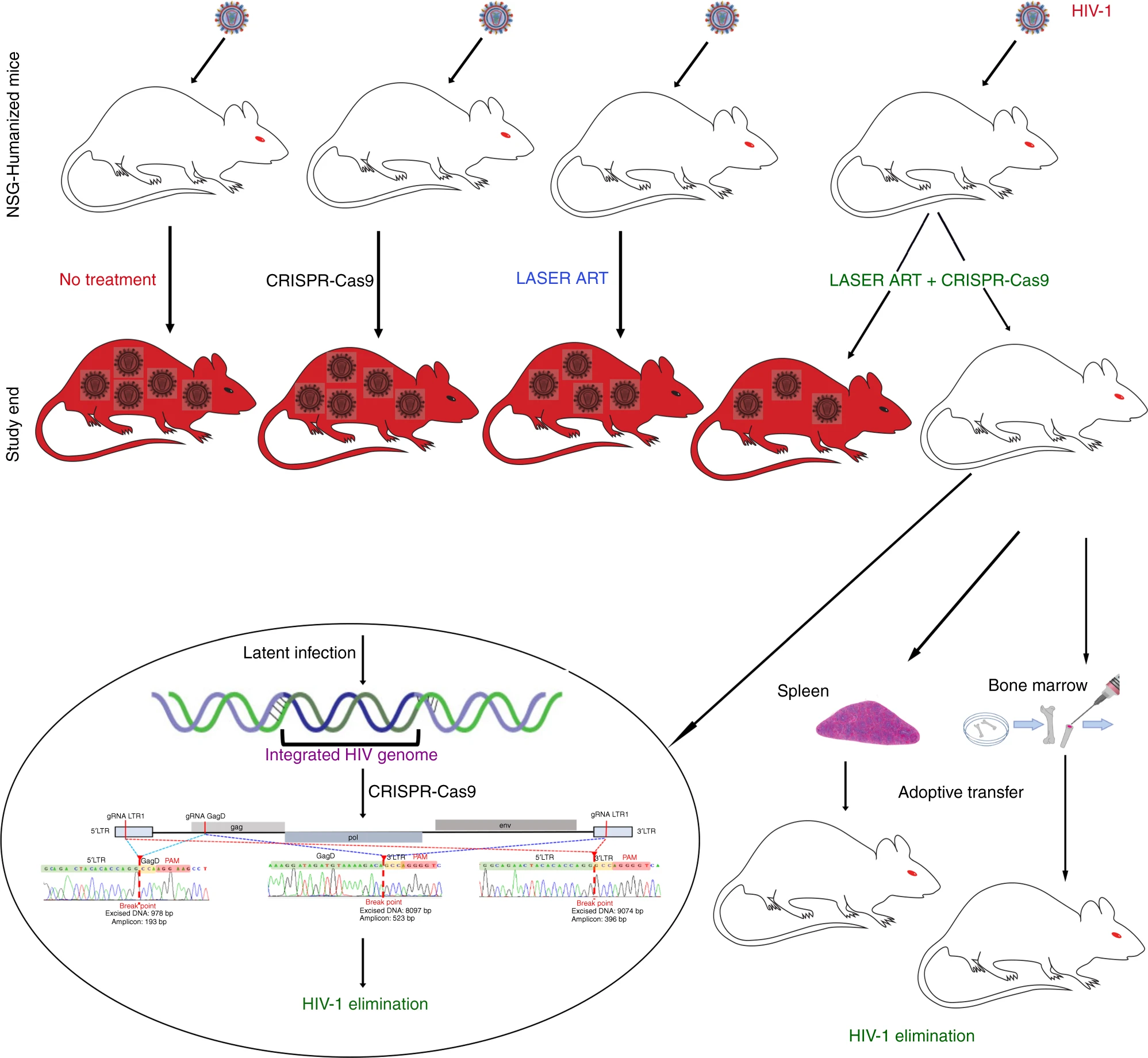
Researchers have for the first time eliminated replication-competent HIV-1 DNA – the virus responsible for AIDS – from the genomes of living animals...
Read More

July 5, 2019,
 Health/Medical, Biology/Biotechnology
Researchers have for the first time eliminated replication-competent HIV-1 DNA – the virus responsible for AIDS – from the genomes of living animals...
Read More
Cerebral organoids are artificially grown, 3D tissue cultures that resemble the human brain. Now, researchers from Japan report functional neural networks derived from these organoids in a study publishing June 27 in the journal Stem Cell Reports. Although the organoids aren’t actually “thinking,” the researchers’ new tool – which detects neural activity using organoids – could provide a method for understanding human brain function.
“Because they can mimic cerebral development, cerebral organoids can be used as a substitute for the human brain to study complex developmental and neurological disorders,” says corresponding author Jun Takahashi, a professor at Kyoto University.
However, these studies ar...
Read More
July 2, 2019,
Health/Medical, Biology/Biotechnology

By using eye-tracking technology to automatically control a pair of autofocus lenses, engineers have created a prototype for ‘autofocals’ designed to restore proper vision in people who would ordinarily need progressive lenses.
Though it may not have the sting of death and taxes, presbyopia is another of life’s guarantees. This vision defect plagues most of us starting about age 45, as the lenses in our eyes lose the elasticity needed to focus on nearby objects...
Read More
July 2, 2019,
Health/Medical, Biology/Biotechnology

Re-engineered device offers clinically accurate eye scans at a fraction of the cost. Biomedical engineers at Duke University have developed a low-cost, portable optical coherence tomography (OCT) scanner that promises to bring the vision-saving technology to underserved regions throughout the United States and abroad.
Thanks to a redesigned, 3D-printed spectrometer, the scanner is 15 times lighter and smaller than current commercial systems and is made from parts costing less than a tenth the retail price of commercial systems – all without sacrificing imaging quality.
In its first cl...
Read More
Recent Comments