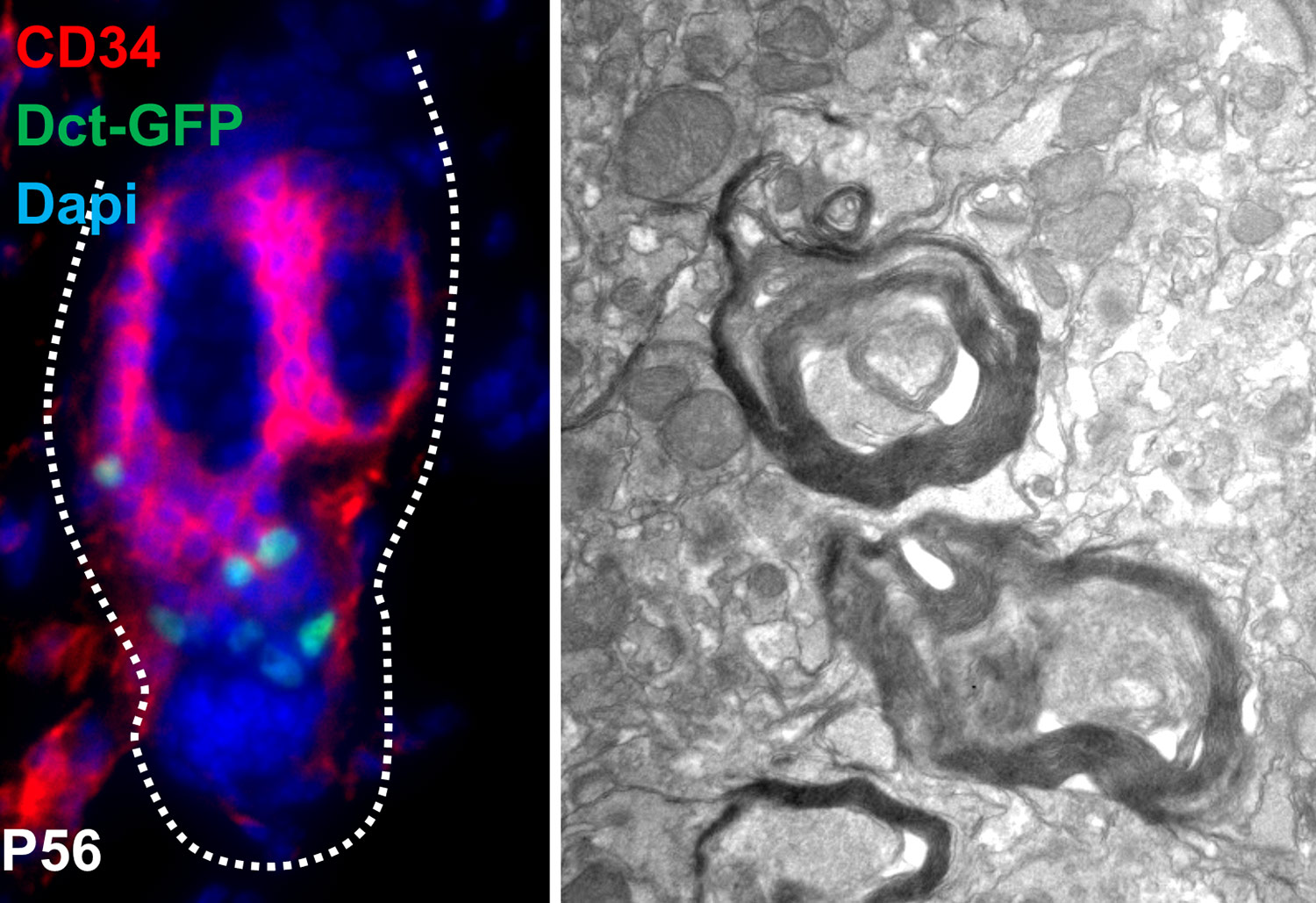
“This research holds promise for treating serious neurodegenerative diseases that impact millions of people each year. Our researchers at the University of Maryland School of Medicine have discovered what could be a critical and non-invasive way to use stem cells as a therapy for these diseases,” said UMSOM Dean, E. Albert Reece, MD, PhD, MBA, Executive Vice President for Medical Affairs, UM Baltimore, and the John Z. and Akiko K. Bowers Distinguished Professor.
Researchers discover certain skin-related stem cells could help in treating neurogenerative diseases. Neurodegenerative diseases like multiple sclerosis (MS) affect millions of people worldwide and occur when parts of the nervous system lose function over time...
Direct Induction of the Three Pre-implantation Blastocyst Cell Types from Fibroblasts
Researchers at the Hebrew University of Jerusalem (HU) have found a way to transform skin cells into the 3 major stem cell types that comprise early-stage embryos. The work (in mouse cells) has significant implications for modelling embryonic disease and placental dysfunctions, as well as paving the way to create whole embryos from skin cells.
As published in Cell Stem Cell, Dr. Yossi Buganim of HU’s Department of Developmental Biology and Cancer Research and his team discovered a set of genes capable of transforming murine skin cells into all three of the cell types that comprise the early embryo: the embryo itself, the placenta and the extra-embryonic tissues, such as the umbilical cord...
Bioprinting research from the lab of Rice University bioengineer Jordan Miller featured a visually stunning proof-of-principle — a scale-model of a lung-mimicking air sac with airways and blood vessels that never touch yet still provide oxygen to red blood cells. Credit: Photo by Jordan Miller/Rice University
Bioengineers clear major hurdle on path to 3D printing replacement organs. Bioengineers have cleared a major hurdle on the path to 3D printing replacement organs with a breakthrough technique for bioprinting tissues. The new innovation allows scientists to create exquisitely entangled vascular networks that mimic the body’s natural passageways for blood, air, lymph and other vital fluids.
The research is featured on the cover of this week’s issue of Science...
(Top) some types of cancers are caused by mutated or overexpressed cell surface proteins that signal to the nucleus (green pathway) to drive uncontrolled growth and survival. (Bottom) Using an approach called RASER, the cancer-causing signals are redirected away from cell growth and survival and toward programmed cell death (orange pathway). Michael Lin and Stuart Jantzen
Synthetic proteins engineered to recognize overly active biological pathways can kill cancer cells while sparing their healthy peers, according to a study by researchers at the Stanford University School of Medicine...






Recent Comments