Category Health/Medical

Electricity, Eel-style: Soft Power Cells could run tomorrow’s Implantables

Electricity, eel-style. Credit: Image courtesy of University of Michigan

Electricity, eel-style. Credit: Image courtesy of University of Michigan

Inspired by the electric eel, a flexible, transparent electrical device could lead to body-friendly power sources for implanted health monitors and medication dispensers, augmented-reality contact lenses and countless other applications. The soft cells are made of hydrogel and salt, and they form the first potentially biocompatible artificial electric organ that generates more than 100 volts. It produces a steady buzz of electricity at high voltage but low current, a bit like an extremely low-volume but high-pressure jet of water. It’s perhaps enough to power a small medical device like a pacemaker.

While the technology is preliminary, Michael Mayer, a professor of biophysics at the Adolphe Merkle Institute of the Uni...

Read More

3D Printed Microfibers could Provide Structure for Artificially Grown Body Parts

cells grown on polymeric fibers

This figure displays the cells grown on polymeric fibers created by 3D near field electrospinning. Image: Justin Brown / Penn State

A team of Penn State engineers believe they have a way to create the structural framework for growing living tissue using an off-the-shelf 3D printer. “We are trying to make stem-cell-loaded hydrogels reinforced with fibers like the rebar in cement,” said Justin L. Brown, associate professor of biomedical engineering. “If we can lend some structure to the gel, we can grow living cells in defined patterns and eventually the fibers will dissolve and go away.”

The researchers’ report in a recent issue of the Journal of Advanced Healthcare Materials that their aim is to create a novel, low-cost and efficient method to fabricate high-resolution and repeatable 3D po...

Read More

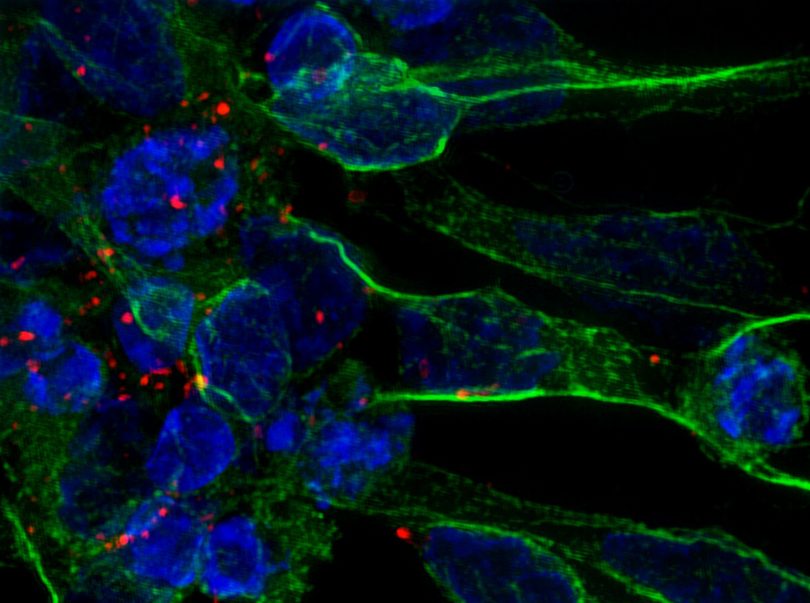
Possible Master Switch for Programming Cancer Immunotherapy

 Study authors Adam Getzler, Dapeng Wang and Matthew Pipkin of The Scripps Research Institute collaborated with scientists at the University of California, San Diego

Study authors Adam Getzler, Dapeng Wang and Matthew Pipkin of The Scripps Research Institute collaborated with scientists at the University of California, San Diego

Researchers report the discovery that a protein called ‘Runx3’ programs killer T cells to establish residence in tumors and infection sites. During infection or tumor growth, CD8+ T cells rapidly multiply within the spleen and lymph nodes and acquire the ability to kill diseased cells. Some of these killer T cells then migrate where required to vanquish the germs or cancers.

But how do killer T cells “learn” to leave their home base and amass within specific tissues like the skin, gut, and lung, or solid tumors? Finding the factors that cause T cells to function beyond the lymphoid system and in sites of infection or cancer has...

Read More

Breath Test could be possible for Drugs and Disease

A schematic presentation of the PExA® instrument (after Larsson et al [21]).

A schematic presentation of the PExA® instrument (after Larsson et al [21]).

Testing for drug use and disease in humans could soon be much simpler, thanks to new Swedish research. Whereas drug tests currently rely on blood or urine samples, researchers from the University of Gothenburg have identified a method for drug testing by analysing various compounds in exhaled breath. They demonstrate how collecting and analysing externally-produced compounds in the lining fluid of the airways allows for non-invasive testing and monitoring.

Dr Göran Ljungkvist said: “Exhaled breath contains particles carrying non-volatile substances. The main components, lipids and proteins, are derived from the respiratory tract lining fluid...

Read More