
Category Health/Medical

1 Gene Mutation, 2 Diseases, many insights into Human Heart Function

Highlights •Systems-level approach reveals GATA4 roles in human cardiac development and function •Heterozygous GATA4 missense mutation impairs cardiac gene program •GATA4 G296S mutation disrupts TBX5 genome occupancy at cardiac super-enhancers •PI3K signaling is a key “hub” in the GATA4 gene regulatory network

Highlights •Systems-level approach reveals GATA4 roles in human cardiac development and function •Heterozygous GATA4 missense mutation impairs cardiac gene program •GATA4 G296S mutation disrupts TBX5 genome occupancy at cardiac super-enhancers •PI3K signaling is a key “hub” in the GATA4 gene regulatory network

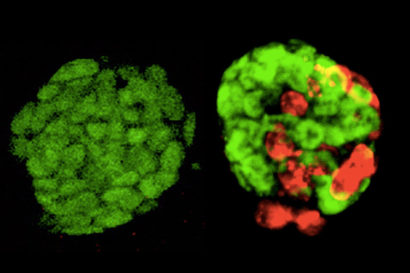
Scientists linked a single gene mutation to 2 types of heart disease: one causes a hole in the heart of infants, and the other causes heart failure. Using cells donated by a family with the mutation, the researchers gained insight into congenital heart disease, heart development, and healthy heart function...

Read More

Cellular Reprogramming Slows Aging in Mice

Highlights •Partial reprogramming erases cellular markers of aging in mouse and human cells •Induction of OSKM in progeria mice ameliorates signs of aging and extends lifespan •In vivo reprogramming improves regeneration in 12-month-old wild-type mice

Highlights •Partial reprogramming erases cellular markers of aging in mouse and human cells •Induction of OSKM in progeria mice ameliorates signs of aging and extends lifespan •In vivo reprogramming improves regeneration in 12-month-old wild-type mice

In mice carrying a mutation leading to premature aging, reprogramming of chemical marks in the genome, ie epigenetic marks, reduced many signs of aging in the mice and extended their lifespan on average from 18 weeks to 24. The study suggests epigenetic changes drive the aging process, and that those changes may be malleable. “We did not correct the mutation that causes premature aging in these mice,” says Juan Carlos Izpisua Belmonte, a professor in the Salk Institute of Biological Science’s Gene Expression Laboratory...

Read More

‘Junk RNA’ molecule found to play key role in Cellular Response to Stress

Highlights •B2 repeat RNA controls stress genes by suppressing transcriptional elongation •Upon heat shock, EZH2 is recruited to stress genes to activate expression •A specific interaction between EZH2 and B2 RNA results in RNA cleavage •B2 cleavage relieves transcriptional suppression and triggers the stress response

Highlights •B2 repeat RNA controls stress genes by suppressing transcriptional elongation •Upon heat shock, EZH2 is recruited to stress genes to activate expression •A specific interaction between EZH2 and B2 RNA results in RNA cleavage •B2 cleavage relieves transcriptional suppression and triggers the stress response

A study from MGH investigators has found a surprising role for what had been considered a nonfunctional “junk” RNA molecule: controlling the cellular response to stress. A highly specific interaction between 2 elements previously known to repress gene transcription – B2 RNA and EZH2, an enzyme previously known only to silence genes – actually induces the expression of stress-response genes in mouse cells.

“EZH2 is part of a structure called the Polycomb Repressive Com...

Read More

Newly-revealed Amino Acid function could be used to Boost Antioxidant levels

A Japanese research team has become the first in the world to discover that 2-aminobutyric acid (2-AB) is closely involved in the metabolic regulation of the antioxidant glutathione, and that it can effectively raise levels of glutathione in the body when ingested. Glutathione plays an important role in keeping us healthy. This finding could contribute to the development of new ways to prevent, diagnose and treat various oxidative stress-related conditions including Alzheimer’s, aging, cancer, lifestyle-related diseases, hardened arteries, and rgan damage caused by medicines and toxins.

Glutathione is a major antioxidant component within cells, contributing to the detoxification of foreign substances...

Read More