
Category Health/Medical

Fast, Efficient Sperm Tails Inspire Nanobiotechnology

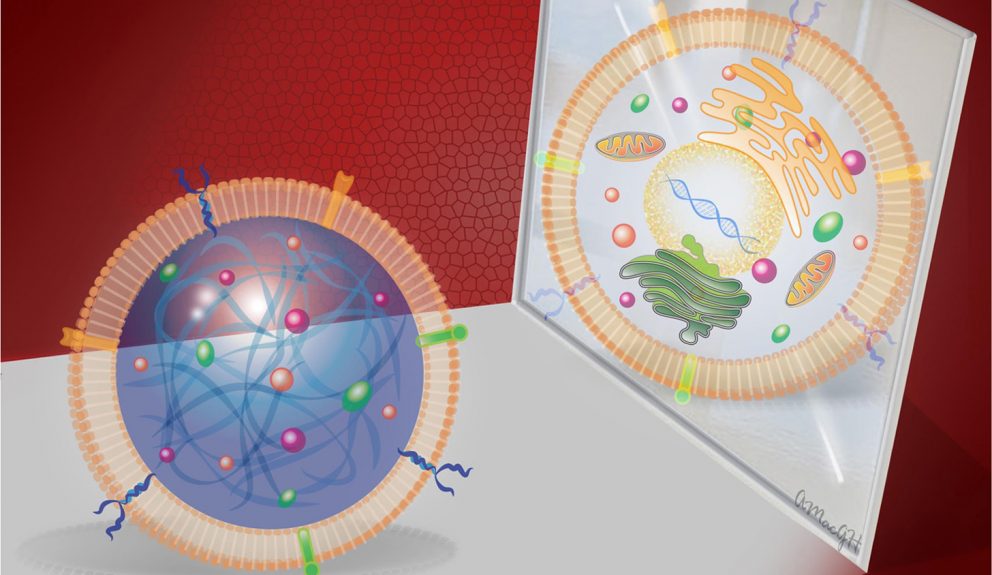
Graphic depicts the tethered enzymes and free-floating enzymes. Credit: Cornell University

Graphic depicts the tethered enzymes and free-floating enzymes. Credit: Cornell University

Just like workers in a factory, enzymes can create a final product more efficiently if they are stuck together in one place and pass the raw material from enzyme to enzyme, assembly line-style. That’s according to scientists at Cornell’s Baker Institute for Animal Health, the first team to recreate a 10-step biological pathway with all the enzymes tethered to nanoparticles. They were inspired to study how nanoparticles could gain biological functions through the enzymes that drive sperm tails, which turn sugar into lactate and energy so quickly that sperm can speed along at 5 body lengths/s

“Sperm have a highly efficient energy-producing system,” said Chinatsu Mukai, a postdoctoral research associate...

Read More

New Minimally Invasive Device to Treat Cancer and Other Illnesses

This diagram describes how the device Dr. Hood helped to develop is implanted into a cancerous tumor. Credit: Lyle Hood/UTSA

This diagram describes how the device Dr. Hood helped to develop is implanted into a cancerous tumor. Credit: Lyle Hood/UTSA

Medicine diffusion capsule could locally treat multiple ailments and diseases over several weeks. This new device that could revolutionize the delivery of medicine. “The problem with most drug-delivery systems is that you have a specific minimum dosage of medicine that you need to take for it to be effective,” Hood said. “There’s also a limit to how much of the drug can be present in your system so that it doesn’t make you sick.”

As a result of these limitations, a person who needs frequent doses of a specific medicine is required to take a pill every day or visit a doctor for injections. Hood’s creation negates the need for either of these approaches...

Read More

High-precision Magnetic Field Sensing

The highly sensitive magnetic field sensor. (Photograph: ETH Zurich / Peter Rüegg)

The highly sensitive magnetic field sensor. (Photograph: ETH Zurich / Peter Rüegg)

Researchers have succeeded in measuring tiny changes in strong magnetic fields with unprecedented precision. In their experiments, the scientists magnetised a water droplet inside an MRI scanner, a device that is used for medical imaging. They were able to detect even the tiniest variations of the magnetic field strength within the droplet. These changes were up to a trillion times smaller than the 7 tesla field strength of the MRI scanner used in the experiment.

“Until now, it was possible only to measure such small variations in weak magnetic fields,” says Klaas Prüssmann, Professor of Bioimaging at ETH Zurich and the University of Zurich...

Read More

Gut Microbes promote Motor Deficits in a mouse model of Parkinson’s disease

Figure thumbnail fx1

Highlights •Gut microbes promote α-synuclein-mediated motor deficits and brain pathology •Depletion of gut bacteria reduces microglia activation •SCFAs modulate microglia and enhance PD pathophysiology •Human gut microbiota from PD patients induce enhanced motor dysfunction in mice

Gut microbes may play a critical role in the development of Parkinson’s-like movement disorders in genetically predisposed mice, researchers report December 1 in Cell. Antibiotic treatment reduced motor deficits and molecular hallmarks of Parkinson’s disease in a mouse model, whereas transplantation of gut microbes from patients with Parkinson’s disease exacerbated symptoms in these mice...

Read More