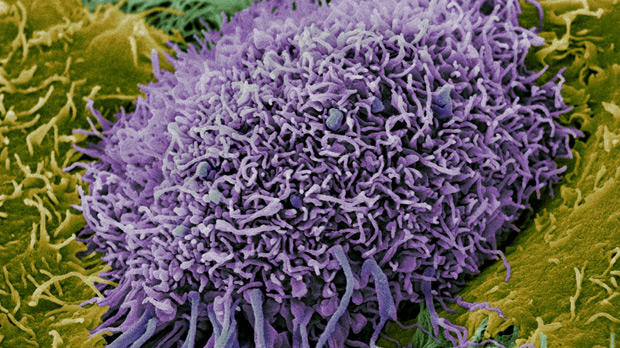
Category Health/Medical

“Cellbots” Programmable T cells chase down Cancer, deliver Drugs directly to tumors

Programmable T cells chase down cancer, deliver drugs directly to tumors

Killer T cells (green and red) surrounding a cancer cell. Credit: Alex Ritter, Jennifer Lippincott Schwartz, Gillian Griffiths/National Institutes of Health

In experiments with mice immune cells, called synNotch T cells, efficiently homed in on tumors and released a specialized antibody therapy, eradicating the cancer without attacking normal cells. In addition to delivering therapeutic agents, synNotch cells can be programmed to kill cancer cells in a variety of other ways. But synNotch cells can also carry out instructions that suppress the immune response, offering the possibility that these cells could be used to treat autoimmune diseases such as type 1 diabetes or to locally suppress immune system rejection of transplanted organs.

“SynNotch is a universal molecular sensor that allows ...

Read More

Fat cells that Amplify Nerve signals in response to Cold also affect blood Sugar Metabolism

Highlights •Cx43 expression and beige adipocyte gap junctions are increased during WAT beiging •Genetic disruption or pharmacological inhibition of Cx43 blunts WAT beiging •Overexpression of Cx43 promotes WAT beiging in the presence of a mild cold stimulus •Human beige or brown fat has higher Cx43 expression than white adipose tissue

Highlights •Cx43 expression and beige adipocyte gap junctions are increased during WAT beiging •Genetic disruption or pharmacological inhibition of Cx43 blunts WAT beiging •Overexpression of Cx43 promotes WAT beiging in the presence of a mild cold stimulus •Human beige or brown fat has higher Cx43 expression than white adipose tissue

When exposed to cold, clusters of cells within the body’s white fat become beige – a color change that reflects the creation of more energy-producing mitochondria, that enable cells to burn calories and give off heat...

Read More

Omega-3 Fatty acid Stops known Trigger of Lupus

B and T cell infiltration in lungs of NZBWF1 mice following cSiO2 exposure is prevented by dietary supplementation with DHA

B and T cell infiltration in lungs of NZBWF1 mice following cSiO2 exposure is prevented by dietary supplementation with DHA

A team of MSU researchers has found that consuming an omega-3 fatty acid called DHA, or docosahexaenoic acid, can stop a known trigger of lupus and potentially other autoimmune disorders. DHA can be found in fatty, cold-water fish and is produced by the algae that fish eat and store in their bodies. It can be found in fish oil supplements as well, used by more than 30 million Americans...

Read More

Genetic Switch for Cancer cells’ Immortality revealed

The linker histone H1.0 generates epigenetic and functional intratumor heterogeneity.

The linker histone H1.0 generates epigenetic and functional intratumor heterogeneity.

Scientists have revealed how a genetic switch involved in the packaging of DNA may be key to a cancer cell’s ability to keep growing.The Francis Crick Institute researchers found that production of a protein called H1.0 was frequently switched off in many cancer types and that reactivating this protein halted tumour growth. Studying cancer cells lacking H1.0, they found that DNA becomes uncoiled at key points, activating a series of genes that stall the cell in an ‘immature’ state. This allows the cells to carry on dividing and expanding the tumour.

But as the tumour grows H1.0 can spontaneously become switched back on in some cells...

Read More