Category Health/Medical

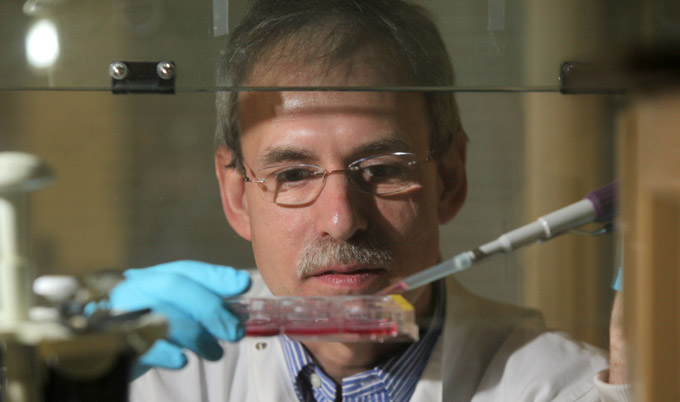
Proteins most associated with Aging revealed in study

Kenneth Dill, right, and co-authors Adam de Graff, left, and Michael Hazoglou, center, standing beside a computerized display of three identified proteins at risk for oxidation: (Left) – A normal protein that has a balance of charges not at risk for oxidation; (Center) – The RBAp48 protein is at risk because of a high negative charge (red area), which are histones known in memory loss. (Right) – Telomerase protein is at risk for oxidation because of high net positive charge (blue area). Credit: John Griffin, Stony Brook University

Kenneth Dill, right, and co-authors Adam de Graff, left, and Michael Hazoglou, center, standing beside a computerized display of three identified proteins at risk for oxidation: (Left) – A normal protein that has a balance of charges not at risk for oxidation; (Center) – The RBAp48 protein is at risk because of a high negative charge (red area), which are histones known in memory loss. (Right) – Telomerase protein is at risk for oxidation because of high net positive charge (blue area). Credit: John Griffin, Stony Brook University

When people turn about 80 yo, ~half of the body’s proteins are damaged by oxidation. Oxidation occurs because of random chemical degradations that are associated with converting food to energy in the presence of oxygen...

Read More

First Topical Rx for common Benign Skin Lesions: Seborrheic keratoses

This is a picture of Seborrheic keratosis lesions on a patient's back. Credit: James Heilman, MD, via Wikimedia Commons

This is a picture of Seborrheic keratosis lesions on a patient’s back. Credit: James Heilman, MD, via Wikimedia Commons

An investigation into the molecular mechanisms responsible for the most common type of benign skin lesion may lead to the first nonsurgical treatment for the growths, seborrheic keratoses (SKs), which in addition to being cosmetically unattractive are often worrisome to patients. Blocking a specific signaling enzyme Akt leads to the death of cultured SK cells and the breakdown of SK lesions with no effect on normal skin cells.

Sometimes called “senile warts,” “barnacles” or “liver spots,” SKs vary in color from tan to black, can be flat or raised, and range in size from quite small to an inch or more across...

Read More

Age-dependent Alterations in Metabolism & Gene Regulation in Middle-Aged Fruitflies linked to a reduction in lifespan

This study shows that metabolism, acetyl‐CoA levels and histone acetylation are increased during midlife in Drosophila, which correlates with changes in the transcriptome. Depleting the enzymes that link metabolism and histone acetylation reduces midlife acetyl‐CoA levels, transcriptome changes and increases life span.

This study shows that metabolism, acetyl‐CoA levels and histone acetylation are increased during midlife in Drosophila, which correlates with changes in the transcriptome. Depleting the enzymes that link metabolism and histone acetylation reduces midlife acetyl‐CoA levels, transcriptome changes and increases life span.

A collaborative study by 2 research groups at LMU’s Biomedical Center has shown in the fruitfly Drosophila melanogaster that age-dependent changes are already detectable in middle age. Genetic investigation of the signal pathways involved in mediating this effect identified a common process – the modification of proteins by the attachment of so-called acetyl groups (CH3COO−) to proteins – that links the age-related changes at the metabolic and genetic levels.

As we age...

Read More

Practice makes Perfect, Study confirms

Supplementary motor area (SMA) in music-visualization and motor tasks.

Supplementary motor area (SMA) in music-visualization and motor tasks.

Researchers were looking at fMRI brain scans of professional ballet dancers to measure the long-term effects of learning. “We wanted to study how the brain gets activated with long-term rehearsal of complex dance motor sequences,” says Professor Joseph DeSouza, who studies and supports people with Parkinson’s disease. “The study outcome will help with understanding motor learning and developing effective treatments to rehabilitate the damaged or diseased brain.”

METHOD: 11 dancers (19-50 years of age) from the National Ballet of Canada were asked to visualize dance movements to music, while undergoing fMRI scanning...

Read More