
Category Health/Medical

Monkeys drive Wheelchairs using only their Thoughts

A computer in the lab of Miguel Nicolelis, M.D., Ph.D., monitors brain signals from a rhesus macaque. Nicolelis and Duke researchers record signals from hundreds of neurons in two regions of the monkeys' brains that are involved in movement and sensation. As the animals think about moving toward their goal -- in this case, a bowl containing fresh grapes -- computers translate their brain activity into real-time operation of a wheelchair. Credit: Shawn Rocco/ Duke Health

A computer in the lab of Miguel Nicolelis, M.D., Ph.D., monitors brain signals from a rhesus macaque. Nicolelis and Duke researchers record signals from hundreds of neurons in two regions of the monkeys’ brains that are involved in movement and sensation. As the animals think about moving toward their goal — in this case, a bowl containing fresh grapes — computers translate their brain activity into real-time operation of a wheelchair. Credit: Shawn Rocco/ Duke Health

Neuroscientists have developed a brain-machine interface (BMI) that allows primates to use only their thoughts to navigate a robotic wheelchair. The BMI uses signals from hundreds of neurons recorded simultaneously in 2 regions of the monkeys’ brains that are involved in movement and sensation...

Read More
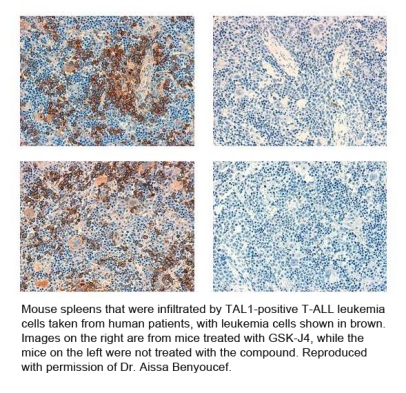
Achilles’ Heel of aggressive leukemia affecting children and adults found + new Rx

Their study focuses on a type of acute lymphoblastic leukemia (ALL) that involves a gene called TAL-1. Dr. Marjorie Brand and her team discovered that GSK-J4 can kill this form of cancer. By transplanting cancer cells from human patients into normal mice, the authors showed that the compound can kill the leukemia quickly, efficiently, and with no short-term side effects. GSK-J4 was created by the pharmaceutical industry for research purposes, and has never been used as a cancer therapy.

“It’s very exciting because this is the first time anyone has found a potential personalized treatment for this aggressive disease,” said Dr. Brand, a senior scientist at The Ottawa Hospital and professor at the University of Ottawa...

Read More

Gene identified that Helps Wound Healing and may Control Scarring in severe injuries & internal organ damage

This image shows modulation of wound healing and scar formation by MG53-mediated cell membrane repair and TGF-? signaling regulation. Credit: Li.et.al., 2015

This image shows modulation of wound healing and scar formation by MG53-mediated cell membrane repair and TGF-? signaling regulation. Credit: Li.et.al., 2015

The protein, MG53, travels throughout the bloodstream and helps the body fix injuries to the skin, heart, and other organs without causing scars. It’s a discovery that could help heal open wounds, decrease recovery time after surgery and reduce the spread of infections. “A massive scar on your skin may look bad, but imagine you have a heart attack and get a scar on your heart – that could be lethal,” says Jianjie Ma.

All animals carry this gene, he said, and it’s almost identical no matter which species. MG53 fixes the cell and tissue damage that occurs during everyday living...

Read More

Physicists have created a Perfect material for Filters and Respirators

A sample of the new fabric in reflected light. Credit: The picture is courtesy of the researchers

A sample of the new fabric in reflected light. Credit: The picture is courtesy of the researchers

Scientists have synthesized the material that is perfect for protection of respiratory organs, analytical research and other practical purposes. An almost weightless fabric made of nylon nanofibers with a diameter <15 nm beats any other similar materials in terms of filtering and optical properties. The material is lightweight (10-20 mg/m2), almost invisible (95% light transmission: more than that of a window glass), showing low resistance to airflow and efficient interception of <1 micrometer fine particulate matter.

Previously, the same team showed reducing fiber diameter from 200 nanometers down to 20 decreased filter resistance to airflow by 2/3s, and this effect could no longer be explain...

Read More