Category Physics

‘You can 3D print one material through another, as if it were invisible’: New 3D printing technique

'You can 3D print one material through another, as if it were invisible': new 3D printing technique ready to advance man
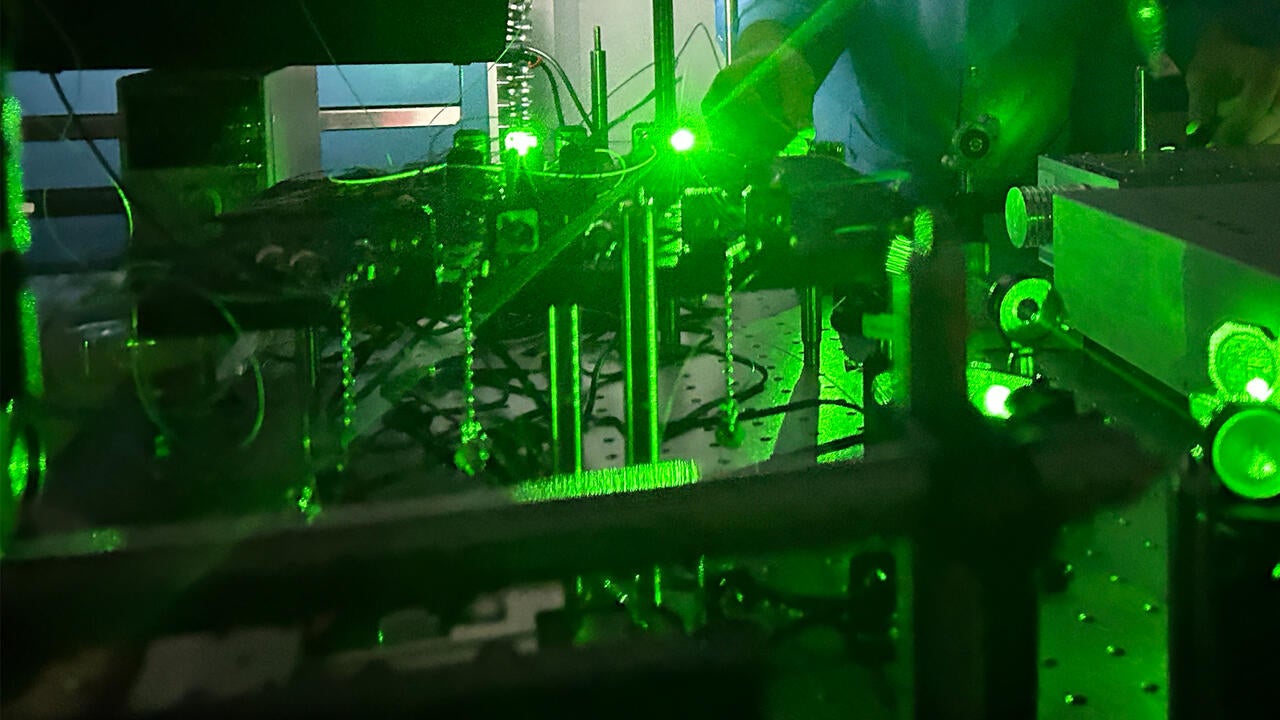
Dr Jose Marques-Hueso from the Institute of Sensors, Signals & Systems at Heriot-Watt University. Credit: Heriot-Watt University

Scientists have developed an advanced technique for 3D printing that is set to revolutionize the manufacturing industry.

The group, led by Dr. Jose Marques-Hueso from the Institute of Sensors, Signals & Systems at Heriot-Watt University in Edinburgh, has created a new method of 3D printing that uses near-infrared (NIR) light to create complex structures containing multiple materials and colors.

They achieved this by modifying a well-established 3D printing process known as stereolithography to push the boundaries of multi-material integration...

Read More

AI Tool Generates Video from Brain Activity

“Alexa, play back that dream I had about Kirsten last week.” That’s a command that may not be too far off in the future, as researchers close in on technology that can tap into our minds and retrieve the imagery of our thoughts.

Researchers at the National University of Singapore and the Chinese University of Hong Kong reported last week that they have developed a process capable of generating video from brain scans. The research is published on the arXiv preprint server.

Using a process called functional magnetic resonance imaging (fMRI), researchers Jiaxin Qing, Zijiao Chen and Juan Helen Zhou coupled data retrieved through imaging with the deep learning model Stable Diffusion to create smooth, high quality videos.

Successful recreations of still imagery gleaned from brain ...

Read More

Forging a Dream Material with Semiconductor Quantum Dots

Image showing the bonding between quantum dots
Figure showing how the bonding between quantum dots contributes to electrical conductivity

Researchers from the RIKEN Center for Emergent Matter Science and collaborators have succeeded in creating a “superlattice” of semiconductor quantum dots that can behave like a metal, potentially imparting exciting new properties to this popular class of materials.

Semiconducting colloidal quantum dots have garnered tremendous research interest due to their special optical properties, which arise from the quantum confinement effect...

Read More

Protein-based Nano-‘computer’ evolves in ability to Influence Cell Behavior

Jiaxing Chen uses fluorescence microscopy to visualize fixed cells on nanopatterns.
Jiaxing Chen uses fluorescence microscopy to visualize fixed cells on nanopatterns.  Credit: Penn State Huck Institutes of the Life Sciences / Penn State

The first protein-based nano-computing agent that functions as a circuit has been created by Penn State researchers. The milestone puts them one step closer to developing next-generation cell-based therapies to treat diseases like diabetes and cancer.

Traditional synthetic biology approaches for cell-based therapies, such as ones that destroy cancer cells or encourage tissue regeneration after injury, rely on the expression or suppression of proteins that produce a desired action within a cell. This approach can take time (for proteins to be expressed and degrade) and cost cellular energy in the process...

Read More