Category Physics

Renewable Solar Energy can help Purify Water, the Environment

Schematic diagram of (left) the formation of (PVF-CNT)/TiO2 NR electrodes. PVF-functionalized CNT was deposited on the NR arrays by electrodeposition. (Right) The proposed solar-driven PEC separation of heavy metal oxyanions is displayed

Chemists led by Beckman researcher Xiao Su have demonstrated that water remediation can be powered in part — and perhaps even exclusively — by renewable energy sources. Using electrochemistry to separate different particles within a solution (also known as electrochemical separation) is an energy-efficient strategy for environmental and water remediation: the process of purifying contaminated water...

Read More

Breakthrough Metasurface Materials Tech Unleashes Enhanced Control for Advanced Telecommunications and Beyond

Breakthrough metasurface materials tech unleashes enhanced control for advanced telecommunications and beyond
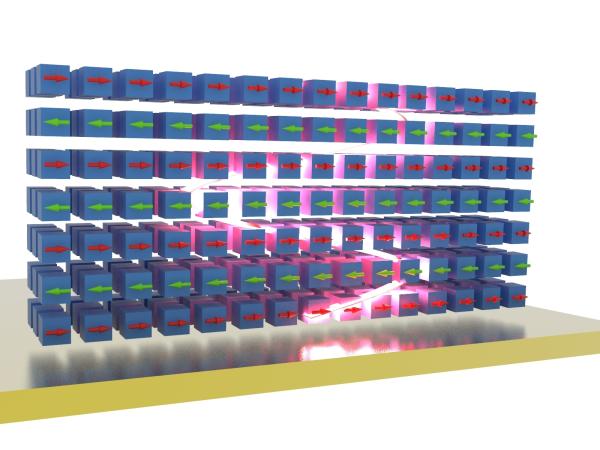
Dual-resonance unit cell with three copper layers on a printed circuit board and a backplane. The front and back of the unit cell are also shown, which, respectively, host a varactor and series varactor-resistor pair. Credit: Physical Review Applied (2023). DOI: 10.1103/PhysRevApplied.20.014004

Cities can be obstacle courses for communications signals. A radio signal must travel from a cell phone to a router to a cell tower, and onward to its recipient—all while bouncing between walls, buildings and other structures. When it hits an obstacle, the radio wave gets scattered, diminishing the signal. This in turn reduces the bandwidth. At the same time, the signal must compete with the bandwidth needs of numerous other devices in the area...

Read More

Engineers use Radiation Suppression to Develop Better Wireless Charging

Going the distance for better wireless charging
Two loop antennas (radius: 3.6 centimeters) can transfer power between each other from 18 centimeters apart. Credit: Nam Ha-Van/Aalto University

A better way to wirelessly charge over long distances has been developed at Aalto University. Engineers have optimized the way antennas transmitting and receiving power interact with each other, making use of the phenomenon of “radiation suppression.” The result is a better theoretical understanding of wireless power transfer compared to the conventional inductive approach, a significant advancement in the field.

Charging over short distances, such as through induction pads, uses magnetic near fields to transfer power with high efficiency, but at longer distances the efficiency dramatically drops...

Read More

New Catalyst could Dramatically Cut Methane Pollution from Millions of Engines

 Simulated Pd/CeO2 interfacial evolution in response to reaction conditions.

Researchers demonstrate a way to remove the potent greenhouse gas from the exhaust of engines that burn natural gas. Today’s catalysts for removing unburnt methane from natural-gas engine exhaust are either inefficient at low, start-up temperatures or break down at higher operating temperatures. A new single-atom catalyst solves both these problems and removes 90% of the methane.

Individual palladium atoms attached to the surface of a catalyst can remove 90% of unburned methane from natural-gas engine exhaust at low temperatures, scientists reported today in the journal Nature Catalysis.

While more research needs to be done, they said, the advance in single atom catalysis has the potential to lower exhau...

Read More