Category Physics

The Next Wonder Semiconductor

scanning ultrafast electron microscope
The scanning ultrafast electron microscope (SUEM) couples a femtosecond pulsed laser with a scanning electron microscope, which enables time-resolved imaging of microscopic energy transport processes with simultaneously high spatial and temporal resolutions
Photo Credit: 
MATT PERKO

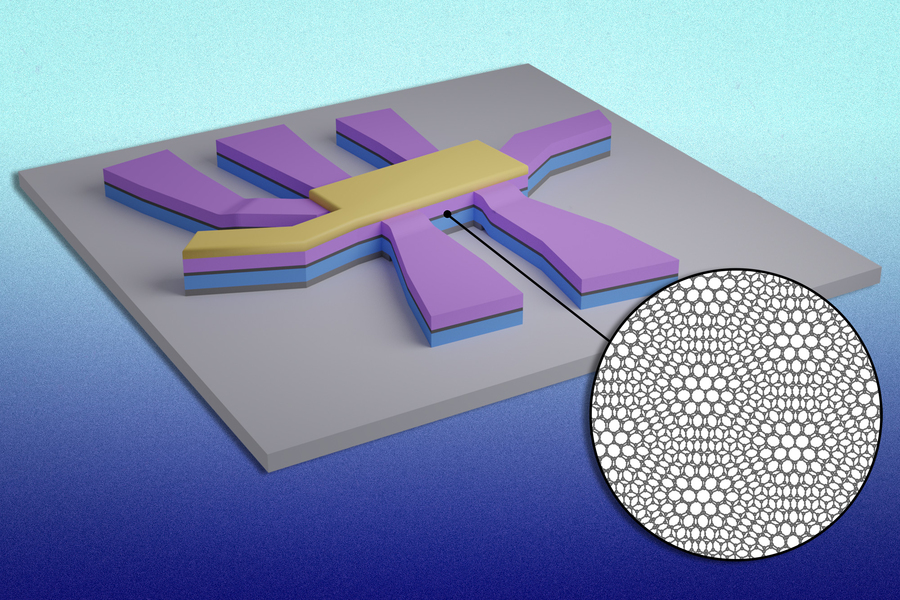
With scanning ultrafast electron microscopy, researchers unveil promising hot photocarrier transport properties of cubic boron arsenide. In a study that confirms its promise as the next-generation semiconductor material, UC Santa Barbara researchers have directly visualized the photocarrier transport properties of cubic boron arsenide single crystals.

“We were able to visualize how the charge moves in our sample,” said Bolin Liao, an assistant professor of mechanical engineering in the College of Engineeri...

Read More

Improving Light Absorption in Perovskite/Si Tandem Solar Cells

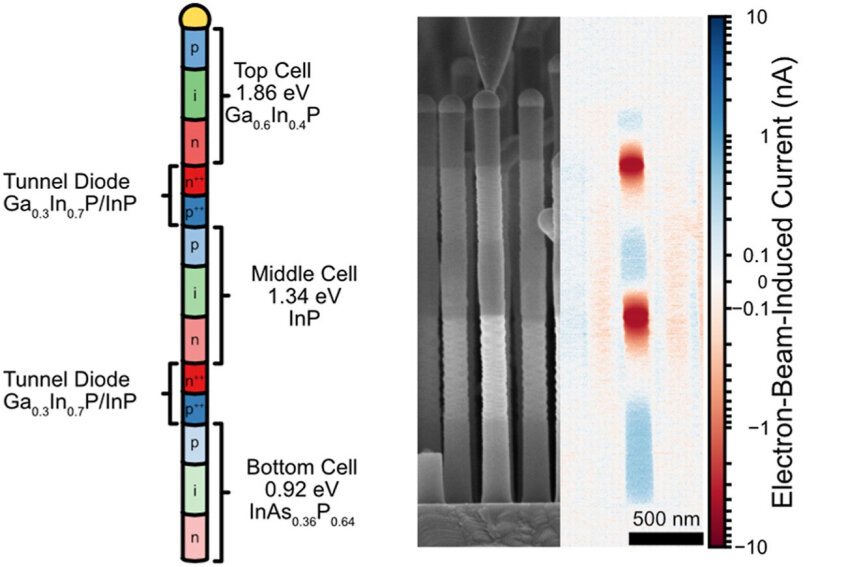
1. (a) A schematic of the PDMS layer containing SGA phosphors and SiO2 nanoparticles, (b) photographs of the PDMS layer with SGA phosphors and SiO2 nanoparticles under ambient light and UV light (λ = 365 nm), (c) a schematic of perovskite/Si tandem solar cell with the PDMS layer containing SGA phosphors and SiO2 nanoparticles, and (d) a cross-sectional SEM image of the perovskite–Si solar cell.

A research team, affiliated with UNIST has succeeded in achieving a power conversion efficiency (PEC) of 23.50% in a perovskite-silicon tandem solar cell built with a special textured anti-reflective coating (ARC) polymeric film. According to the research team, the PCE of the device with the ARC film was sustained for 120 hours, maintaining 91% of its initial value.

This breakthrough has b...

Read More

New Computing Architecture: Deep Learning with Light

Artist’s rendering of a smart transceiver. The dark blue device has golden pathways and rectangles, which represent the wires that connect the smart transceiver chip to a circuit board. A light blue square covered with thin lines rises from the middle, to represent the smart transceiver chip. The thin lines represent an array of fibers that move light from lasers in and out of the chip.
Caption:This rendering shows a novel piece of hardware, called a smart transceiver, that uses technology known as silicon photonics to dramatically accelerate one of the most memory-intensive steps of running a machine-learning model. This can enable an edge device, like a smart home speaker, to perform computations with more than a hundred-fold improvement in energy efficiency.
Credits:Image: Alex Sludds. Edited by MIT New

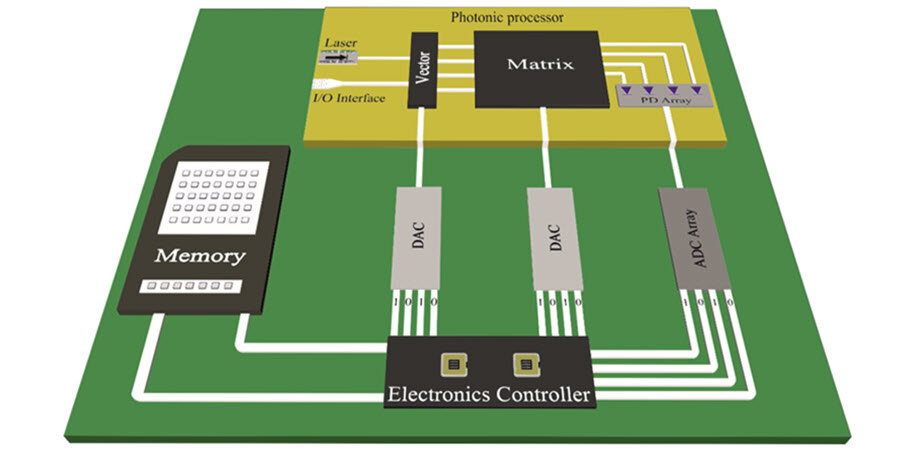
A new method uses optics to accelerate machine-learning computations on smart speakers and other low-power connected devices. The technique may enable self-driving cars to make decisions in realtime while only using a fraction of the energy that is currently demanded by their power-hungry on-board computers.

Ask a smart home device for the weather forecast, and it...

Read More

Blocking the buzz: MXene Composite could Eliminate Electromagnetic Interference by Absorbing it

A MXene polymer composite being developed in Drexel’s College of Engineering could help to curtail the ever-increasing electromagnetic interference that comes with the proliferation of electronics devices.

Drexel Materials science researchers demonstrate MXene polymer coating can block and absorb interference. A recent discovery by materials science researchers in Drexel University’s College of Engineering might one day prevent electronic devices and components from going haywire when they’re too close to one another. A special coating that they developed, using a type of two-dimensional material called MXene, has shown to be capable of absorbing and disbursing the electromagnetic fields that are the source of the problem.

Buzzing, feedback or static are the noticeable manifestation...

Read More