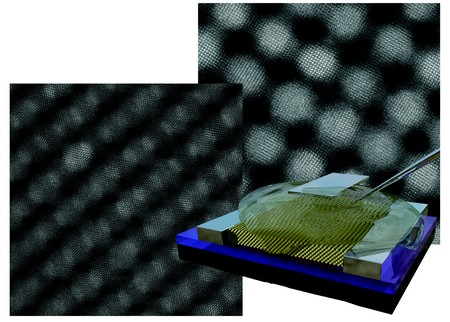
Electron microscope images showing two of the ordered structures formed in the experiments. Atoms inside the quantum dots are resolved by the microscope and it can be seen that they are aligned throughout adjacent dots. A model of the device used for the measurement of the electronic properties is shown in the bottom right. The superlattice lies between two electrodes while an ionic gel on top (gate electrode) is used to accumulate carriers in the active material. | Illustration Jacopo Pinna
Finding paves the way for new generation of opto-electronic applications. Quantum dots are clusters of some 1,000 atoms which act as one large ‘super-atom’. It is possible to accurately design the electronic properties of these dots just by changing their size...
Sound waves that propagate only in one direction break the light transmission reciprocity. Scientists at the Max Planck Institute for the Science of Light have managed for the first time to create a unidirectional device that significantly increases the quality of a special class of transmitted signals in optical communications: optical vortices. By transmitting selective optical vortex modes exclusively unidirectionally, the developed device largely reduces detrimental backscattering to a minimum...
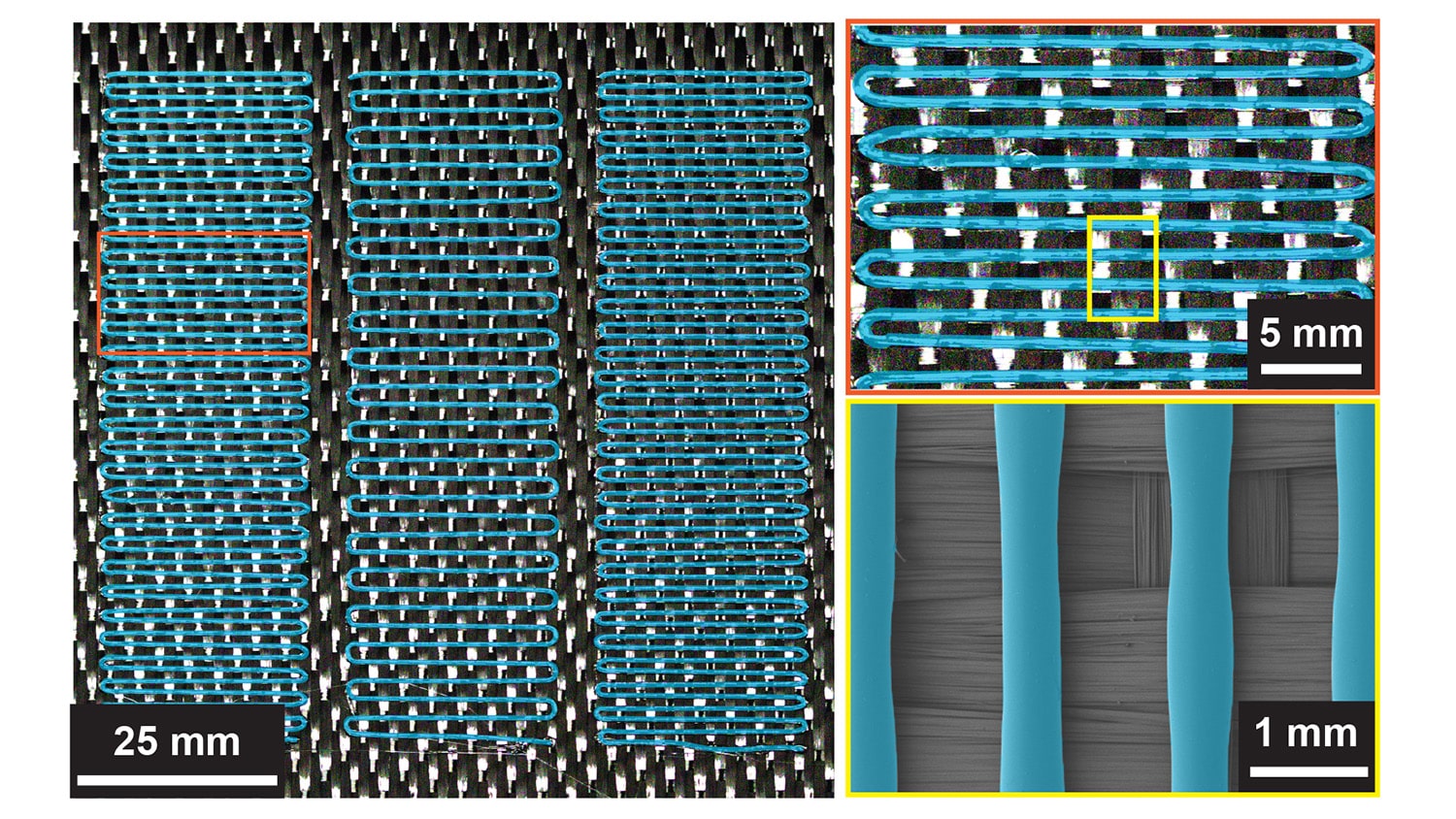
3D printed thermoplastic on woven-carbon fiber reinforcement.
Engineering researchers have developed a new self-healing composite that allows structures to repair themselves in place, without having to be removed from service. This latest technology resolves two longstanding challenges for self-healing materials, and can significantly extend the lifespan of structural components such as wind-turbine blades and aircraft wings.
“Researchers have developed a variety of self-healing materials, but previous strategies for self-healing composites have faced two practical challenges,” says Jason Patrick, corresponding author of the research paper and an assistant professor of civil, construction and environmental engineering at North Carolina State University.
Scientists at EPFL have increased the power conversion efficiency of dye-sensitized solar cells (“Grätzel cells”) beyond 15% in direct sunlight and 30% in ambient light conditions.
Mesoscopic dye-sensitized solar cells (DSCs) were invented in 1990s by Brian O’Regan and Michael Grätzel, taking on the latter’s name – the world-famous Grätzel cells. DSCs convert light into electricity through photosensitizers – dye compounds that absorb light and inject electrons into an array of oxide nanocrystals which subsequently are collected as electric current.
In DSCs, photosensitizers are attached (“adsorbed”) to the surface of nanocrystalline mesoporous titanium dioxide films that are imbibed with redox active electrolytes or a solid charge-transport material – the entire design aims...







Recent Comments