Category Physics

Bluetooth Signals can be used to Identify and Track Smartphones

Bluetooth signals can be used to identify and track smartphones
Researchers tested their method to track Bluetooth fingerprints on campus. They use an off-the-shelf device to track and identify devices. Credit: University of California San Diego

A team of engineers at the University of California San Diego has demonstrated for the first time that the Bluetooth signals emitted constantly by our mobile phones have a unique fingerprint that can be used to track individuals’ movements.

Mobile devices, including phones, smartwatches and fitness trackers, constantly transmit signals, known as Bluetooth beacons, at the rate of roughly 500 beacons per minute.These beacons enable features like Apple’s “Find My” lost device tracking service; COVID-19 tracing apps; and connect smartphones to other devices such as wireless earphones.

Prior research has s...

Read More

Earth-Abundant Solar Pixels found to produce Hydrogen for Weeks

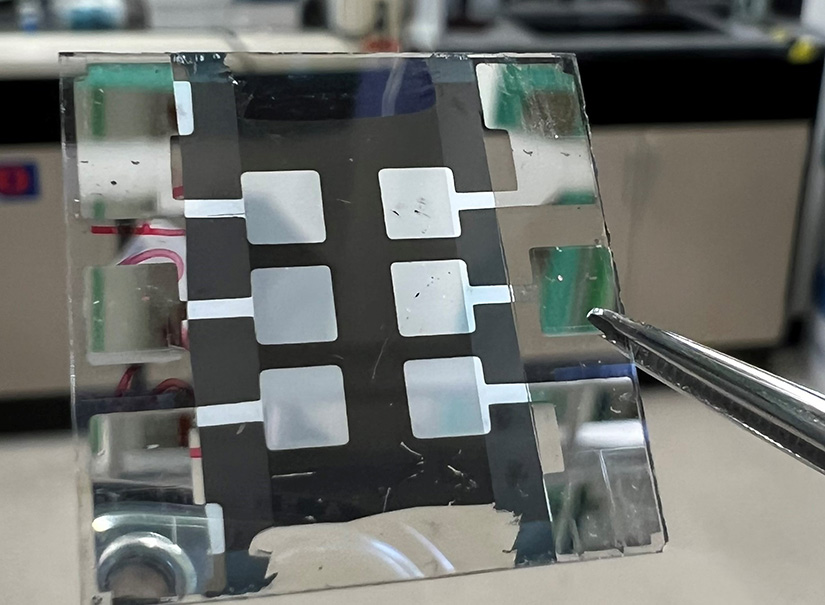
Multiple BiOI and BiOI-BiVO4 pixels on a device.
Multiple BiOI and BiOI-BiVO4 pixels on a device. Credit: Dr Virgil Andrei.

Devices made of readily available oxide and carbon-based materials can produce clean hydrogen from water over weeks — according to new research.

The findings, co-led by Dr Virgil Andrei, a Research Fellow at St John’s College, University of Cambridge, with academics at Imperial College London, could help overcome one of the key issues in solar fuel production, where current earth-abundant light-absorbing materials are limited through either their performance or stability.

Underexplored materials for light harvesting

Hydrogen fuel will play a critical role in the transition to full decarbonisation and reaching the UK’s goal of net-zero emissions by 2050...

Read More

Breakthrough paves way for Photonic Sensing at the Ultimate Quantum Limit

Photonic chip with a microring resonator nanofabricated in a commercial foundry. Photo credit: Joel Tasker, QET Labs

A team of physicists has found a way to operate mass manufacturable photonic sensors at the quantum limit. This breakthrough paves the way for practical applications such as monitoring greenhouse gases and cancer detection.

Sensors are a constant feature of our everyday lives. Although they often go unperceived, sensors provide critical information essential to modern healthcare, security, and environmental monitoring. Modern cars alone contain over 100 sensors and this number will only increase.

Quantum sensing is poised to revolutionise today’s sensors, significantly boosting the performance they can achieve...

Read More

A Novel All-Optical Switching Method makes Optical Computing and Communication Systems more Power-Efficient

Photo: Tampere University

Photonics researchers have introduced a novel method to control a light beam with another beam through a unique plasmonic metasurface in a linear medium at ultralow power. This simple linear switching method makes nanophotonic devices such as optical computing and communication systems more sustainable requiring low intensity of light.

All-optical switching is the modulation of signal light due to control light in such a way that it possesses the ON/OFF conversion function. In general, a light beam can be modulated with another intense laser beam in the presence of a nonlinear medium.

The switching method developed by the researchers is fundamentally based on the quantum optical phenomenon known as Enhancementof Index of Refraction (EIR).

“Our work is...

Read More