Category Physics

Research Breakthrough means Warp Speed ‘Unruh Effect’ can finally be Tested in Lab Settings

Discovery advances understanding of theory of relativity and quantum. A major hurdle for work at the forefront of fundamental physics is the inability to test cutting-edge theories in a laboratory setting. But a recent discovery opens the door for scientists to see ideas in action that were previously only understood in theory or represented in science fiction.

One such theory is on the Unruh effect. When astronauts in a spacecraft undergo super strong acceleration and see the light of stars stream by, then the Unruh effect is an additional warm glow on top of the streaming light. First predicted by Canadian physicist Bill Unruh, this effect is closely related to the glow from black holes predicted by Stephen Hawking...

Read More

‘Nanomagnetic’ Computing can provide Low-energy AI

Researchers have shown it is possible to perform artificial intelligence using tiny nanomagnets that interact like neurons in the brain. The new method, developed by a team led by Imperial College London researchers, could slash the energy cost of artificial intelligence (AI), which is currently doubling globally every 3.5 months.

In a paper published today in Nature Nanotechnology, the international team have produced the first proof that networks of nanomagnets can be used to perform AI-like processing. The researchers showed nanomagnets can be used for ‘time-series prediction’ tasks, such as predicting and regulating insulin levels in diabetic patients.

Artificial intelligence that uses ‘neural networks’ aims to replicate the way parts of the brain work, where neurons talk to...

Read More

Building a Better Quantum Bit: New qubit breakthrough could transform quantum computing

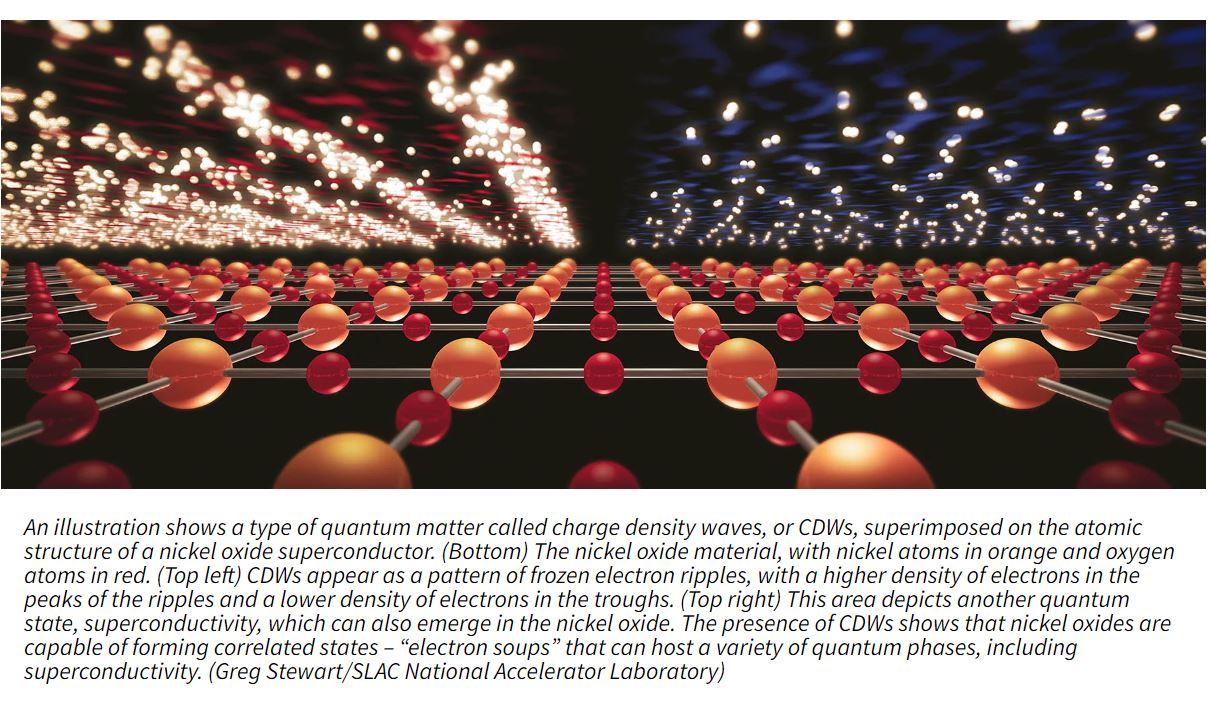
An illustration of the qubit platform made of a single electron on solid neon. Researchers froze neon gas into a solid at very low temperatures, sprayed electrons from a light bulb onto the solid and trapped a single electron there to create a qubit. (Courtesy of Dafei Jin/Argonne National Laboratory)

A team led by researchers at the U.S. Department of Energy’s (DOE) Argonne National Laboratory, in close collaboration with FAMU-FSU College of Engineering Associate Professor of Mechanical Engineering Wei Guo, has announced the creation of a new qubit platform that shows great promise to be developed into future quantum computers. Their work is published in Nature.

“Quantum computers could be a revolutionary tool for performing calculations that are practically impossible for classica...

Read More

Wi-Fi may be coming soon to a Lamppost near you

NIST communications researchers traveled to downtown Boulder, Colorado, to verify their channel model for evaluating high-frequency wireless network designs. Sung Yun Jun is checking the alignment of the transmitter, mounted 6 meters high on a mast, with the receiver antenna array on the roof of the blue van. Derek Caudill, barely visible inside the van, is preparing software programs to collect measurement data. Justin Sadinski, in a yellow vest, is checking equipment on the masts. Credit: NIST

As Wi-Fi is deployed more widely in cities, and perhaps at higher frequencies, it may depend on an abundant urban asset: streetlight poles.

To help ensure these networks work well, researchers at the National Institute of Standards and Technology (NIST) have developed and verified a novel mo...

Read More