Category Physics

New World Record for Qubit Storage

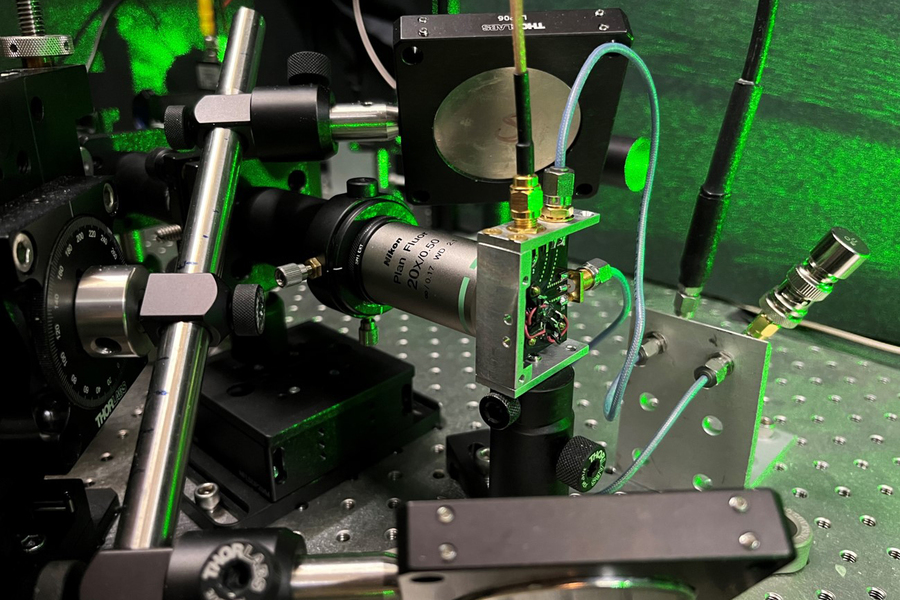
Crystal used for storing photonic qubits and illuminated by a laser in a cryostat, an instrument for obtaining cryogenic temperatures. 
(c) Antonio Ortu/CC-BY

A UNIGE team has succeeded in storing a quantum bit for 20 milliseconds. A duration that had never before been achieved by a solid-state quantum memory.

Computers, smartphones, GPS: quantum physics has enabled many technological advances. It is now opening up new fields of research in cryptography (the art of coding messages) with the aim of developing ultrasecure telecommunications networks. There is one obstacle, however: after a few hundred kilometers within an optical fiber, the photons that carry the qubits or ‘quantum bits’ (the information) disappear...

Read More

Quantum Technology could make Charging Electric Cars as Fast as Pumping Gas

A pictorial illustration of today’s electric vehicle versus the future vehicle based on quantum battery technologies. Employing quantum charging would lead to a 200 times speedup in a typical EV, which means that the charging time would be cut from 10 hours to about 3 minutes (at home), or 30 minutes to 9 seconds at a charging station. Image Credit: Institute for Basic Science.

Whether it’s photovoltaics or fusion, sooner or later, human civilization must turn to renewable energies. This is deemed inevitable, considering the ever-growing energy demands of humanity and the finite nature of fossil fuels. Much research has been pursued in order to develop alternative sources of energy, most of which use electricity as the main energy carrier...

Read More

A Chip-Scale Broadband Light Source in Silicon Carbide

(a) Schematic top view (left) and cross section (right) of the 4H-silicon-carbide-on-insulator platform for frequency comb generation based on compact microring resonators. The sidewall angle (θ) is estimated near 80–85 deg in our nanofabrication. Dispersion engineering is carried out by varying the ring waveguide width (RW). In addition, efficient coupling is realized using the pulley structure where the access waveguide width and coupling length are adjusted to achieve phase matching to the desired resonant mode families. (b) Scanning electron micrograph of a 36-μm-radius SiC microring. In this work, the SiC thickness is fixed at 500 nm with a pedestal layer of 50 nm. (c) Simulated integrated dispersion [Dint; see its definition in Eq. (1)] for the fundamental transverse-electric (i.e...
Read More

Tiny Battery-free Devices Float in the wind like Dandelion seeds

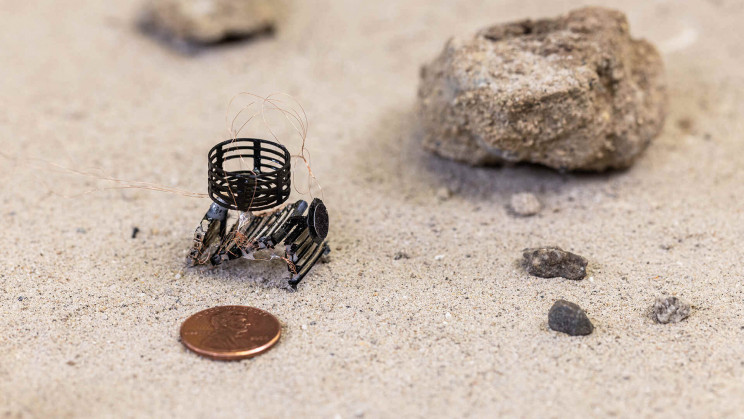
Wireless sensors can monitor how temperature, humidity or other environmental conditions vary across large swaths of land, such as farms or forests.

These tools could provide unique insights for a variety of applications, including digital agriculture and monitoring climate change. One problem, however, is that it is currently time-consuming and expensive to physically place hundreds of sensors across a large area.

Inspired by how dandelions use the wind to distribute their seeds, a University of Washington team has developed a tiny sensor-carrying device that can be blown by the wind as it tumbles toward the ground...

Read More