Category Physics

New Lightweight Super Material could Battle Bullets, Deflect Space Debris

This illustration shows a high-speed microprojectile penetrating the researchers’ nanofiber mat, which consists of carbon nanotubes and Kevlar nanofibers. Image courtesy of Ramathasan Thevamaran.

University of Wisconsin–Madison engineers have created a nanofiber material that outperforms its widely used counterparts—including steel plates and Kevlar fabric—in protecting against high-speed projectile impacts.

Basically, it’s better than bulletproof.

“Our nanofiber mats exhibit protective properties that far surpass other material systems at much lighter weight,” says Ramathasan Thevamaran, a UW–Madison assistant professor of engineering physics who led the research.

He and his collaborators detailed the advance in a paper published recently in the journal ACS Nano.

...Read More

Research team makes Breakthrough Discovery in Light Interactions with Nanoparticles, paving the way for Advances in Optical Computing

Scattered waves from a nanoscale object encode the solution of a complex mathematical problem when interrogated by tailored input signals (Credit: Heedong Goh)

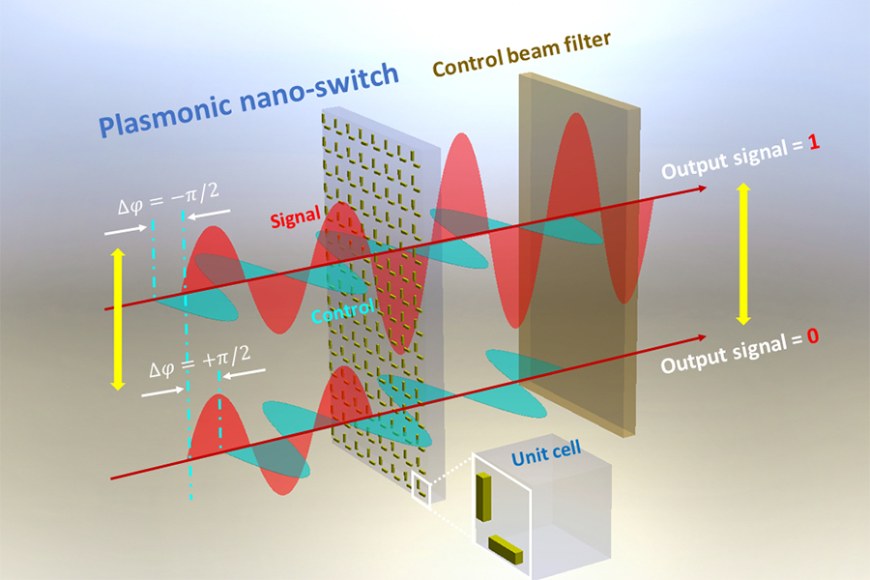
Computers are an indispensable part of our daily lives, and the need for ones that can work faster, solve complex problems more efficiently, and leave smaller environmental footprints by minimizing the required energy for computation is increasingly urgent. Recent progress in photonics has shown that it’s possible to achieve more efficient computing through optical devices that use interactions between metamaterials and light waves to apply mathematical operations of interest on the input signals, and even solve complex mathematical problems...

Read More

Physicists bring a Once-Theoretical Effect of Quantum Matter into Observable Reality

The Weld Lab’s quantum boomerang showed a lithium atom’s initial departure and return to average zero momentum despite periodic energy “kicks” from their quantum kicked rotor
Photo Credit: 
ROSHAN SAJJAD

Physicists at UC Santa Barbara have become the first to experimentally observe a quirky behavior of the quantum world: a “quantum boomerang” effect that occurs when particles in a disordered system are kicked out of their locations. Instead of landing elsewhere as one might expect, they turn around and come back to where they started and stop there.

“It’s really a fundamentally quantum mechanical effect,” said atomic physicist David Weld, whose lab produced the effect and documented it in a paper published in Physical Review X. “There’s no classical explanation for this phenomenon.”

...Read More

Novel Design greatly Improves Output from Commercial Circuit Boards next to Superconducting Qubits

Green commercial circuit boards—the largest is 11.4 cm (4.5 in) by 19 cm (7.5  in)—inside a dilution refrigerator. When enclosed and pumped down, the system reaches temperatures only a few thousandths of a degree above absolute zero. Credit: NIST

Researchers at the National Institute of Standards and Technology (NIST) have constructed and tested a system that allows commercial electronic components—such as microprocessors on circuit boards—to operate in close proximity with ultracold devices employed in quantum information processing. That design allows 4X as much data to be output for the same number of connected wires.

In the rising excitement about quantum computing, it can be easy to overlook the physical fact that the data produced by manipulation of quantum bits (qubit...

Read More