Category Physics

The First Topological Acoustic Transistor

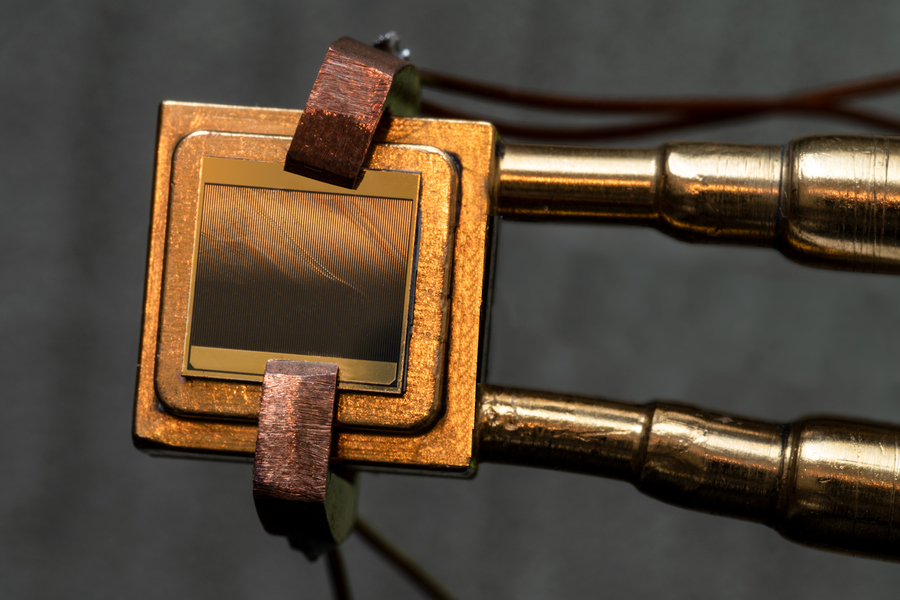
To turn ‘on’ an acoustic transistor, ultrasound arriving at the ‘gate’ input heats and expands the base plate, changing the spacing in two lattices of slightly-different-sized pillars, and inducing a topological transition that guides sound along the interface. (Credit: Hoffman Lab/Harvard SEAS)

Sound waves may pave the way for topological electronic transistors. Researchers have designed and simulated the first topological acoustic transistors — with sound waves instead of electrons — and proposed a connection architecture to form a universal logic gate that can switch the flow of sound on and off.

Topological materials move electrons along their surface and edges without any loss, making them promising materials for dissipationless, high-efficiency electronics...

Read More

Charging Electric Vehicles with Photovoltaics at Home

Exemplary week of a single user showing the usage of the BEV as well as the energy production by rooftop PV. In this recorded charging pattern (i.e., the baseline scenario, as explained below), it would be beneficial to not immediately recharge the car to the maximum, but instead wait for periods of increased PV energy generation. Credit: DOI: 10.1016/j.rser.2021.111969

An electric car that runs on PV power sounds appealing. But is it really possible to enjoy flexibility with a vehicle charged through a home photovoltaic system? An ETH research team has reached some surprising conclusions.

The area of photovoltaics (PV) is rapidly increasing in popularity, and in Switzerland it already covers 5 percent of the country’s electricity consumption...

Read More

Experimental Quantum Teleportation of Propagating Microwaves

Quantum teleportation (QT) of propagating microwaves: concept and implementation. (A) General concept. (B) Our experimental implementation of QT with propagating quantum microwaves and analog feedforward (also see note S1 for the full technical schematics). Here, an unknown input coherent state is teleported from Alice to Bob by exploiting quantum entanglement characterized by the two-mode squeezing level ST ≲ S. The feedforward signal is generated by the measurement JPAs with the degenerate gain G, in combination with two hybrid rings and a local displacement operation on Bob’s side. The latter is implemented with a directional coupler with the coupling β = −15 dB...
Read More

Self-healing Nanomaterials usable in Solar Panels and other Electronic devices

Electron microscopy images displaying the formation of the hole on the surface of the nanocrystal and its movement inwards. Credit: Bekenstein lab

The field of self-repairing materials is rapidly expanding, and what used to be science fiction might soon become reality, thanks to scientists who developed eco-friendly nanocrystal semiconductors capable of self-healing. Their findings describe the process, in which a group of materials called double perovskites display self-healing properties after being damaged by the radiation of an electron beam.

From the Terminator to Spiderman’s suit, self-repairing robots and devices abound in sci-fi movies. In reality, though, wear and tear reduce the effectiveness of electronic devices until they need to be replaced...

Read More