Category Physics

New Holographic Camera sees the Unseen with High Precision

holographic camera
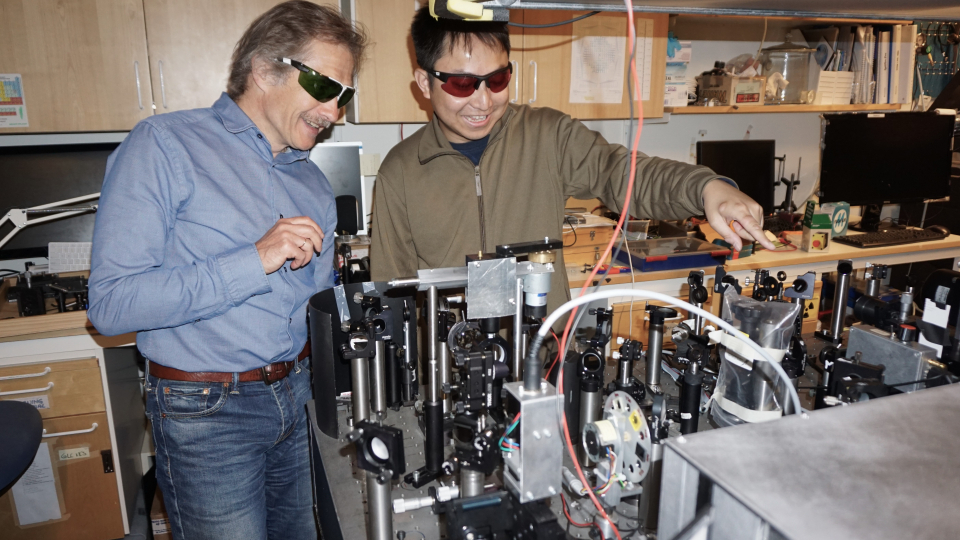
A setup of one of the prototypes in the laboratory

Device can see around corners and through scattering media like fog and human tissue. Northwestern University researchers have invented a new high-resolution camera that can see the unseen — including around corners and through scattering media, such as skin, fog or potentially even the human skull.

Called synthetic wavelength holography, the new method works by indirectly scattering coherent light onto hidden objects, which then scatters again and travels back to a camera. From there, an algorithm reconstructs the scattered light signal to reveal the hidden objects...

Read More

A Nanoantenna for Long-Distance, Ultra-Secure Communication

 Conceptual illustration of efficient illumination of photons to semiconductor lateral quantum dots, by using a surface plasmon antenna and excitation of electrons in the quantum dots. (credit: copyright @ 2021 Oiwa lab. All Rights Reserved)

Researchers have improved the transfer efficiency between quantum information carriers, in a manner that’s based on well-established nanoscience and is compatible with upcoming advanced communication technologies.

Information storage and transfer in the manner of simple ones and zeros — as in today’s classical computer technologies — is insufficient for quantum technologies under development. Now, researchers from Japan have fabricated a nanoantenna that will help bring quantum information networks closer to practical use.

In a study recently...

Read More

Tiny Chip provides a Big Boost in Precision Optics

Closeup of tweezers grasping tiny chip.
A 2 mm by 2 mm integrated photonic chip developed by Jaime Cardenas, assistant professor of optics, and PhD student Meiting Song (lead author) will make interferometers—and therefore precision optics—even more powerful. Potential applications include more sensitive devices for measuring tiny flaws on mirrors, or dispersion of pollutants in the atmosphere, and ultimately, quantum applications. (University of Rochester photo / J. Adam Fenster)

By merging two or more sources of light, interferometers create interference patterns that can provide remarkably detailed information about everything they illuminate, from a tiny flaw on a mirror, to the dispersion of pollutants in the atmosphere, to gravitational patterns in far reaches of the Universe.

“If you want to measure something w...

Read More

First Quantum Simulation of Baryons

A team of researchers led by an Institute for Quantum Computing (IQC) facu11lty member performed the first-ever simulation of baryons — fundamental quantum particles — on a quantum computer.

With their results, the team has taken a step towards more complex quantum simulations that will allow scientists to study neutron stars, learn more about the earliest moments of the universe, and realize the revolutionary potential of quantum computers.

“This is an important step forward — it is the first simulation of baryons on a quantum computer ever,” Christine Muschik, an IQC faculty member, said. “Instead of smashing particles in an accelerator, a quantum computer may one day allow us to simulate these interactions that we use to study the origins of the universe and so much more.”

...Read More