Category Physics

Physicists find a novel way to Switch Antiferromagnetism On and Off

antiferromagnetism device
In turning antiferromagnetism on and off, MIT physicists may have found a route towards faster, denser, and more secure memory devices.
Credits:Credit: stock image

The findings could lead to faster, more secure memory storage, in the form of antiferromagnetic bits. When you save an image to your smartphone, those data are written onto tiny transistors that are electrically switched on or off in a pattern of “bits” to represent and encode that image. Most transistors today are made from silicon, an element that scientists have managed to switch at ever-smaller scales, enabling billions of bits, and therefore large libraries of images and other files, to be packed onto a single memory chip.

But growing demand for data, and the means to store them, is driving scientists to search beyond...

Read More

Will your Future Clothes be Made of Algae?

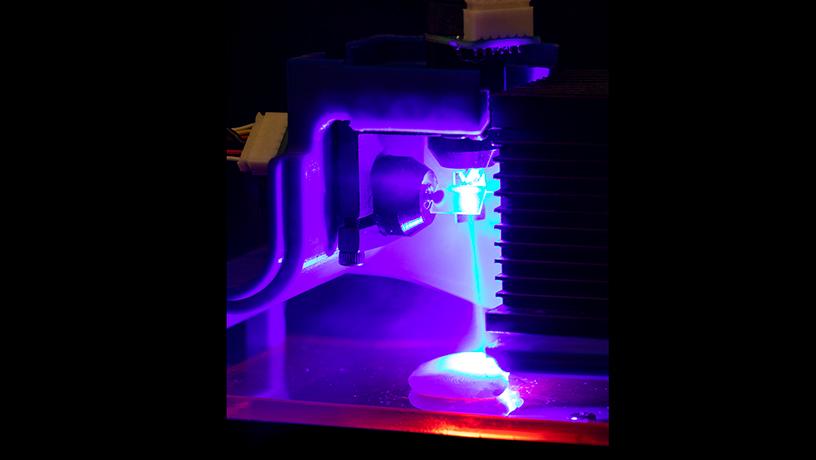
A mini T-shirt demonstrates the photosynthetic living materials created in the lab of Rochester biology professor Anne S. Meyer using 3D printers and a new bioink technique. (University of Rochester photo)

For the first time, an international team of researchers from the University of Rochester and Delft University of Technology in the Netherlands used 3D printers and a novel bioprinting technique to print algae into living, photosynthetic materials that are tough and resilient. The material has a variety of applications in the energy, medical, and fashion sectors. The research is published in the journal Advanced Functional Materials.

“Three-dimensional printing is a powerful technology for fabrication of living functional materials that have a huge potential in a wide range of env...

Read More

Single Photon Switch Advance

The ability to turn on and off a physical process with just one photon is a fundamental building block for quantum photonic technologies. Realizing this in a chip-scale architecture is important for scalability, which amplifies a breakthrough by City College of New York researchers led by physicist Vinod Menon. They’ve demonstrated for the first time the use of “Rydberg states” in solid state materials (previously shown in cold atom gases) to enhance nonlinear optical interactions to unprecedented levels in solid state systems. This feat is a first step towards realizing chip-scale scalable single photon switches.

In solid state systems, exciton-polaritons, half-light half-matter quasiparticles, which result from the hybridization of electronic excitations (excitons) and photons, a...

Read More

Silicon could be a Photonics Game-Changer

Ben_murdin_photonics

New research from the University of Surrey has shown that silicon could be one of the most powerful materials for photonic informational manipulation — opening up new possibilities for the production of lasers and displays.

While computer chips’ extraordinary success has confirmed silicon as the prime material for electronic information control, silicon has a reputation as a poor choice for photonics; there are no commercially available silicon light-emitting diodes, lasers or displays.

Now, in a paper published by Light: Science and Applications journal, a Surrey-led international team of scientists has shown that silicon is an outstanding candidate for creating a device that can control multiple light beams.

The discovery means that it is now possible to produce silicon pro...

Read More