Category Physics

Contactless High Performance Power Transmission

Einem Team um die Physiker Christoph Utschick und Prof. Dr. Rudolf Gross von der Technischen Universität München (TUM) ist es gelungen, eine Spule aus supraleitenden Drähten herzustellen, die Leistungen von mehr als fünf Kilowatt kontaktlos und ohne große Verluste übertragen kann.
A team led by the physicists Christoph Utschick and Prof. Dr. Rudolf Gross from the Technical University of Munich (TUM) has developed a coil made of superconducting wires that can contactlessly transmit power of more than five kilowatts without major losses.Image: C. Utschick / Würth Elektronik eiSos

Superconducting coils for contactless power transmission in the kilowatt range.
A team led by Christoph Utschick and Prof. Rudolf Gross, physicists at the Technical University of Munich (TUM), has developed a coil with superconducting wires capable of transmitting power in the range of more than five kilowatts contactless and with only small losses. The wide field of conceivable applications include autonomous industrial robots, medical equipment, vehicles and even aircraft.

Contactles...

Read More

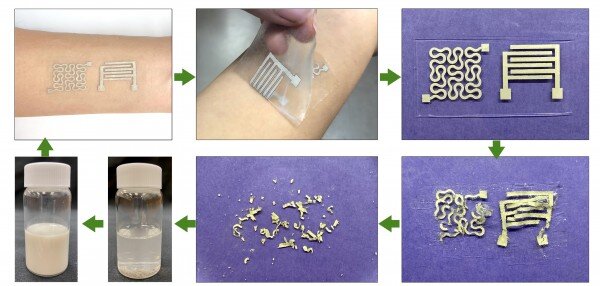
Unique Ag-Hydrogel Composite for Soft Bioelectronics created

Source: Soft Machines Lab
Stingray-inspired soft swimmer

In the field of robotics, metals offer advantages like strength, durability, and electrical conductivity. But, they are heavy and rigid – properties that are undesirable in soft and flexible systems for wearable computing and human-machine interfaces.

Hydrogels, on the other hand, are lightweight, stretchable, and biocompatible, making them excellent materials for contact lenses and tissue engineering scaffolding. They are, however, poor at conducting electricity, which is needed for digital circuits and bioelectronics applications.

Researchers in Carnegie Mellon University’s Soft Machines Lab have developed a unique silver-hydrogel composite that has high electrical conductivity and is capable of delivering direct current w...

Read More

Producing Highly Efficient LEDs based on 2D Perovskite Films

The structure and performance of 2D perovskite LEDs.
(Figure source: DOI number: 10.1038/s41467-021-21522-8 )

Energy-efficient light-emitting diodes (LEDs) have been used in our everyday life for many decades. But the quest for better LEDs, offering both lower costs and brighter colours, has recently drawn scientists to a material called perovskite. A recent joint-research project co-led by the scientist from City University of Hong Kong (CityU) has now developed a 2D perovskite material for the most efficient LEDs.

From household lighting to mobile phone displays, from pinpoint lighting needed for endoscopy procedures to light source to grow vegetables in Space, LEDs are everywhere...

Read More

Using Artificial Intelligence to generate 3D Holograms in Real-time

hologram projection

Researchers have developed a way to produce holograms almost instantly. The deep learning-based method is so efficient, it could run on a smartphone, they say.

Despite years of hype, virtual reality headsets have yet to topple TV or computer screens as the go-to devices for video viewing. One reason: VR can make users feel sick. Nausea and eyestrain can result because VR creates an illusion of 3D viewing although the user is in fact staring at a fixed-distance 2D display. The solution for better 3D visualization could lie in a 60-year-old technology remade for the digital world: holograms.

Holograms deliver an exceptional representation of 3D world around us. Plus, they’re beautiful. (Go ahead — check out the holographic dove on your Visa card...

Read More