Category Physics

Shells and Grapefruits inspire first manufactured Non-Cuttable material

It is a ‘smart material’ that has been made from ceramic spheres that are encased in a cellular aluminium structure and could be used to create new lightweight armour

Engineers have taken their inspiration from shells and grapefruits to create what they say is the first manufactured non-cuttable material.

This new material, which could be used in the security and health and safety industries, can turn back the force of a cutting tool upon itself. The lightweight material – named Proteus after the shape-changing mythical god — is made of ceramic spheres encased in a cellular aluminium structure that in tests could not be cut by angle grinders, drills or high-pressure water jets.

An international research team, led by Durham University, UK, and Fraunhofer Institute for Machine Tool...

Read More

New study reveals a Graphene Sheet behaves ‘Like a mirror’ for water molecules

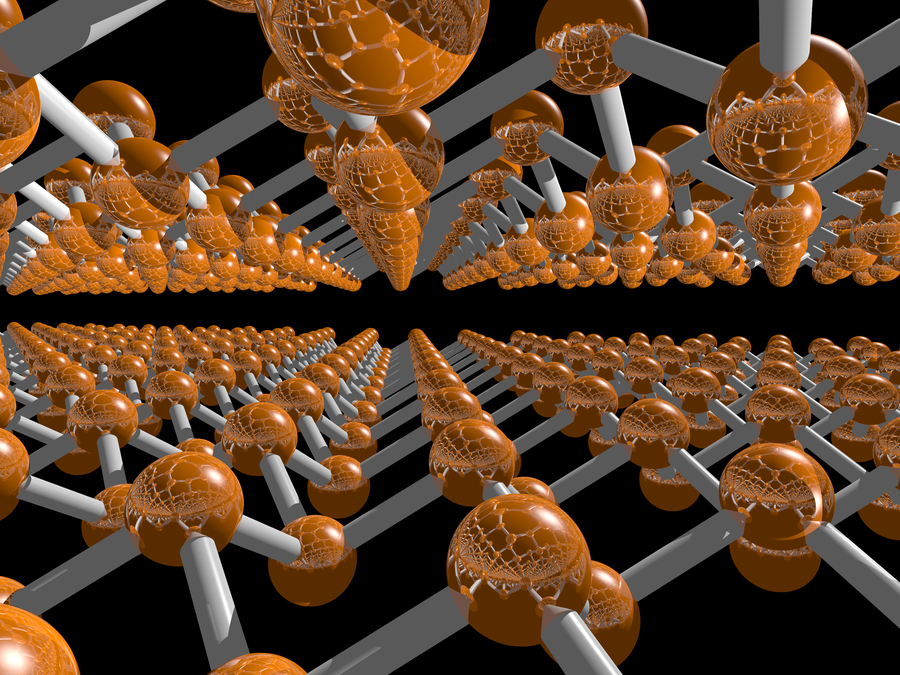
An image showing graphene water molecules on both sides of graphene. Because graphene is a conductor of electricity, water molecules on both sides of the graphene attract each other by the same charges. (Courtesy image)

A recently published study led by Virginia Commonwealth University researchers sheds new light on how water interacts with the nanomaterial graphene, a single, thin layer of carbon atoms arranged in a hexagonal honeycomb lattice.

The researchers’ findings could hold implications for a variety of applications, including sensors, fuel cell membranes, water filtration, and graphene-based electrode materials in high-performance supercapacitors.

The study, “Solvent–Solvent Correlations across Graphene: The Effect of Image Charges,” was published in the American Chemica...

Read More

New Technology Speeds up Organic Data Transfer

Credit: CC0 Public Domain

Researchers are pushing the boundaries of data speed with a brand new type of organic LED. An international research team, involving Newcastle University experts, developed a visible light communication (VLC) setup capable of a data rate of 2.2 Mb/s by employing a new type of organic light-emitting diodes (OLEDs).

To reach this speed, the scientists created new far-red/near-infrared, solution-processed OLEDs. And by extending the spectral range to 700-1000 nm, they successfully expanded the bandwidth and achieved the fastest-ever data speed for solution-based OLEDs.

Described in the journal Light Science & Applications, the new OLEDs create opportunities for new internet-of-things (IoT) connectivity, as well as wearable and implantable biosensors technol...

Read More

Tech to help Autonomous Vehicles better Scan for nearby Fast-Moving Objects

New technology uses acoustics to better control a pulse of laser light split into a frequency comb, potentially helping lidar to achieve detection of nearby high-speed objects. (WoogieWorks graphic/Alex Mehler)

Mechanical control and modulation of light on a silicon chip could enhance lidar. Researchers have built a way that lidar could achieve higher-resolution detection of nearby fast-moving objects through mechanical control and modulation of light on a silicon chip.

A self-driving car has a hard time recognizing the difference between a toddler and a brown bag that suddenly appears into view because of limitations in how it senses objects using lidar.

The autonomous vehicle industry is exploring “frequency modulated continuous wave” (FMCW) lidar to solve this problem...

Read More