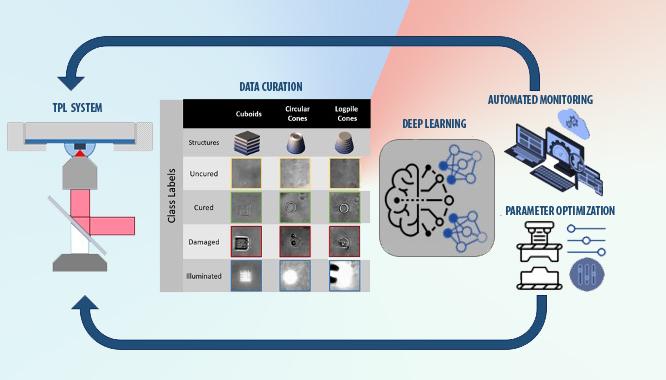
Lawrence Livermore National Laboratory scientists and collaborators are using machine learning to address two key barriers to industrialization of two-photon lithography (TPL): monitoring of part quality during printing and determining the right light dosage for a given material. The team developed a machine learning algorithm trained on thousands of video images of TPL builds to identify the optimal parameters for settings such as exposure and laser intensity and to automatically detect part quality at high accuracy.
Two-photon lithography (TPL)—a widely used 3-D nanoprinting technique that uses laser light to create 3-D objects—has shown promise in research applications but has yet to achieve widespread industry acceptance due to limitations on large-scale part production and time-in...
A new generation of micro-robotics inside Evgueni Filipov’s lab at the G.G. Brown Building on North Campus, Ann Arbor Mi. on June 17, 2020. Image credit: Robert Coelius/University of Michigan Engineering, Communications & Marketing
Engineers create centimeter-sized robots capable of more than ever before. Origami principles can unlock the potential of the smallest robots, enhancing speed, agility and control in machines no more than a centimeter in size.
University of Michigan researchers have demonstrated that behavioral rules underpinning the Japanese art of folding can expand the capabilities of these machines, creating potential for greater use in fields as diverse as medical equipment and infrastructure sensing.
“We’ve come up with a new way to design, fabricate and actuat...
Thermoconductive, Moisture-Permeable, and Superhydrophobic Nanofibrous Membranes with Interpenetrated Boron Nitride Network for Personal Cooling Fabrics
Air conditioning and other space cooling methods account for about 10% of all electricity consumption in the U.S., according to the U.S. Energy Information Administration. Now, researchers reporting in ACS Applied Materials & Interfaces have developed a material that cools the wearer without using any electricity. The fabric transfers heat, allows moisture to evaporate from the skin and repels water.
Cooling off a person’s body is much more efficient than cooling an entire room or building...
Study of bacterium links biology, materials science, and electrical engineering. When the Shewanella oneidensis bacterium “breathes” in certain metal and sulfur compounds anaerobically, it produces materials that could be used to enhance electronics, electrochemical energy storage, and drug-delivery devices.
The ability of this bacterium to produce molybdenum disulfide – a material that is able to transfer electrons easily, like graphene – is the focus of research published in Biointerphases by a team of engineers from Rensselaer Polytechnic Institute.
“This has some serious potential if we can understand this process and control aspects of how the bacteria are making these and other materials,” said Shayla Sawyer, an associate professor of electrical, computer, and systems ...






Recent Comments