Category Physics

Researchers build a Particle Accelerator that fits on a Chip, miniaturizing a technology that can now find new applications in research and medicine

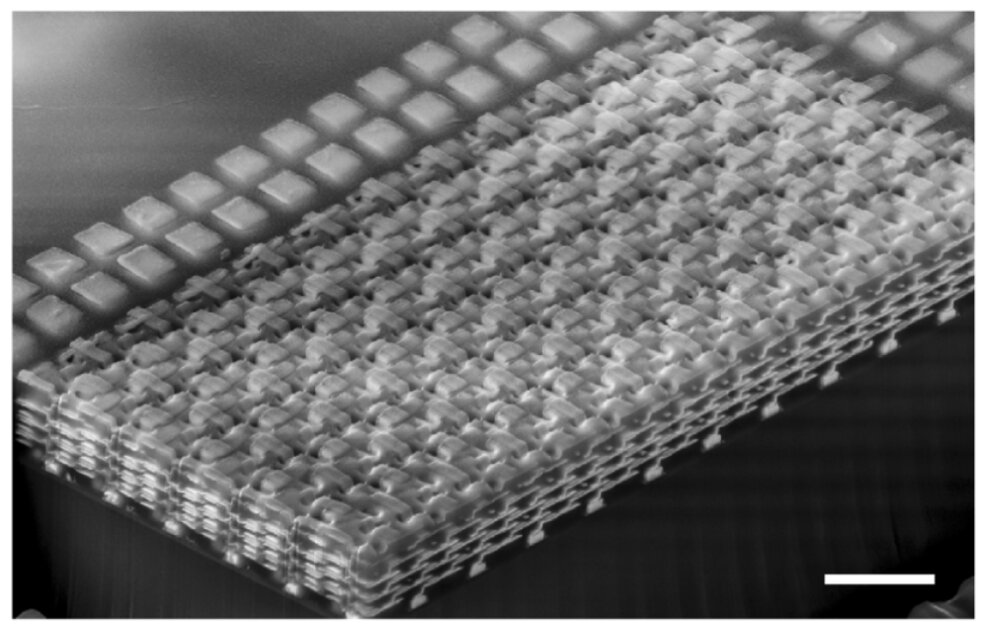
This image, magnified 25,000 times, shows a section of an accelerator-on-a-chip. The gray structures focus infrared laser light (shown in yellow and purple) on electrons flowing through the center channel. By packing 1,000 channels onto an inch-sized chip, Stanford researchers hope to accelerate electrons to 94 percent of the speed of light. (Image credit: Courtesy Neil Sapra

On a hillside above Stanford University, the SLAC National Accelerator Laboratory operates a scientific instrument nearly 2 miles long...

Read More

In leap for Quantum Computing, Silicon quantum Bits establish a Long-distance Relationship

silicon-spin quantum bit
The team showed that a silicon-spin quantum bit (shown in the box) can communicate with another quantum bit located a significant distance away on a computer chip. The feat could enable connections between multiple quantum bits to perform complex calculations.
Image by Felix Borjans

In an important step forward in the quest to build a quantum computer using silicon-based hardware, researchers have succeeded in making possible the exchange of information between two qubits located relatively far apart – about the length of a grain of rice, which is a considerable distance on a computer chip. Connecting two silicon qubits across this distance makes possible new and more complex silicon-based quantum computer circuits.

Imagine a world where people could only talk to their next-door ne...

Read More

Paving the way for Spintronic RAMs: A deeper look into a powerful spin phenomenon

Figure 1. An extremely simple MRAM
An extremely simple MRAM

The proposed combination of materials serves as a memory unit by supporting read and write operations. The spin injection by the topological insulator (TI) material reverses the magnetization of the ferromagnetic (FM) material, representing the “write” operation. Furthermore, the spin injection can also change the overall resistance of the materials, which can be sensed through an external circuit, representing the “read” operation.

Scientists at Tokyo Institute of Technology (Tokyo Tech) explore a new material combination that sets the stage for magnetic random access memories, which rely on spin – an intrinsic property of electrons – and could outperform current storage devices...

Read More

Device Splits and Recombines Superconducting Electron Pairs

image of  Josephson junction
A Josephson junction can split and recombine Cooper pairs of electrons as they travel through two nanowires.

A device that can separate and recombine pairs of electrons may offer a way to study an unusual form of superconductivity, according to RIKEN physicists. This superconducting state would involve exotic particles, Majorana fermions that could prove useful in developing quantum computers.

In conventional superconductors, electrical current flows with no resistance due to electrons teaming up to make ‘Cooper pairs’. A superconductor touching a normal conductor can sometimes induce superconductivity in that conductor through Cooper pairs from the superconductor penetrating the normal conductor.

Now, Sadashige Matsuo of the RIKEN Center for Emergent Matter Science and collea...

Read More