Category Physics

Search for New Semiconductors Heats up with Gallium Oxide

An artist rendering of the MacEtch-produced fin array structures in a beta-gallium oxide semiconductor substrate from professor Xiuling Li’s latest project.
Image courtesy ACS Nano

University of Illinois electrical engineers have cleared another hurdle in high-power semiconductor fabrication by adding the field’s hottest material – beta-gallium oxide – to their arsenal. Beta-gallium oxide is readily available and promises to convert power faster and more efficiently than today’s leading semiconductor materials – gallium nitride and silicon, the researchers said. Their findings are published in the journal ACS Nano.

Flat transistors have become about as small as is physically possible, but researchers addressed this problem by going vertical...

Read More

Breakthrough Material could lead to Cheaper, more Widespread Solar Panels and Electronics

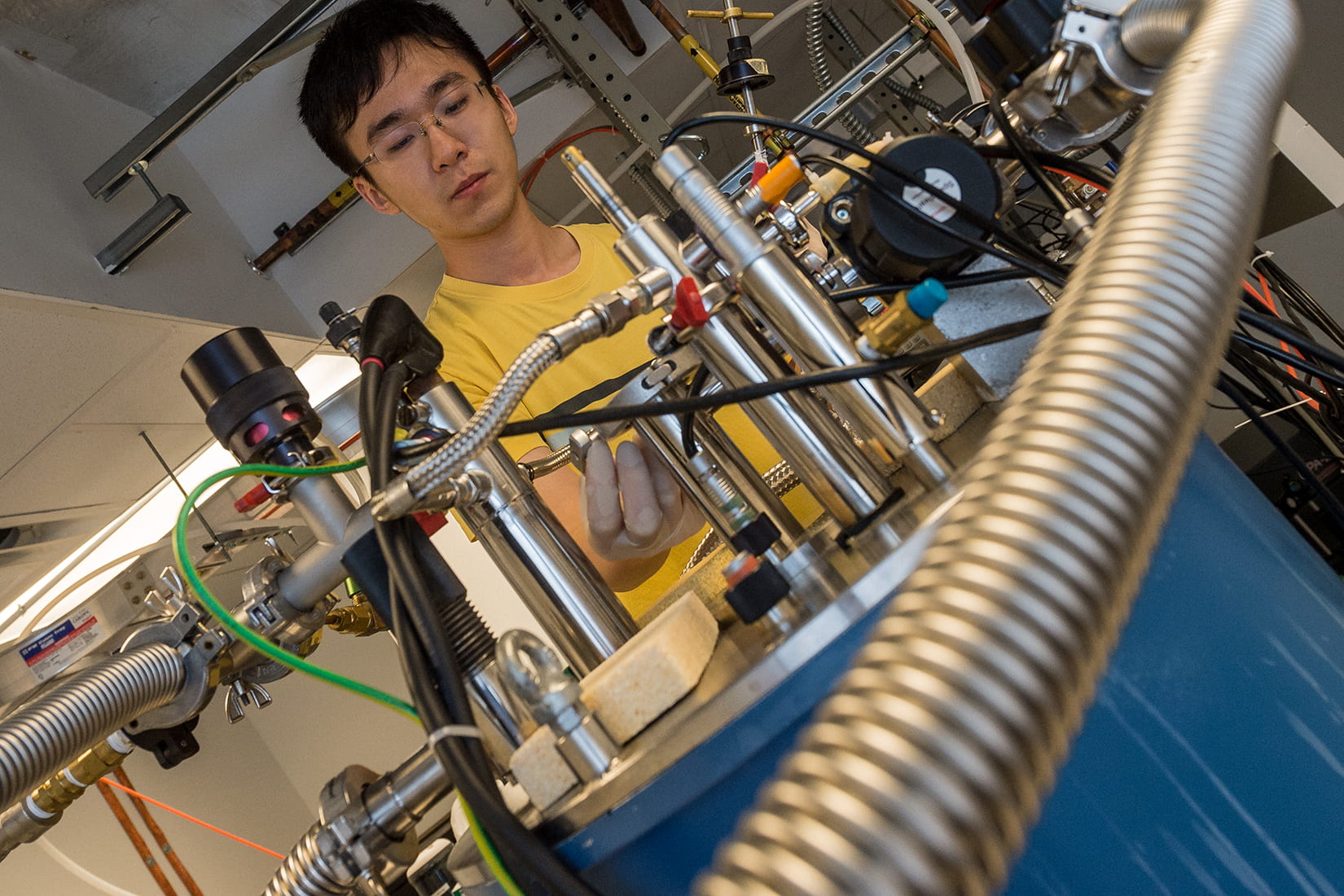
Photo: Graduate student Tika Kafle (facing camera) works on the time-resolved photoemission spectroscopy setup. Credit: Cody Howard/University of Kansas.

Physics research groups have generated free electrons from organic semiconductors when combined with a single atomic layer of molybdenum disulfide, a recently discovered 2D semiconductor.

Imagine printing electronic devices using a simple inkjet printer – or even painting a solar panel onto the wall of a building. Such technology would slash the cost of manufacturing electronic devices and enable new ways to integrate them into our everyday lives. Over the last two decades, a type of material called organic semiconductors, made out of molecules or polymers, has been developed for such purposes...

Read More

Researchers build Transistor-like Gate for Quantum Information processing – with Qudits

A two-qudit gate, among the first of its kind, maximizes the entanglement of photons so that quantum information can be manipulated more predictably and reliably. (Purdue University image/Allison Rice)

Two-qudit gate on a photonic platform achieves massive entangled quantum state. Researchers have built what could be a quantum version of a transistor – with qudits.

Quantum information processing promises to be much faster and more secure than what today’s supercomputers can achieve, but doesn’t exist yet because its building blocks, qubits, are notoriously unstable.

Purdue University researchers are among the first to build a gate – what could be a quantum version of a transistor, used in today’s computers for processing information – with qudits...

Read More

Robot-ants that can Jump, Communicate with each other and work together

Some tribots and one of them jumping © Zhenishbek Zhakypov / 2019 EPFL
Designing minimal and scalable insect-inspired multi-locomotion millirobotsNature, 2019; DOI: 10.1038/s41586-019-1388-8

A team of researchers has developed tiny 10-gram robots that are inspired by ants: they can communicate with each other, assign roles among themselves and complete complex tasks together. These reconfigurable robots are simple in structure, yet they can jump and crawl to explore uneven surfaces. Individually, ants have only so much strength and intelligence. However, as a colony, they can use complex strategies to complete sophisticated tasks and evade larger predators.

At EPFL, robotics researchers in Professor Jamie Paik’s Laboratory have reproduced this phenomenon, developing tiny robots that display minimal physical intelligence on an individual level but t...

Read More