


- Helping others linked to younger-looking adult brains, even after accounting for health and lifestyle
- Undergraduate student may have solved puzzle regarding isolated galaxies that have stopped producing stars
- Levitating glass sphere becomes entangled with light at room temperature
- Alcohol in space: Exotic methanol discovered in planet-building zones
Category Physics
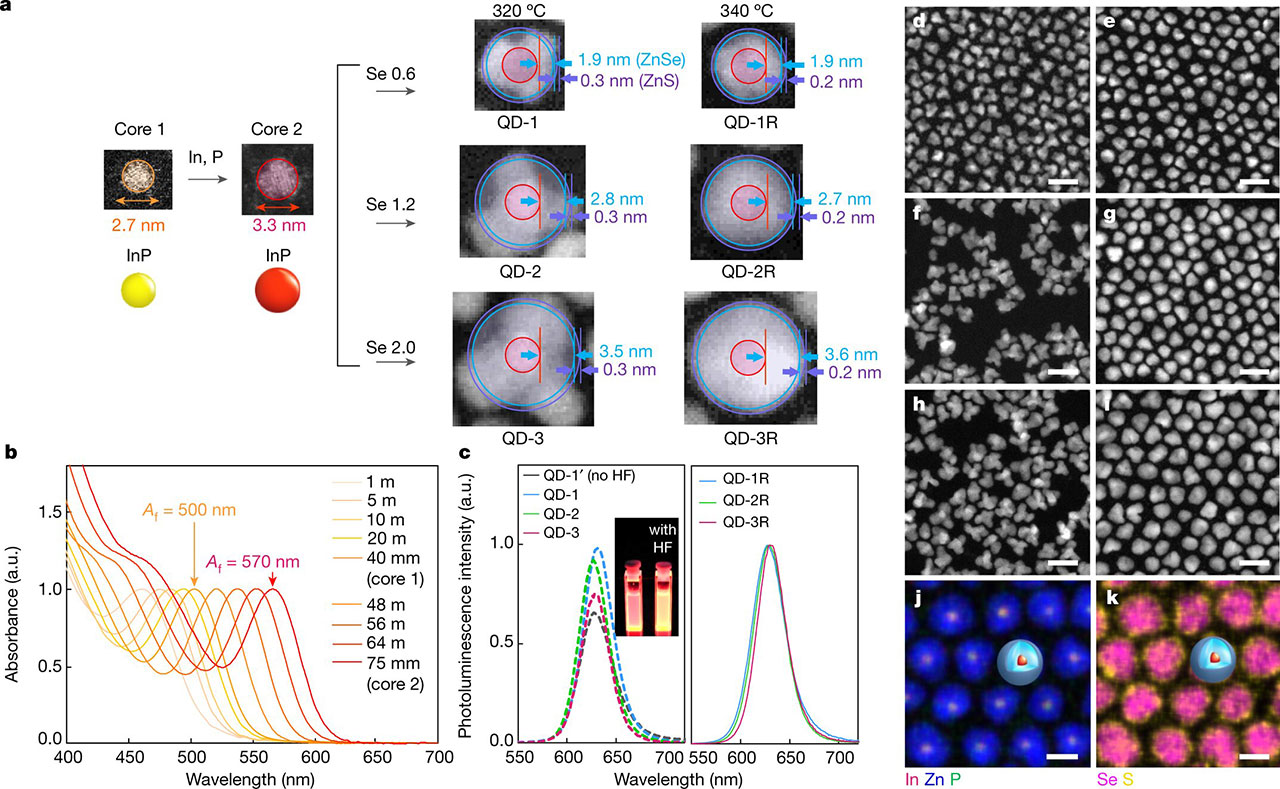
More efficient Quantum Dots without Heavy Metals
December 2, 2019,
 Physics, Technology/Electronics
First-of-a-kind Electro-Optical Device provides solution to faster and more energy efficient Computing Memories and processors
December 2, 2019,
Physics, Technology/Electronics

The first ever integrated nanoscale device which can be programmed with either photons or electrons has been developed by scientists in Harish Bhaskaran’s Advanced Nanoscale Engineering research group at the University of Oxford.
In collaboration with researchers at the universities of Münster and Exeter, scientists have created a first-of-a-kind electro-optical device which bridges the fields of optical and electronic computing. This provides an elegant solution to achieving faster and more energy efficient memories and processors.
Computing at the speed of light has been an enticing but elusive prospect, but with this development it’s now in tangible pro...
Read MoreMolecular Eraser enables better Data Storage and Computers for AI
December 2, 2019,
Physics, Technology/Electronics

Scientists have added a crucial tool to the atomic-scale manufacturing toolkit with major implications for today’s data driven—carbon intensive—world, according to new research from the University of Alberta in Canada.
“Computers today are contributing one gigatonne of carbon emissions to the atmosphere, and we can eliminate that by enhancing the most power-hungry parts of conventional computers with our atomic-scale circuitry,” said Robert Wolkow, professor in the University of Alberta’s Department of Physics a Principal Research Officer at the National Research Council of Canada’s Nanotechnology Research Centre, and chief technical officer of Quantum Silicon Inc, a...
Read MorePsychosensory Electronic Skin Technology for Future and Humanoid development
August 30, 2019,
Physics, Technology/Electronics, Health/Medical, Biology/Biotechnology

Scientists have developed electronic skin technology for robots or electronic devices to feel pain through sense of touch. Expected to be applied in humanoid that needs 5 human senses and patients wearing prosthetic hands.
The attempt to mimic human’s five senses led to the development of innovative electronic devices such as camera and TV, which are inventions that dramatically changed human life. As a result, many scientists are continuously performing research to imitate tactile, olfactory, and palate senses and tactile sensing is expected to be the next mimetic technology for various reasons...
Read More
Recent Comments