A microscopic image of multiple electrodes on a sheet of Weyl semimetal, with red and blue arrows depicting the circular movement of the light-induced electrical current by either left- (blue) or right-circularly polarized light (right). (Photo: Zhurun Ji)
A new study found that Weyl semimetals, a class of quantum materials, have bulk quantum states whose electrical properties can be controlled using light. Insights from quantum physics have allowed engineers to incorporate components used in circuit boards, optical fibers, and control systems in new applications ranging from smartphones to advanced microprocessors...
The system helps cool its surroundings by absorbing heat from the air inside the box and transmitting that energy through the Earth’s atmosphere into outer space. Credit: University at Buffalo.
Engineers have designed a new system that can help cool buildings in crowded metropolitan areas without consuming electricity, an important innovation at a time when cities are working to adapt to climate change.
The system consists of a special material – an inexpensive polymer/aluminum film – that’s installed inside a box at the bottom of a specially designed solar “shelter.” The film helps to keep its surroundings cool by absorbing heat from the air inside the box and transmitting that energy through the Earth’s atmosphere into outer space...
Weight-bearing, slope-climbing, and load-carrying capabilities.(A to C) Soft robot can continue to function (one-half of the original speed) after being stepped on by an adult human (59.5 kg), a load about 1 million times its own body weight. Scale bars, 3 cm. A robot climbs a slope (D) of 7.5° with a relative speed of 7 BL/s and a slope (E) of 15.6° with a relative speed of 1 BL/s. Scale bars, 1 cm. (F and G) A robot (0.064 g) carries a peanut (0.406 g), which is six times its own body weight, to show the load-carrying capability. The speed with the peanut on top is about one-six of the original speed without the peanut. Scale bars, 1 cm.
Insect-sized device scurries at the speed of a cockroach and can withstand the weight of a human...
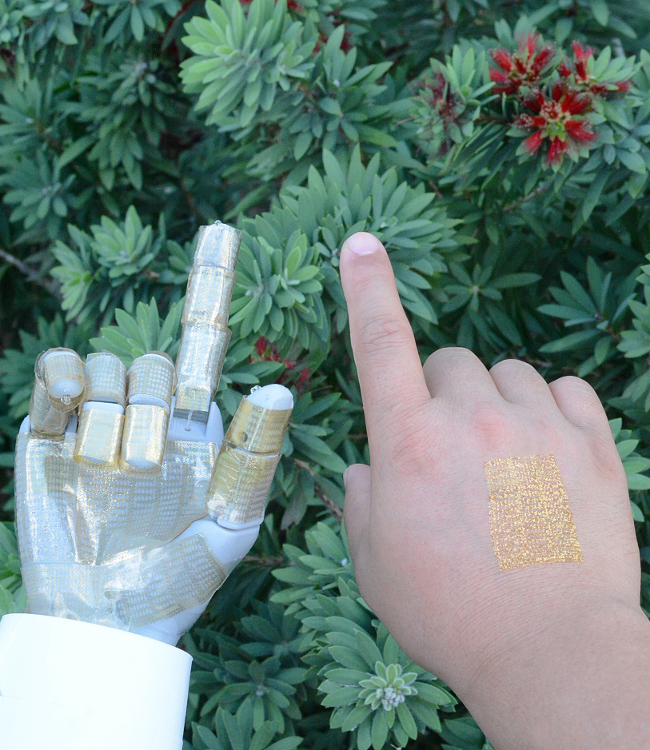
Cunjiang Yu, Bill D. Cook Associate Professor of Mechanical Engineering at UH, led a project to develop a multifunctional, ultra-thin wearable human-machine interface.
Device also can serve as robotic skin, relaying information back to the user. Wearable human-machine interfaces – devices that can collect and store important health information about the wearer, among other uses – have benefited from advances in electronics, materials and mechanical designs. But current models still can be bulky and uncomfortable, and they can’t always handle multiple functions at one time.
Researchers reported Friday, Aug. 2, the discovery of a multifunctional ultra-thin wearable electronic device that is imperceptible to the wearer.
The device allows the wearer to move naturally and is less no...





Recent Comments