

Credit: S. Kelley/NIST
Nanopillars shape light precisely for practical applications...
Read More

May 5, 2019,
 Physics, Technology/Electronics
Nanopillars shape light precisely for practical applications...
Read More
May 5, 2019,
Physics, Technology/Electronics

For emerging wearable tech to advance, it needs improved power sources. Now researchers from Michigan State University have provided a potential solution via crumpled carbon nanotube forests, or CNT forests.
Changyong Cao, director of MSU’s Soft Machines and Electronics Laboratory, led a team of scientists in creating highly stretchable supercapacitors for powering wearable electronics...
Read More
May 1, 2019,
Physics, Technology/Electronics, Chemistry/Nanotechnology
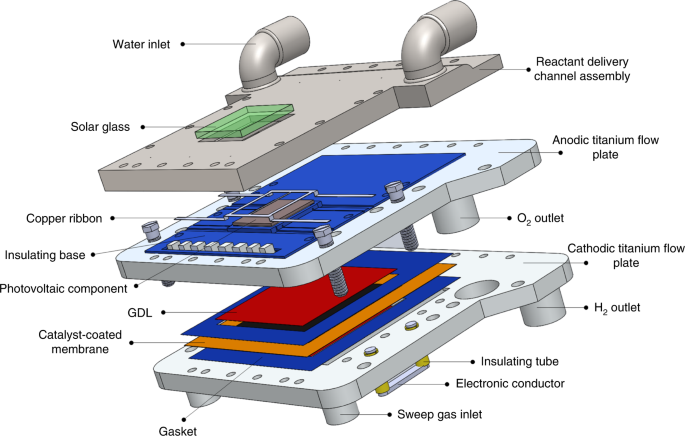
Researchers have created a smart device capable of producing large amounts of clean hydrogen. By concentrating sunlight, their device uses a smaller amount of the rare, costly materials that are required to produce hydrogen, yet it still maintains a high solar-to-fuel efficiency. Their research has been taken to the next scale with a pilot facility installed on the EPFL campus.
Scientists at EPFL’s Laboratory of Renewable Energy Science and Engineering (LRESE) came up with the idea of concentrating solar irradiation to produce a larger amount of hydrogen over a given area at a lower cost...
Read More
April 28, 2019,
Physics, Technology/Electronics

Scientists have further explored a new effect that enhances their ability to control the direction of electron spin in certain materials. Their discovery may lead to more powerful and energy-efficient materials for information storage.
Sometimes scientific discoveries can be found along well-trodden paths. That proved the case for a cobalt-iron alloy material commonly found in hard disk drives. As reported in a recent issue of Physical Review Letters, researchers from the U.S...
Read More
Recent Comments