
Category Physics

Breakthrough Opens Door to Smartphone-Powered $100 Ultrasound machine

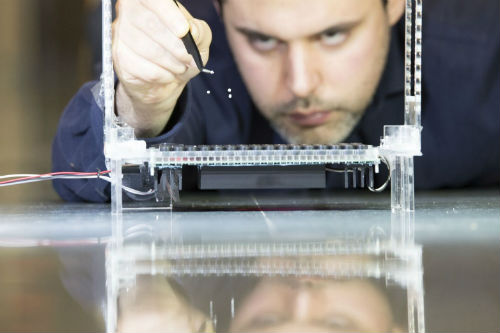
UBC researcher Carlos Gerardo shows new ultrasound transducer Credit: Clare Kiernan, University of British Columbia

UBC researcher Carlos Gerardo shows new ultrasound transducer
Credit: Clare Kiernan, University of British Columbia

Engineers at the University of British Columbia have developed a new ultrasound transducer, or probe, that could dramatically lower the cost of ultrasound scanners to as little as $100. Their patent-pending innovation – no bigger than a Band-Aid – is portable, wearable and can be powered by a smartphone.

Conventional ultrasound scanners use piezoelectric crystals to create images of the inside of the body and send them to a computer to create sonograms. Researchers replaced the piezoelectric crystals with tiny vibrating drums made of polymer resin, called polyCMUTs (polymer capacitive micro-machined ultrasound transducers), which are cheaper to manufacture.

“Transducer drums h...

Read More

Novel Nano Material for Quantum Electronics

Formation of the layered conductive magnet CrCl2(pyrazine)2 through redox-active coordination chemistry. Nature Chemistry, 2018; DOI: 10.1038/s41557-018-0107-7

Formation of the layered conductive magnet CrCl2(pyrazine)2 through redox-active coordination chemistry. Nature Chemistry, 2018; DOI: 10.1038/s41557-018-0107-7

An international team led by Assistant Professor Kasper Steen Pedersen, DTU Chemistry, has synthesized a novel nano material with electrical and magnetic properties making it suitable for future quantum computers and other applications in electronics.

Chromium-Chloride-Pyrazine (chemical formula CrCl2(pyrazine)2) is a layered material, which is a precursor for a so-called 2D material. In principle, a 2D material has a thickness of just a single molecule and this often leads to properties very different from those of the same material in a normal 3D version. Not least will the electrical properties differ...

Read More

Researchers Resolve a Major Mystery in 2D Material Electronics

Schematic drawing of a 2D-material-based lateral (left) and vertical (right) Schottky diode. For broad classes of 2D materials, the current-temperature relation can be universally described by a scaling exponent of 3/2 and 1, respectively, for lateral and vertical Schottky diodes. Credit: Singapore University of Technology and Design

Schematic drawing of a 2D-material-based lateral (left) and vertical (right) Schottky diode. For broad classes of 2D materials, the current-temperature relation can be universally described by a scaling exponent of 3/2 and 1, respectively, for lateral and vertical Schottky diodes.
Credit: Singapore University of Technology and Design

A one-size-fits-all master equation shall pave the way towards better design of 2D material electronics. Schottky diode is composed of a metal in contact with a semiconductor. Despite its simple construction, Schottky diode is a tremendously useful component and is omnipresent in modern electronics...

Read More

Holography, Light-field technology combo could deliver practical 3D displays

Figure 1a) A fabricated DDHOE lens array; 1b) The 3-D display system consisting of a 2-D projector and DDHOE; 1c) A computer-modeled 3-D scene of depth 6 cm; 1d) A 3-D reconstruction of a modeled scene captured by camera looking into the DDHOE. Credit: Boaz Jessie Jackin.

Figure 1a) A fabricated DDHOE lens array; 1b) The 3-D display system consisting of a 2-D projector and DDHOE; 1c) A computer-modeled 3-D scene of depth 6 cm; 1d) A 3-D reconstruction of a modeled scene captured by camera looking into the DDHOE. Credit: Boaz Jessie Jackin.

New approach would eliminate visual disturbances without additional bulky optics. While most interaction with digital content is still constrained to keyboards and 2D touch panels, augmented and virtually reality (AR/VR) technologies promise ever more freedom from these limitations.

AR/VR devices can have their own drawbacks, such as a tendency to induce visual motion sickness or other visual disturbances with prolonged usage due to their stereoscopy or auto-stereoscopy based designs...

Read More