
Category Physics

New Battery is Activated by your Spit

A Papertronic, On-Demand and Disposable Biobattery: Saliva-Activated Electricity Generation from Lyophilized Exoelectrogens Preinoculated on Paper. Advanced Materials Technologies, 2017; 1700127 DOI: 10.1002/admt.201700127

A Papertronic, On-Demand and Disposable Biobattery: Saliva-Activated Electricity Generation from Lyophilized Exoelectrogens Preinoculated on Paper. Advanced Materials Technologies, 2017; 1700127 DOI: 10.1002/admt.201700127

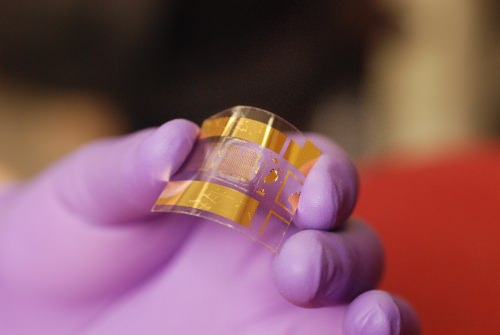
Researchers have developed the next step in microbial fuel cells (MFCs): a battery activated by spit that can be used in extreme conditions where normal batteries don’t function. Researchers at Binghamton University, State University of New York have developed the next step in microbial fuel cells (MFCs): a battery activated by spit that can be used in extreme conditions where normal batteries don’t function.

For the last 5 years, Binghamton University Electrical and Computer Science Assistant Professor Seokheun Choi has focused on developing micro-power sources for the ...

Read More

Tiny Terahertz Laser could be used for Imaging, Chemical detection

Tiny terahertz laser could be used for imaging, chemical detection

Tiny terahertz laser could be used for imaging, chemical detection A new technique boosts the power output of tiny, chip-mounted terahertz lasers by 88 percent. Credit: Demin Liu/Molgraphics

Terahertz radiation—the band of the electromagnetic spectrum between microwaves and visible light—has promising applications in medical and industrial imaging and chemical detection, among other uses. But many of those applications depend on small, power-efficient sources of terahertz rays, and the standard method for producing them involves a bulky, power-hungry, tabletop device. For over 20 years, Prof. Qing Hu at MIT, and his group have been working on sources of terahertz radiation that can be etched onto microchips...

Read More

New CubeSat Propulsion System uses Water as Propellant

Purdue University graduate student Katherine Fowee and postdoctoral research associate Anthony Cofer work on a new micropropulsion system for miniature satellites called CubeSats. Credit: Purdue University photo/Erin Easterling

Purdue University graduate student Katherine Fowee and postdoctoral research associate Anthony Cofer work on a new micropropulsion system for miniature satellites called CubeSats. Credit: Purdue University photo/Erin Easterling

A new type of micropropulsion system for miniature satellites called CubeSats uses an innovative design of tiny nozzles that release precise bursts of water vapor to maneuver the spacecraft. Low-cost “microsatellites” and “nanosatellites” far smaller than conventional spacecraft, have become increasingly prevalent. Thousands of the miniature satellites might be launched to perform a variety of tasks, from high-resolution imaging and internet services, to disaster response, environmental monitoring and military surveillance...

Read More

From Greenhouse Gas to 3D Surface-Microporous Graphene

The folds of 3-D graphene make mesopore channels that work with the surface's micropores to increase the material's supercapacitive properties.

The folds of 3-D graphene make mesopore channels that work with the surface’s micropores to increase the material’s supercapacitive properties.

Tiny dents in the surface of graphene greatly enhances its potential as a supercapacitor. Even better, it can be made from CO2. A material scientist at Michigan Technological University invented a novel approach to take carbon dioxide and turn it into 3D graphene with micropores across its surface. The conversion of carbon dioxide to useful materials usually requires high energy input due to its ultrahigh stability. However, materials science professor Yun Hang Hu and his research team created a heat-releasing reaction between carbon dioxide and sodium to synthesize 3D surface-microporous graphene.

“3D surface-microporous graphene is a brand-new ma...

Read More