
Category Physics

Quantum Thermometer or Optical Refrigerator?

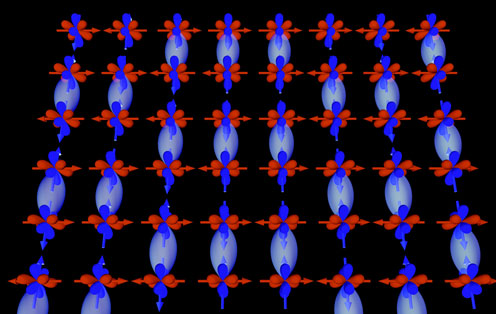
Artist's rendition of a quantum thermometer, a micron-scale mechanical device that can provide highly accurate temperature. Credit: Emily Edwards/Joint Quantum Institute

Artist’s rendition of a quantum thermometer, a micron-scale mechanical device that can provide highly accurate temperature. Credit: Emily Edwards/Joint Quantum Institute

Versatile optomechanical beams have potential applications in biology, chemistry, electronics. In an arranged marriage of optics and mechanics, physicists have created microscopic structural beams that have a variety of powerful uses when light strikes them. Able to operate in ordinary, room-temperature environments, yet exploiting some of the deepest principles of quantum physics, these optomechanical systems can act as inherently accurate thermometers, or conversely, as a type of optical shield that diverts heat.

The potential applications include chip-based temperature sensors for electronics and biology that would neve...

Read More

Chemical Solution to Shrink Digital Data Storage

CWRU chemists developed a space-saving method to store digital data optically, using four-symbol, or quaternary code. The four symbols are the absence of color and three colors -- fluorescent green, ultramarine and cyan -- produced when dyes contained in a common polymer are exposed to heat, ultraviolet light or both. Credit: Emily Pentzer

CWRU chemists developed a space-saving method to store digital data optically, using four-symbol, or quaternary code. The four symbols are the absence of color and three colors — fluorescent green, ultramarine and cyan — produced when dyes contained in a common polymer are exposed to heat, ultraviolet light or both. Credit: Emily Pentzer

Chemists at Case Western Reserve University have found a way to possibly store digital data in half the space current systems require. From supercomputers to smartphones, the amount of data people generate and collect continues to grow exponentially, and the need to store all that information grows with it. To reduce storage space, engineers have traditionally used existing technology but made it smaller...

Read More

Plant Inspiration could lead to Flexible Electronics

Biomimetic Architectured Graphene Aerogel with Exceptional Strength and Resilience

Biomimetic Architectured Graphene Aerogel with Exceptional Strength and Resilience

Versatile, light-weight materials that are both strong and resilient are crucial for the development of flexible electronics, such as bendable tablets and wearable sensors. Aerogels are good candidates for such applications, but until now, it’s been difficult to make them with both properties. Now, researchers report in ACS Nano that mimicking the structure of the “powdery alligator-flag” plant has enabled them to make a graphene-based aerogel that meets these needs.

Aerogels are light, porous materials that are already used in many applications, such as pollution control and insulation...

Read More

Return to the Fold for Super-Strong Structures

Return to the fold for super-strong structures

An origami pattern known as the Miura fold can help dissipate energy inside explosive-proof structural panels. Credit: Swinburne University of Technology

Lightweight structural panels that can stop bullets or withstand bombs are the goal of a team of researchers working at Swinburne. A team led by Professor Guoxing Lu from Swinburne’s School of Engineering has put a modern twist on this ancient science by replacing solid metal panels with super-tough and light aluminium ‘sandwich’ structures inspired by Japanese origami patterns. A typical sandwich panel inserts a soft, semi-hollow inner core between 2 thin and strong outer skins. Spacing the skins a small distance apart makes the panels much stiffer than the sheet would otherwise be while dramatically decreasing overall bulk...

Read More