Category Physics

Ultrashort Light Pulses for Fast ‘Lightwave’ Computers

A semiconductor crystal has shown an unprecedented capacity to shape ultrashort laser pulses. Credit: Fabian Langer, Regensburg University

A semiconductor crystal has shown an unprecedented capacity to shape ultrashort laser pulses. Credit: Fabian Langer, Regensburg University

Extremely short, configurable “femtosecond” pulses of light demonstrated by an international team could lead to future computers that run up to 100,000 times faster than today’s electronics. The researchers, including engineers at the University of Michigan, showed that they could control the peaks within the laser pulses and also twist the light. The method moves electrons faster and more efficiently than electrical currents – and with reliable effects on their quantum states. It is a step toward so-called “lightwave electronics” and, in the more distant future, quantum computing, said U-M professor Mackillo Kira.

Electrons moving through a semiconduct...

Read More

2 Radio Signals, 1 Chip, open a new World for Wireless Communication

Al Molnar, holding a test board with the two-way transceiver chip mounted in the center, is shown with graduate student Hazal Yüksel in Molnar's lab. Yüksel is co-lead author of the latest paper from the Molnar lab, published earlier this year in the Journal of Solid-State Circuits. Credit: Cornell University

Al Molnar, holding a test board with the two-way transceiver chip mounted in the center, is shown with graduate student Hazal Yüksel in Molnar’s lab. Yüksel is co-lead author of the latest paper from the Molnar lab, published earlier this year in the Journal of Solid-State Circuits. Credit: Cornell University

Cornell engineers have devised a method for transmitting and receiving radio signals on a single chip, which could ultimately help change the way wireless communication is done. Separating the send and receive bands is difficult enough, but the problem is compounded by the ever-increasing number of bands in the latest devices, which handle everything wireless technology has to offer...

Read More

Perovskite Edges can be tuned for Optoelectronic Performance Layered 2D material improves efficiency for Solar cells & LEDs

Scientists at Los Alamos National Laboratory and their research partners are creating innovative 2-D layered hybrid perovskites that allow greater freedom in designing and fabricating efficient optoelectronic devices. Credit: Los Alamos National Laboratory

Scientists at Los Alamos National Laboratory and their research partners are creating innovative 2-D layered hybrid perovskites that allow greater freedom in designing and fabricating efficient optoelectronic devices. Credit: Los Alamos National Laboratory

In the eternal search for next generation high-efficiency solar cells and LEDs, scientists at Los Alamos National Laboratory and their partners are creating innovative 2D layered hybrid perovskites that allow greater freedom in designing and fabricating efficient optoelectronic devices...

Read More

Single Atom Memory: The World’s Smallest Storage Medium

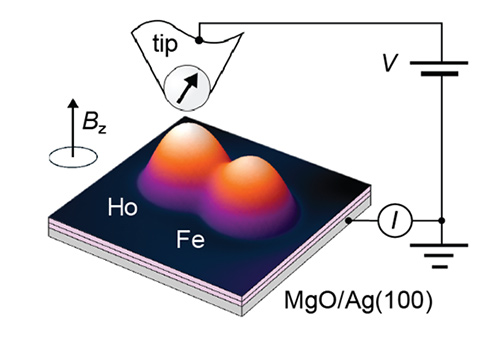
 A holmium (Ho) and a iron (Fe) atom placed on a MgO substrate are the components for the world's smallest memory device. Ho is used as a storage medium and Fe as a sensor were. The magnetism of the holmium atom can be changed or read by flowing current through the STM tip.

A holmium (Ho) and a iron (Fe) atom placed on a MgO substrate are the components for the world’s smallest memory device. Ho is used as a storage medium and Fe as a sensor were. The magnetism of the holmium atom can be changed or read by flowing current through the STM tip.

Storing 1 bit in 1 atom is possible: The extraordinary end of Moore’s law. One bit of digital information can now be successfully stored in an individual atom, according to a study just published in Nature. Current commercially-available magnetic memory devices require approximately 1 million atoms to do the same...

Read More