Category Physics

DNA Origami lights up a Microscopic Glowing Van Gogh

This reproduction of The Starry Night contains 65,536 glowing pixels and is just the width of a dime across. Credit: Paul Rothemund and Ashwin Gopinath/Caltech

This reproduction of The Starry Night contains 65,536 glowing pixels and is just the width of a dime across. Credit: Paul Rothemund and Ashwin Gopinath/Caltech

A hurdle for large-scale integration of molecular devices on chips has been removed by a technique that allows humanmade DNA shapes to be placed wherever desired, to within a margin of error of just 20nm. Using folded DNA to precisely place glowing molecules within microscopic light resonators, researchers at Caltech have created one of the world’s smallest reproductions of Vincent van Gogh’s The Starry Night...

Read More

Engineered ‘Sand’ may help Cool Electronic Devices

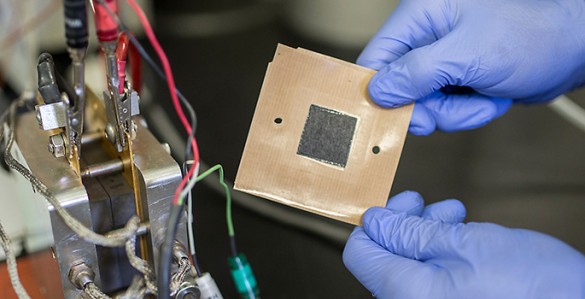
A thermal probe tests heat conductance in a sample of silicon dioxide nanoparticles. The material could potentially conduct heat at an efficiency higher than that of conventional materials. Credit: Rob Felt, Georgia Tech

A thermal probe tests heat conductance in a sample of silicon dioxide nanoparticles. The material could potentially conduct heat at an efficiency higher than that of conventional materials. Credit: Rob Felt, Georgia Tech

Not beach sand, but silicon dioxide nanoparticles coated with a high dielectric constant polymer can inexpensively provide improved cooling for increasingly power-hungry electronic devices. The silicon dioxide doesn’t do the cooling itself. Instead, the unique surface properties of the coated nanoscale material conduct the heat at potentially higher efficiency than existing heat sink materials. The theoretical physics is complicated, involving nanoscale electromagnetic effects created on the surface of the tiny silicon dioxide particles acting together.

The bottom line cou...

Read More

Germs add Ripples to make ‘Groovy’ Graphene

This is an atomic force microscopy image of a graphene sheet draped over a Bacillus bacterium (left). The bacterium is about 1 micron or 1/25,000 of an inch wide. After applying vacuum and heat treatment, regular wrinkles form in the graphene (right, at twice the magnification). Credit: UNIVERSITY OF ILLINOIS AT CHICAGO/Vikas Berry

This is an atomic force microscopy image of a graphene sheet draped over a Bacillus bacterium (left). The bacterium is about 1 micron or 1/25,000 of an inch wide. After applying vacuum and heat treatment, regular wrinkles form in the graphene (right, at twice the magnification). Credit: UNIVERSITY OF ILLINOIS AT CHICAGO/Vikas Berry

New nanomaterial conducts differently at right angles. Now University of Illinois at Chicago researchers have used rod-shaped bacteria – precisely aligned in an electric field, then vacuum-shrunk under a graphene sheet – to introduce nanoscale ripples in the material, causing it to conduct electrons differently in perpendicular directions...

Read More

Watch out, Silicon Chips: Molecular Electronics are coming

Optically imaging of on-surface and suspended carbon nanotube devices.

Optically imaging of on-surface and suspended carbon nanotube devices.

Technion researchers have developed a method for growing carbon nanotubes that could lead to the day when molecular electronics replace silicon chip as the building block of electronics.Carbon nanotubes (CNTs) have long fascinated scientists because of their unprecedented electrical, optical, thermal and mechanical properties, and chemical sensitivity. But significant challenges remain before CNTs can be implemented on a wide scale, including the need to produce them in specific locations on a smooth substrate, in conditions that will lead to the formation of a circuit around them.

Prof. Yuval Yaish et al have developed a technology that addresses these challenges...

Read More