
Category Physics

Nature-inspired 3D-printing method shoots up faster than bamboo

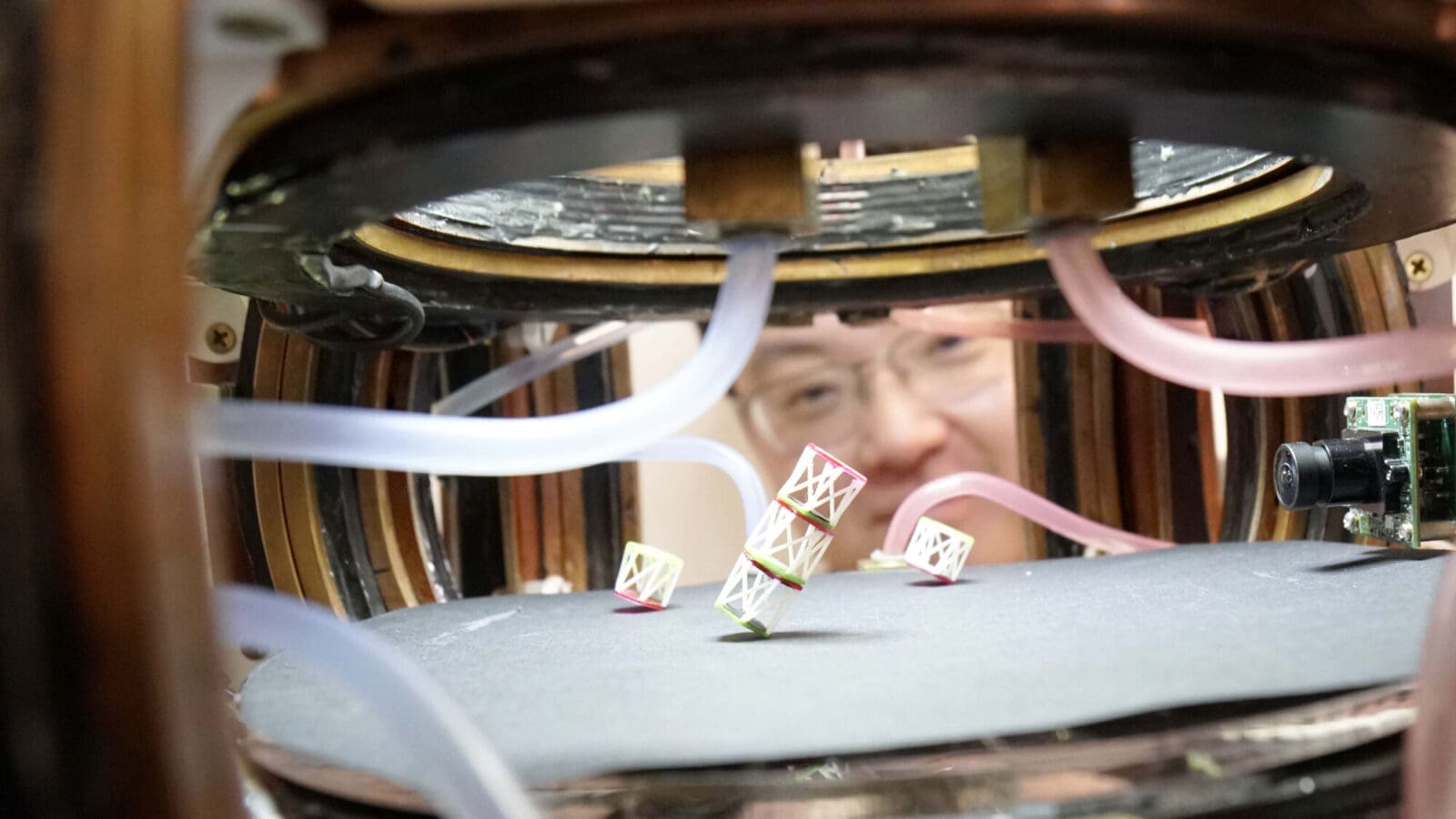
A simple, energy-efficient 3D-printing process takes its cues from trees to manufacture polymers quickly and inexpensively. Charging forward at top speed, a garden snail slimes up 1 millimeter of pavement per second. By this logic, Beckman Institute for Advanced Science and Technology researchers’ new 3D printing process speeds past existing methods — at a snail’s pace.

Researchers in Beckman’s Autonomous Materials Systems Group created “growth printing,” which mimics tree trunks’ outward expansion to print polymer parts quickly and efficiently without the molds and expensive equipment typically associated with 3D printing. Their work appears in the journal Advanced Materials.

“Humans are incredibly talented at making things...

Read More

‘Nanodot’ control could fine-tune light for sharper displays, quantum computing

Illustration of light emission from a molybdenum diselenide nanodot embedded in tungsten diselenide.
On the left is an illustration of the experimental setup from this study. Molybdenum diselenide nanodots, represented by red triangles, are embedded in tungsten diselenide and encapsulated by hexagonal boron nitride (hBN) on top and bottom. A focused electron beam, shown in green, in a scanning transmission electron microscope (STEM) is aimed at the structure. The emitted light is collected to generate an intensity map. On the upper right is a dark-field STEM image of the molybdenum diselenide nanodot embedded inside tungsten diselenide. The contour of the nanodot is marked by dotted green lines. On the lower right is an artificially colored light emission intensity map of the same region, with the localized emission from the nanodot clearly visible. Credit: Provided by the researchers...
Read More

Evidence of a new phenomenon: Quantum tornadoes in momentum space

Quantum tornado in momentum space: In the quantum material tantalum arsenide (TaAs), electrons form vortices in momentum space. Momentum space is a physics concept used to analyze how electrons behave in solids. A research team from the Cluster of Excellence ct.qmat at Würzburg and Dresden has now provided the first experimental evidence of these quantum tornadoes. (Image: think-design | Jochen Thamm)

A team of researchers from Würzburg has for the first time experimentally demonstrated a quantum tornado. Electrons form vortices in the momentum space of the quantum semi-metal tantalum arsenide.

Scientists have long known that electrons can form vortices in quantum materials...

Read More

Laser light made into a supersolid for the first time

A small international team of nanotechnologists, engineers and physicists has developed a way to force laser light into becoming a supersolid. Their paper is published in the journal Nature. The editors at Nature have published a Research Briefing in the same issue summarizing the work.

Supersolids are entities that exist only in the quantum world, and, up until now, they have all been made using atoms. Prior research has shown that they have zero viscosity and are formed in crystal-like structures similar to the way atoms are arranged in salt crystals.

Because of their nature, supersolids have been created in extremely cold environments where the quantum effects can be seen...

Read More