
Category Physics

Pressure-responsive, layered semiconductor shows potential for next-gen data storage

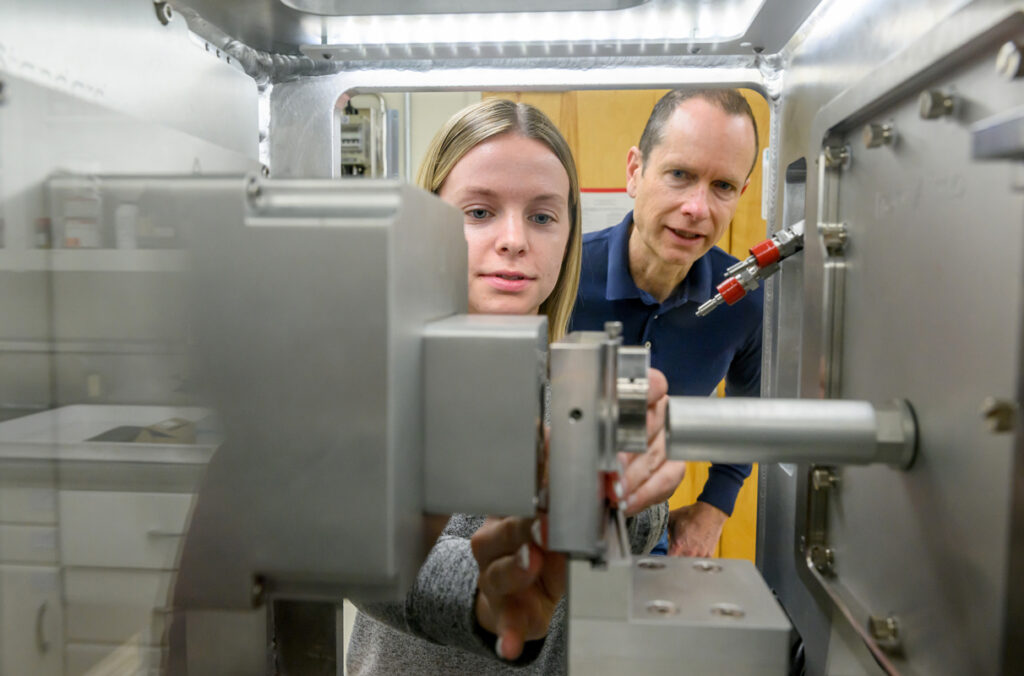
Julie Miller and Matt McCluskey using an X‑ray beamline.
Julie Miller (left) and Matt McCluskey conduct research using the X‑ray beamline at WSU’s Dodgen Research Facility. (Photo by Robert Hubner, WSU Photo Services)

A squishy, layered material that dramatically transforms under pressure could someday help computers store more data with less energy.

That’s according to a new study by researchers at Washington State University and the University of North Carolina at Charlotte that shows a hybrid zinc telluride-based material can undergo surprising structural changes when squeezed together like a molecular sandwich...

Read More
A shortcut to AI computation: In-memory computing overcomes data transfer bottlenecks

A schematic representation of in-memory computing using electrochemical memory devices (ECRAMs) arranged in a cross-point array structure, mimicking the way synapses in the brain process information. When voltage is applied to the device, ions move within the channel, enabling simultaneous computation and data storage. This study reveals how ions and electrons behave under applied voltage, uncovering the device’s internal operational dynamics. Credit: POSTECH

As artificial intelligence (AI) continues to advance, researchers at POSTECH (Pohang University of Science and Technology) have identified a breakthrough that could make AI technologies faster and more efficient.

Professor Seyoung Kim and Dr...

Read More

Material? Robot? It’s a metabot

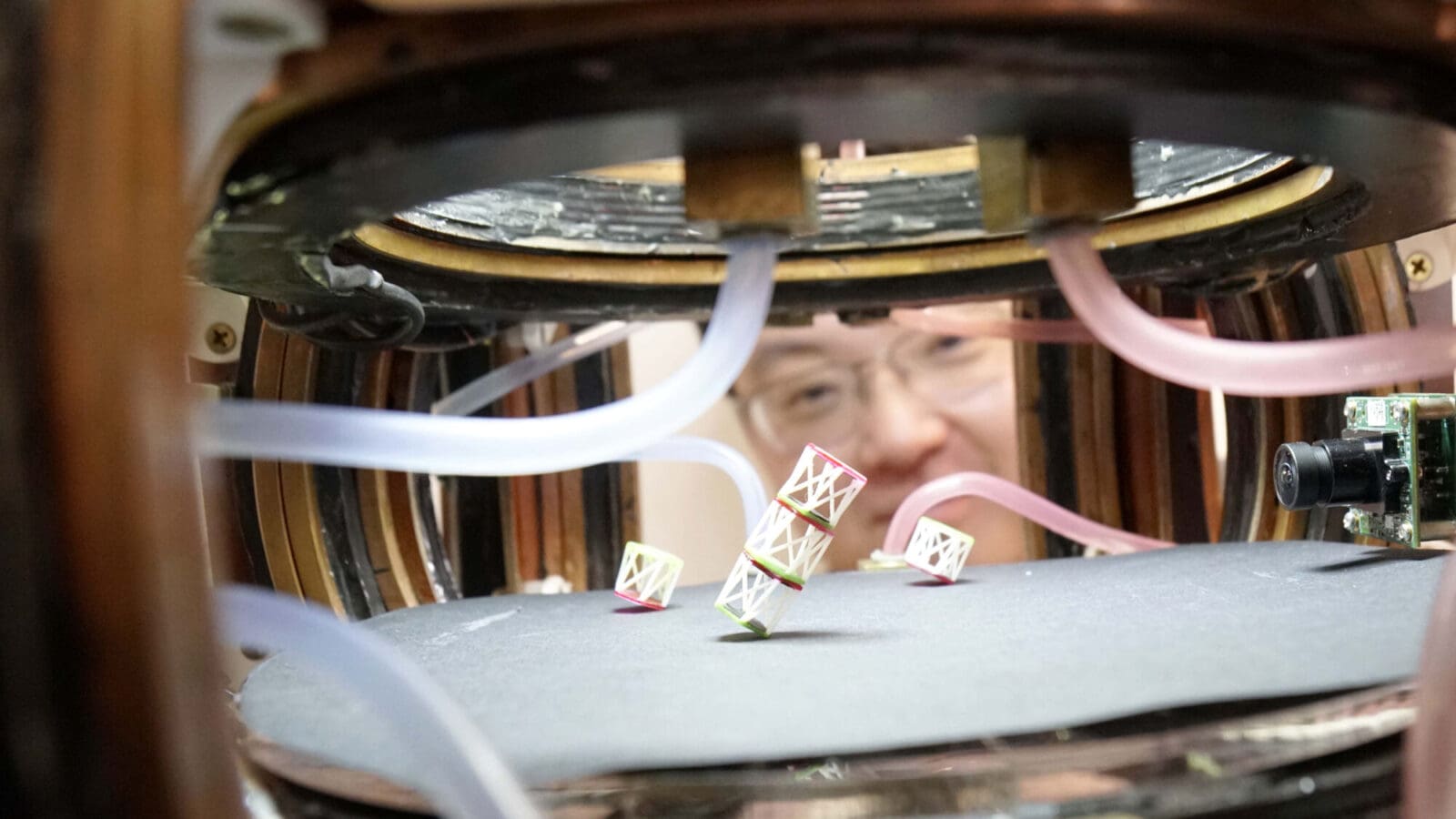
A researcher observes a metabot inside a magnetic chamber

In an experiment reminiscent of the Transformers movie franchise, engineers at Princeton University have created a type of material that can expand, assume new shapes, move and follow electromagnetic commands like a remotely controlled robot even though it lacks any motor or internal gears.

“You can transform between a material and a robot, and it is controllable with an external magnetic field,” said researcher Glaucio Paulino, the Margareta Engman Augustine Professor of Engineering at Princeton.

In an article published April 23 in the journal Nature, the researchers describe how they drew inspiration from the folding art of origami to create a structure that blurs the lines between robotics and materials...

Read More

Researchers develop compact superradiant Smith-Purcell device with ultra-narrow linewidth

Pump-induced stimulated superradiant smith-purcell radiation with ultra-narrow linewidth
A schematic view of the pump-induced stimulated superradiant Smith-Purcell radiation (PIS-SPR) device, which consists of the electron pre-bunching, electron-compression and harmonic-emission section. Based on PIS-SPR, the free electron beam is well bunched and ultra-narrow spectral linewidth at THz frequency region has been observed. Credit: eLight (2025). DOI: 10.1186/s43593-025-00083-z

Superradiant Smith-Purcell radiation (S-SPR) is a kind of free electron radiation with a train of free electron bunches passing over a periodic grating. In theory, the ultra-narrow spectral linewidth of S-SPR could be realized which would be greatly beneficial to various applications such as imaging, sensing and communication.

However, in the free electron accelerators, customized setups and orotr...

Read More