Category Physics

DeepMind Researchers find LLMs can Serve as Effective Mediators

DeepMind researchers find LLMs can serve as effective mediators
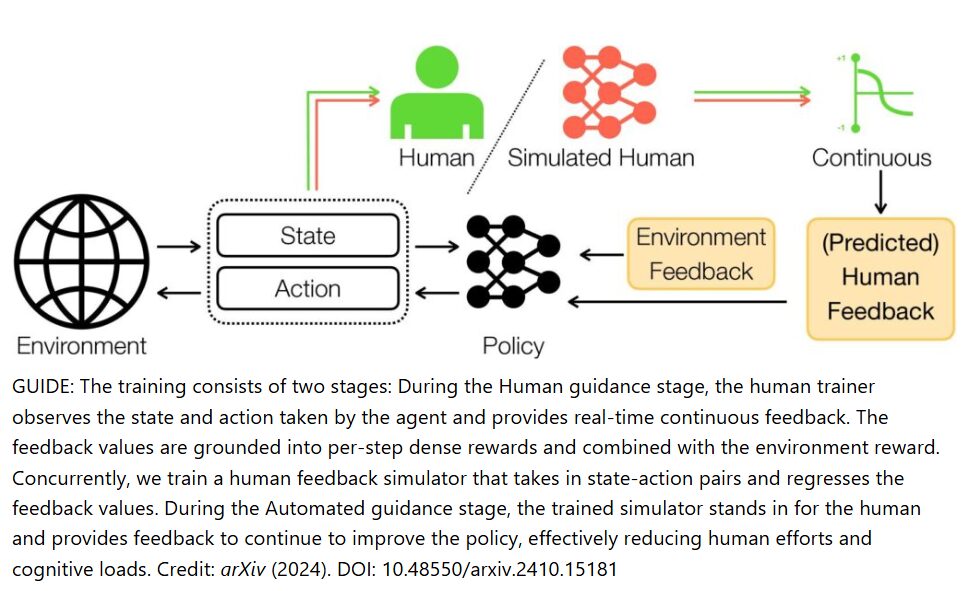
The Habermas Machine generates high-quality group opinion statements that are preferred to human-written group statements, and critiquing provides further improvements. Credit: Science (2024). DOI: 10.1126/science.adq2852

A team of AI researchers with Google’s DeepMind London group has found that certain large language models (LLMs) can serve as effective mediators between groups of people with differing viewpoints regarding a given topic. The work is published in the journal Science.

Over the past several decades, political divides have become common in many countries—most have been labeled as either liberal or conservative...

Read More

Adaptive Ferroelectric Materials show Promise for Energy-Efficient Supercomputing

Artistic rendering showing light pulses striking a computer chip.
Artistic rendering representing light pulses yielding adaptive transformations in nanodomain structures applicable to neuromorphic computing. (Image by Argonne National Laboratory/Haidan Wen and Ellen Weiss.)

Researchers have revealed an adaptive response with a ferroelectric device, which responds to light pulses in a way that resembles the plasticity of neural networks. This behavior could find application in energy-efficient microelectronics.

“Today’s supercomputers and data centers demand many megawatts of power,” said Haidan Wen, a physicist at the U.S. Department of Energy (DOE) Argonne National Laboratory. “One challenge is to find materials for more energy-efficient microelectronics...

Read More

Researchers Develop System Cat’s Eye-Inspired Vision for Autonomous Robotics

Optical simulation of the characteristics of the feline eye–inspired vision system

Feline-inspired vision technology enhances accuracy in challenging environments, paving the way for smarter, more efficient autonomous systems

Researchers have unveiled a vision system inspired by feline eyes to enhance object detection in various lighting conditions. Featuring a unique shape and reflective surface, the system reduces glare in bright environments and boosts sensitivity in low-light scenarios. By filtering unnecessary details, this technology significantly improves the performance of single-lens cameras, representing a notable advancement in robotic vision capabilities.

Autonomous systems like drones, self-driving cars, and robots are becoming more common in our daily lives...

Read More

Ancient 3D Paper Art, Kirigami, could Reshape Modern Wireless Technology

Credit: Drexel University

The future of wireless technology—from charging devices to boosting communication signals—relies on the antennas that transmit electromagnetic waves becoming increasingly versatile, durable and easy to manufacture. Researchers at Drexel University and the University of British Columbia believe kirigami, the ancient Japanese art of cutting and folding paper to create intricate three-dimensional designs, could provide a model for manufacturing the next generation of antennas.

Recently published in the journal Nature Communications, research from the Drexel-UBC team showed how kirigami—a variation of origami—can transform a single sheet of acetate coated with conductive MXene ink into a flexible 3D microwave antenna whose transmission frequency can be adju...

Read More