Category Technology/Electronics

“Grätzel” Solar Cells achieve a New Record

Grätzel cells installed at the SwissTech Convention Center (credit: Alain Herzog)
Scientists at EPFL have increased the power conversion efficiency of dye-sensitized solar cells (“Grätzel cells”) beyond 15% in direct sunlight and 30% in ambient light conditions.

Mesoscopic dye-sensitized solar cells (DSCs) were invented in 1990s by Brian O’Regan and Michael Grätzel, taking on the latter’s name – the world-famous Grätzel cells. DSCs convert light into electricity through photosensitizers – dye compounds that absorb light and inject electrons into an array of oxide nanocrystals which subsequently are collected as electric current.

In DSCs, photosensitizers are attached (“adsorbed”) to the surface of nanocrystalline mesoporous titanium dioxide films that are imbibed with redox active electrolytes or a solid charge-transport material – the entire design aims...

Read More

Scientists discover Exotic Quantum State at Room Temperature

Quantum Hall effect

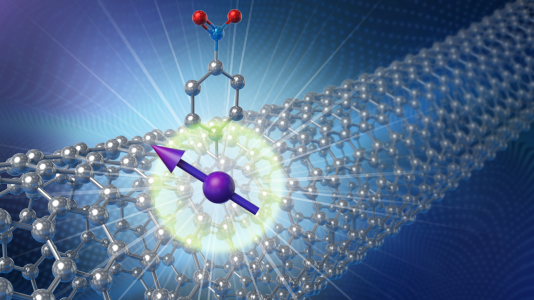
For the first time, physicists have observed novel quantum effects in a topological insulator at room temperature. This breakthrough, published as the cover article of the October issue of Nature Materials, came when Princeton scientists explored a topological material based on the element bismuth.

The scientists have used topological insulators to demonstrate quantum effects for more than a decade, but this experiment is the first time these effects have been observed at room temperature. Typically, inducing and observing quantum states in topological insulators requires temperatures around absolute zero, which is equal to -459 degrees Fahrenheit (or -273 degrees Celsius).

This finding opens up a new range of possibilities for the development of efficient quantum technologies, ...

Read More

The Next Wonder Semiconductor

scanning ultrafast electron microscope
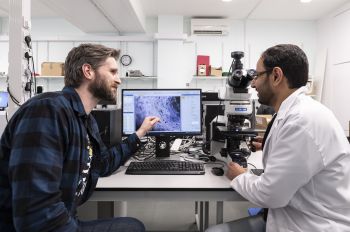
The scanning ultrafast electron microscope (SUEM) couples a femtosecond pulsed laser with a scanning electron microscope, which enables time-resolved imaging of microscopic energy transport processes with simultaneously high spatial and temporal resolutions
Photo Credit: 
MATT PERKO

With scanning ultrafast electron microscopy, researchers unveil promising hot photocarrier transport properties of cubic boron arsenide. In a study that confirms its promise as the next-generation semiconductor material, UC Santa Barbara researchers have directly visualized the photocarrier transport properties of cubic boron arsenide single crystals.

“We were able to visualize how the charge moves in our sample,” said Bolin Liao, an assistant professor of mechanical engineering in the College of Engineeri...

Read More

Improving Light Absorption in Perovskite/Si Tandem Solar Cells

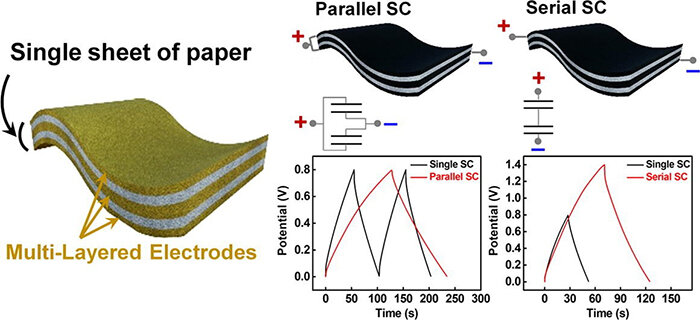
1. (a) A schematic of the PDMS layer containing SGA phosphors and SiO2 nanoparticles, (b) photographs of the PDMS layer with SGA phosphors and SiO2 nanoparticles under ambient light and UV light (λ = 365 nm), (c) a schematic of perovskite/Si tandem solar cell with the PDMS layer containing SGA phosphors and SiO2 nanoparticles, and (d) a cross-sectional SEM image of the perovskite–Si solar cell.

A research team, affiliated with UNIST has succeeded in achieving a power conversion efficiency (PEC) of 23.50% in a perovskite-silicon tandem solar cell built with a special textured anti-reflective coating (ARC) polymeric film. According to the research team, the PCE of the device with the ARC film was sustained for 120 hours, maintaining 91% of its initial value.

This breakthrough has b...

Read More