Category Technology/Electronics

From Transistor to Memristor: Switching Technologies for the Future

From transistor to memristor: switching technologies for the future
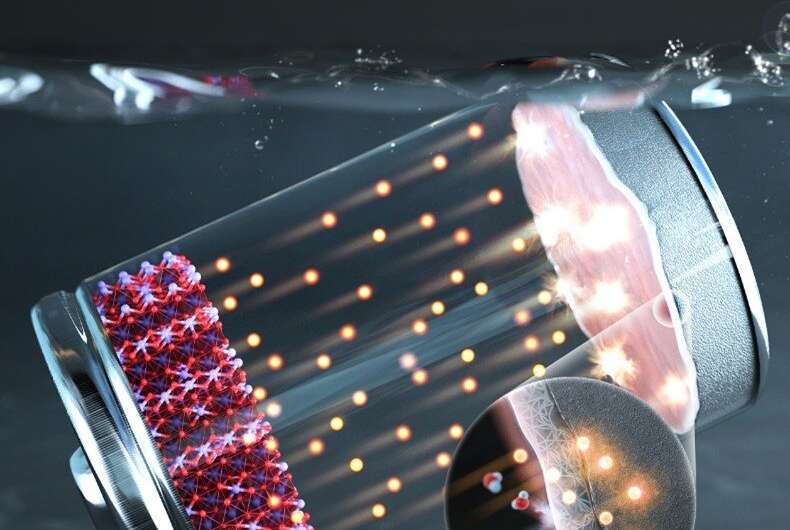
Three-dimensional schematic of a memristor made of multilayer hexagonal boron nitride. Credit: Mario Lanza / KAUST

The invention of the transistor by Bell Laboratory in 1947 ushered in an era of electronic devices that were smaller and ran cooler using far less power than their bulky and fragile vacuum tube counterparts. Transistors function as a binary switch to facilitate electrical current from off to on states. Radios, calculators and telephones were among the first wave of instruments to replace vacuum tubes with the new semiconductor technology...

Read More

Topological Superconductors: Fertile ground for Elusive Majorana (‘angel’) Particle

Scanning tunnelling microscopy (STM) images: edge of FeSe/STO, with inset atomic-resolution STM showing the topmost Se atom arrangement and crystal orientation

Majorana fermions promise information technology with zero resistance. A new, multi-node FLEET review investigates the search for Majorana fermions in iron-based superconductors.

The elusive Majorana fermion, or ‘angel particle’ proposed by Ettore Majorana in 1937, simultaneously behaves like a particle and an antiparticle — and surprisingly remains stable rather than being self-destructive.

Majorana fermions promise information and communications technology with zero resistance, addressing the rising energy consumption of modern electronics (already 8% of global electricity consumption), and promising a sustainable future...

Read More

Organic Bipolar Transistor developed

Organic bipolar transistors can also handle demanding data processing and transmission tasks on flexible electronic elements, e.g. here for electrocardiogram (ECG) data.

Researchers have developed a highly efficient organic bipolar transistor. The work opens up new perspectives for organic electronics – both in data processing and transmission, as well as in medical technology applications.

Prof. Karl Leo has been thinking about the realization of this component for more than 20 years, now it has become reality: His research group at the Institute for Applied Physics at the TU Dresden has presented the first highly efficient organic bipolar transistor. The results of the research work have now been published in the leading specialist journal Nature.

The invention of the transisto...

Read More

Introducing a Transceiver that can tap into the Higher Frequency Bands of 5G Networks

New 5G Transceiver Smooths Out Challenges in Beamforming

5G networks are becoming more prevalent worldwide. Many consumer devices that support 5G are already benefiting from increased speeds and lower latency. However, some frequency bands allocated for 5G are not effectively utilized owing to technological limitations. These frequency bands include the New Radio (NR) 39 GHz band, but actually span from 37 GHz to 43.5 GHz, depending on the country. The NR band offers notable advantages in performance over other lower frequency bands 5G networks use today. For instance, it enables ultralow latency in communication along with data rates of over 10 Gb/s and a massive capacity to accommodate several users.

However, these feats come at a cost. High-frequency signals are attenuated quickly as they travel through space...

Read More