Category Technology/Electronics

Modified Microwave oven cooks up Next-gen Semiconductors

James Hwang
James Hwang, research professor in the Department of Materials Science and Engineering, right, at his modified microwave with Gianluca Fabi holding a semiconductor at left. Ryan Young/Cornell University

A household microwave oven modified by a Cornell engineering professor is helping to cook up the next generation of cellphones, computers and other electronics after the invention was shown to overcome a major challenge faced by the semiconductor industry.

The research is detailed in a paper published in Applied Physics Letters. The lead author is James Hwang, a research professor in the department of materials science and engineering.

As microchips continue to shrink, silicon must be doped, or mixed, with higher concentrations of phosphorus to produce the desired current...

Read More
Solar Energy breakthrough: Perovskite cell with Greater Stability, Efficiency

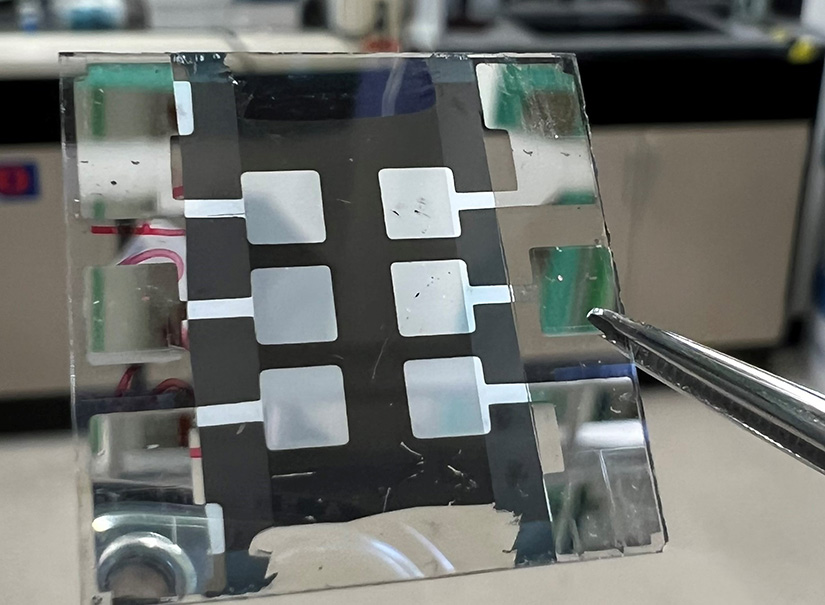
Photo shows the new perovskite solar cell.
The inverted architecture of this perovskite solar cell, coupled with surface engineering, enabled researchers to improve efficiency and stability. Photo from NREL

Researchers at the U.S. Department of Energy’s (DOE’s) National Renewable Energy Laboratory (NREL) made a technological breakthrough and constructed a perovskite solar cell with the dual benefits of being both highly efficient and highly stable.

The work was done in collaboration with scientists from the University of Toledo, the University of Colorado-Boulder, and the University of California-San Diego.

A unique architectural structure enabled the researchers to record a certified stabilized efficiency of 24% under 1-sun illumination, making it the highest reported of its kind...

Read More

Researchers demonstrate New, More Energy-Efficient Devices using Gallium Nitride

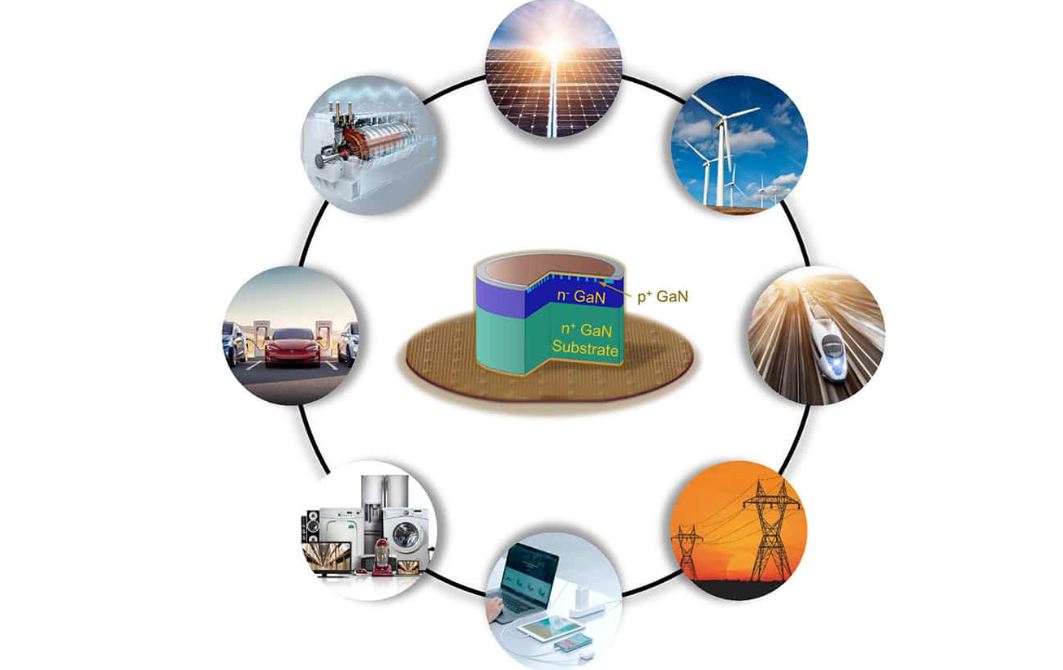
Engineering researchers have created new high-power electronic devices that are more energy efficient than previous technologies. The devices are made possible by a unique technique for “doping” gallium nitride (GaN) in a controlled way.

“Many technologies require power conversion — where power is switched from one format to another,” says Dolar Khachariya, the first author of a paper on the work and a former Ph.D. student at North Carolina State University. “For example, the technology might need to convert AC to DC, or convert electricity into work — like an electric motor. And in any power conversion system, most power loss takes place at the power switch — which is an active component of the electrical circuit that makes the power conversion system.

“Developing more efficien...

Read More

Researchers devise Tunable Conducting Edge

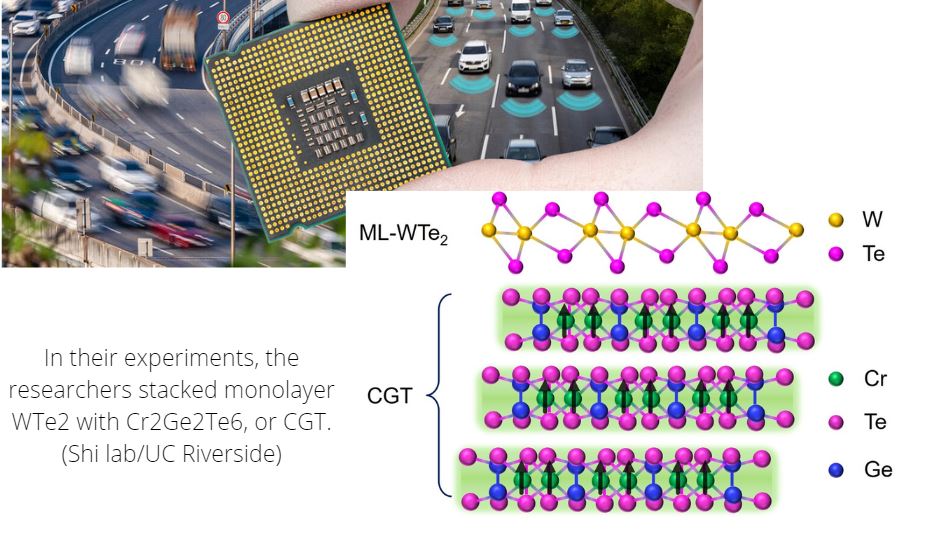
A research team led by a physicist at the University of California, Riverside, has demonstrated a new magnetized state in a monolayer of tungsten ditelluride, or WTe2, a new quantum material. Called a magnetized or ferromagnetic quantum spin Hall insulator, this material of one-atom thickness has an insulating interior but a conducting edge, which has important implications for controlling electron flow in nanodevices.

In a typical conductor, electrical current flows evenly everywhere. Insulators, on the other hand, do not readily conduct electricity. Ordinarily, monolayer WTe2 is a special insulator with a conducting edge; magnetizing it bestows upon it more unusual properties.

“We stacked monolayer WTe2 with an insulating ferromagnet of several atomic layer thickness—of Cr2Ge2...

Read More